Get Full Government Meeting Transcripts, Videos, & Alerts Forever!
Get email alerts on the Police Pursuits topic
No spam. Unsubscribe anytime.
Community speakers and NYU recommend restrictive pursuit policy as FPC hears emotional testimony
Summary
Public commenters recounted deaths and injuries tied to Milwaukee Police Department vehicle pursuits and urged limits; Josh Parker of NYU’s Policing Project presented national data and a model 'Core Pursuit Standard' recommending chases only for narrow violent-crime circumstances and highlighted safer alternatives like StarChase and OnStar.
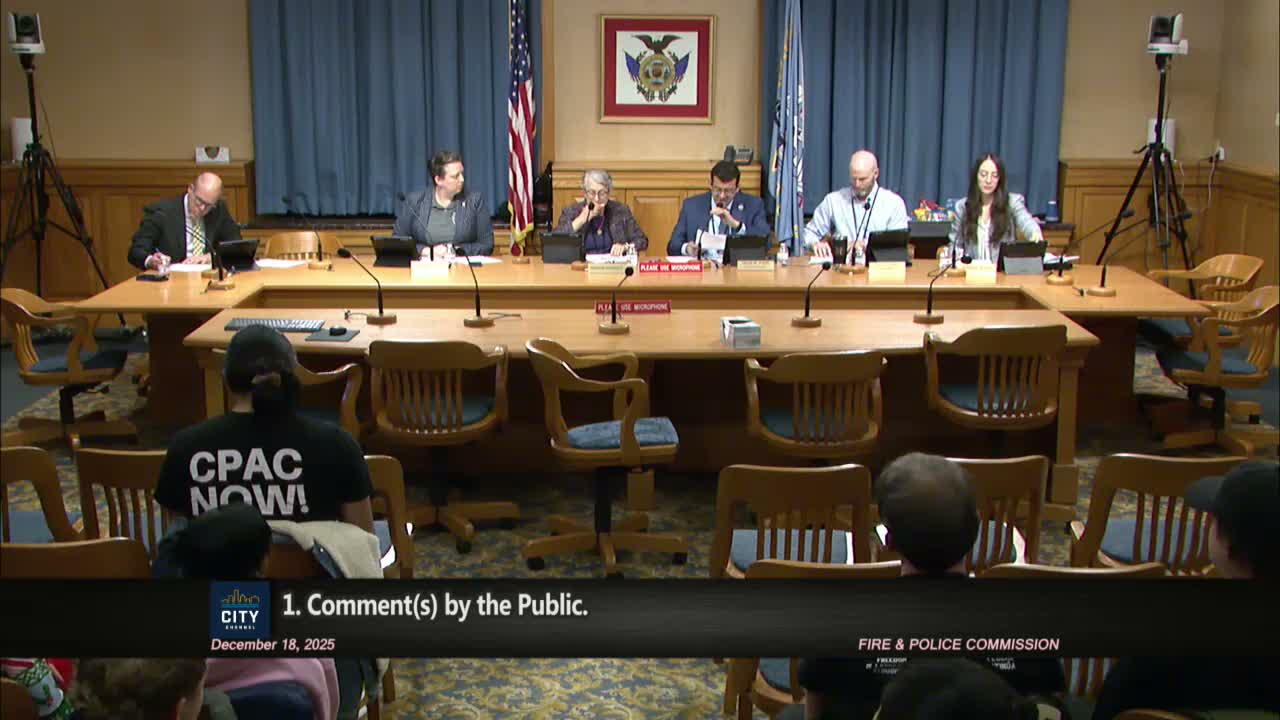
Public speakers at the Milwaukee Fire and Police Commission’s Dec. 18 meeting urged stricter limits on police vehicle pursuits and more transparency, and a policy expert from New York University said data support narrowing when chases are allowed.
Tiffany Stark, a mental-health social worker with the Milwaukee Alliance, told commissioners her daughter’s father was injured in a June 9, 2024 police pursuit and later died from complications. "What if this was your spouse, your partner, your mother, your father," Stark said, asking commissioners to imagine the loss. Gladell Higgins, who said she lost her son after a high-speed chase, said, "Enough is enough. Too many innocent people dying."
Josh Parker, deputy director of policy at the Policing Project at NYU School of Law, told the commission his organization’s model pursuit policy and supporting data show the public safety costs of permissive chase rules. "Vehicle pursuits cause more than a death each day across the country," Parker said, citing a national study and federal estimates of thousands of pursuit-related injuries and deaths between 2017 and 2022.
Parker summarized a "Core Pursuit Standard" used in his model policy: officers should generally permit chases only when (1) there is probable cause the vehicle contains a suspect in a violent crime (or, in rare cases, an OWI/DUI), (2) the officer reasonably believes the suspect poses a substantial risk of death or serious injury if not immediately apprehended, (3) apprehension cannot be accomplished later without a pursuit, and (4) the safety risks of a pursuit are outweighed by the risks of not pursuing after considering traffic, weather and other factors.
He told the commission restrictive policies have reduced pursuits and injuries in multiple jurisdictions and do not, in the studies he cited, meaningfully increase crime or significantly raise rates of fleeing. Parker also outlined alternatives, including GPS tagging tools such as StarChase, OnStar remote slowing for consenting vehicle owners, automated license-plate readers (with privacy guardrails), and tire-deflation devices placed when a vehicle is stationary.
Commissioners and members of the public asked detailed questions about technology effectiveness and local context. One commissioner noted prior policy changes in Milwaukee that allowed chases for reckless driving in 2018 and asked whether the city’s history makes it different; Parker cited Roanoke and PERF/DOJ findings showing restrictive policies typically reduce pursuits and injuries while concentrating enforcement on serious violent crime. Commissioners praised the presentation but emphasized that a restrictive policy is not the same as a total ban.
The item from NYU was a communication file — no vote was required. Chair Commissioner Horowitz and other commissioners said the commission could take the presentation into account in future discussions with MPD and the Common Council.