Get Full Government Meeting Transcripts, Videos, & Alerts Forever!
Get email alerts on the School Resources Funding topic
No spam. Unsubscribe anytime.
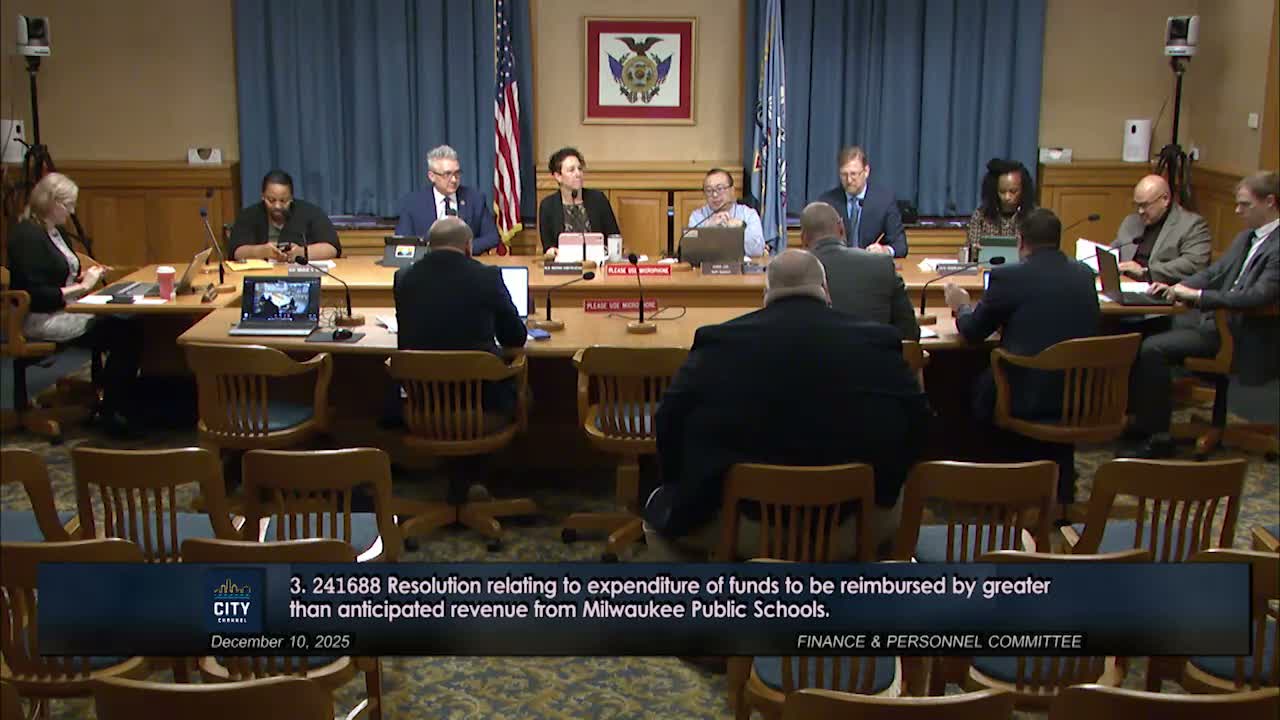
City attorneys tell aldermen MPS payment must go to tax stabilization fund; committee places SRO reimbursement file on file
Summary
After legal advice, the Finance & Personnel Committee agreed to place on file a proposal about using Milwaukee Public Schools payments for school resource officer costs. City attorneys and the comptroller said a 2025 MPS payment is "unanticipated revenue" that by ordinance must flow to the tax stabilization fund and can only be withdrawn during the formal budget process.
A proposal asking the city to spend greater‑than‑anticipated payments from Milwaukee Public Schools to cover School Resource Officer (SRO) costs was placed on file Wednesday after the city attorney told the Finance & Personnel Committee the money cannot be spent midyear.
Council President Jose Perez and Aldermen Mark Chambers and Peter Bergellis sponsored the file (3241688), which asked the council to consider how MPS payments intended to reimburse SRO costs might be used. Evan Goicky, the city attorney, and Assistant City Attorney Tom Miller told the committee the 2025 payment is "unanticipated revenue" that goes first to the general fund and then—by ordinance—becomes part of the tax stabilization fund (Milwaukee Code 304‑29). That ordinance, they said, allows withdrawals only during the city’s formal budget process, not for midyear spending.
"When we receive [the payment] from the public school district pursuant to our agreement, they don't just come to a pot where we can then disperse them as we so choose," Goicky said, explaining the legal constraints. Miller added that only revenues set up as external reimbursements (which would credit a department directly) can be spent by that department for the reimbursed purpose; the court‑mandated 50/50 split established the district’s obligation but the payment here was not structured as an external reimbursable.
Comptroller Bill Christiansen confirmed the city has received one payment this year and said the comptroller's office has already factored anticipated MPS revenue into the 2026 budget. He said the amount received in October was $284,000, with an additional invoice of about $200,000 still outstanding.
Several alderpeople pressed the administration and legal staff for why the city could not have structured the agreement differently so at least a first‑year payment would be immediately available for community uses. Alderman Bergellis said the city missed an opportunity by not negotiating a treatment that would have allowed the first year's money to be used midyear. "This could have been structured differently from the very beginning in the agreement with MPS," he said.
Legal staff and the comptroller answered that timing and the inability to forecast an exact payment amount during the budget cycle made it difficult to create the necessary expenditure authority; they also pointed to state budget law and prior court proceedings as constraining factors. Laura Engen, who handles billing, told the committee the city billed MPS in July for spring services and received the initial check in October; the follow‑up invoice will go out in January.
After the discussion the sponsor moved to place the file on file. Chair Marina Dimitrijevich said the committee had proactively sought the city attorney's advice and, with no objections, the committee ordered the file placed on file rather than authorizing a midyear reallocation of those dollars.
The committee's action does not change the council's ability to consider tax stabilization fund withdrawals during the next budget cycle; it does, however, mean the 2025 MPS payment will not be available for one‑time community expenditures outside the formal budget process unless the council chooses to withdraw it in the next budget exercise.
What happens next: The payment for 2025 will be reflected in year‑end results and become part of the tax stabilization fund, making it available for the '27 budget under current ordinances. Aldermen who expressed frustration said they intend to push for clearer advance guidance and better structuring in future agreements with external partners so unexpected revenues can be used more quickly when policy makers intend them for community needs.