
Prince George's County advisers weigh CLT pricing, governance and use of surplus land
Get AI-powered insights, summaries, and transcripts
Subscribe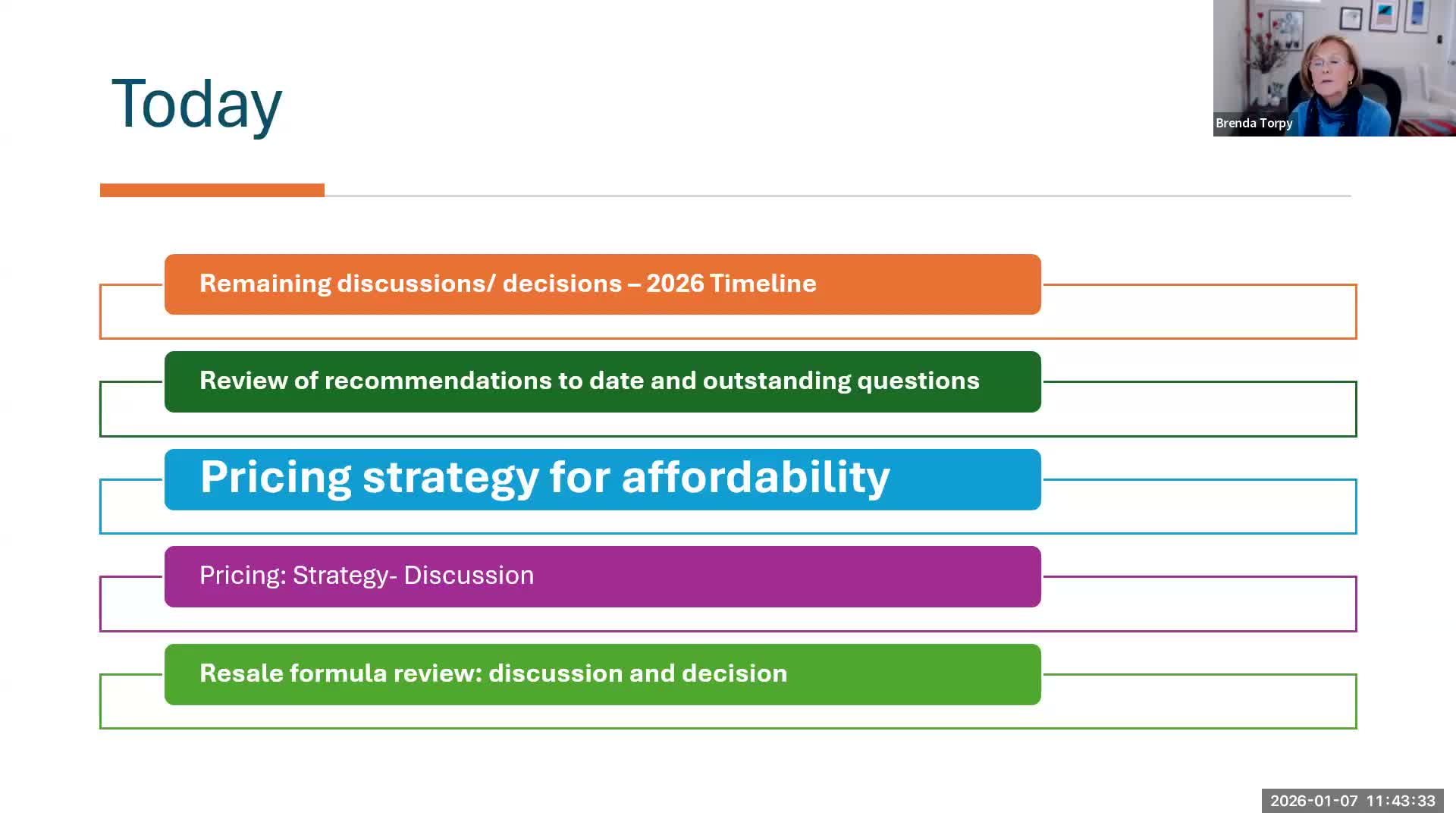
Summary
County advisers reviewed a proposed community land trust model, tested a 20% capital subsidy against inside/outside-Beltway market data, debated whether to require an existing nonprofit operator or open the process to new groups via RFP/RFQ, and recommended draft language and budget scenarios for the council; minutes were approved and a Feb. 4 follow-up was set.
At a recent Prince George's County advisory meeting, staff and committee members discussed a proposed countywide community land trust (CLT) and the pricing strategy needed to create permanently affordable homeownership.
Brenda, the presenter, said the meeting’s main topic was “the pricing strategy for affordability,” and walked members through sales-data analysis that split the county into inside‑and‑outside‑the‑Beltway markets. She said housing prices in the county have risen roughly $100,000 on average since 2019—about a 25% gain—and that incomes have not kept pace, driving the need for a CLT and public subsidy. “I tested a 20% subsidy,” she said, describing that level as a common starting point that helps buyers qualify for mortgages and provides buyer equity, while acknowledging that post‑COVID construction costs may require deeper capital in some markets.
Why it matters: The committee must balance program goals—preserving long‑term affordability for lower‑income households—with practical implementation choices, including who will run the trust, how selection will be procured, and how much public capital is needed to make units affordable in higher‑cost neighborhoods.
Committee debate focused on three operational choices. Ashley urged the group not to lock the recommendation to an “existing” nonprofit, saying, “Just wondering if we could strike the word existing from a recommendation,” to avoid excluding new or coalition applicants; she and others favored an open competitive process (RFP), with scoring that rewards local experience. Brian countered that an existing organization can bring balance‑sheet capacity and operational experience critical for stewardship: “existing would be important for a few reasons,” he said, noting operating costs and the ability to manage subsidy and programs.
Members discussed procurement mechanics (RFQ leading to RFP; multiyear contracts with renewal windows) and recommended that scoring criteria give preference points for demonstrated capacity and county experience rather than an absolute requirement that only incumbents are eligible.
On funding and subsidy design, staff walked the group through two scenario types: (1) acquiring or rehabbing existing homes (smaller capital outlays spread over time) and (2) new construction (higher upfront capital needs and slower initial revenue). Brenda and others recommended testing scenarios that include land subsidy (county surplus parcels or land bank transfers), silent second loans, HOME/CDBG/HUD programs and partnerships with Habitat affiliates to stretch public dollars. The analysis showed that with a 20% subsidy, households inside the Beltway are more likely to access single‑family units or townhomes, while outside the Beltway the same subsidy generally only reaches condos; deeper subsidy or alternative funding stacks would be needed to enable single‑family purchases in higher‑cost submarkets.
Members also debated income targeting. Several participants argued for prioritizing households at or below 80% of area median income (AMI) because of HUD and HOME program norms and explicit federal compliance rules, while others recommended allowing a higher program cap (100%–120% AMI) so the trust can capture more units and preserve affordability across a broader share of the market; Stephanie cautioned that funding source rules (HOME/CDBG) will affect allowable caps and compliance.
The committee discussed leveraging county resources through the Redevelopment Authority (RDA) and an existing surplus‑land disposition process enacted in 2025, and recommended coordinating with RDA, DACD/central services and planning to identify suitable parcels. Members asked staff to size start‑up budgets by example (including College Park’s recent CLT startup) and to present scenario cost estimates at the next meeting.
Action and next step: The committee approved the minutes from the prior meeting (motion and second recorded; vocal aye vote carried). Brenda said she will circulate the slides and a PDF of the analysis and draft recommendation language; Reyna noted the next meeting is scheduled for Feb. 4. The group closed without formal decisions on final subsidy cap or a single procurement method; staff will return with refined draft language, budget scenarios and references to county planning priorities.
Closing note: The discussion emphasized preserving long‑term subsidy through deed covenants or lease restrictions and favoring layered funding approaches; several members urged that selection criteria prioritize operational capacity and local knowledge while keeping the process competitive.