Get Full Government Meeting Transcripts, Videos, & Alerts Forever!
Get email alerts on the Health Insurance Program Funding topic
No spam. Unsubscribe anytime.
Work group urges permanent county funding and a utilization-based allocation for Prince George’s Health Insurance Program
Summary
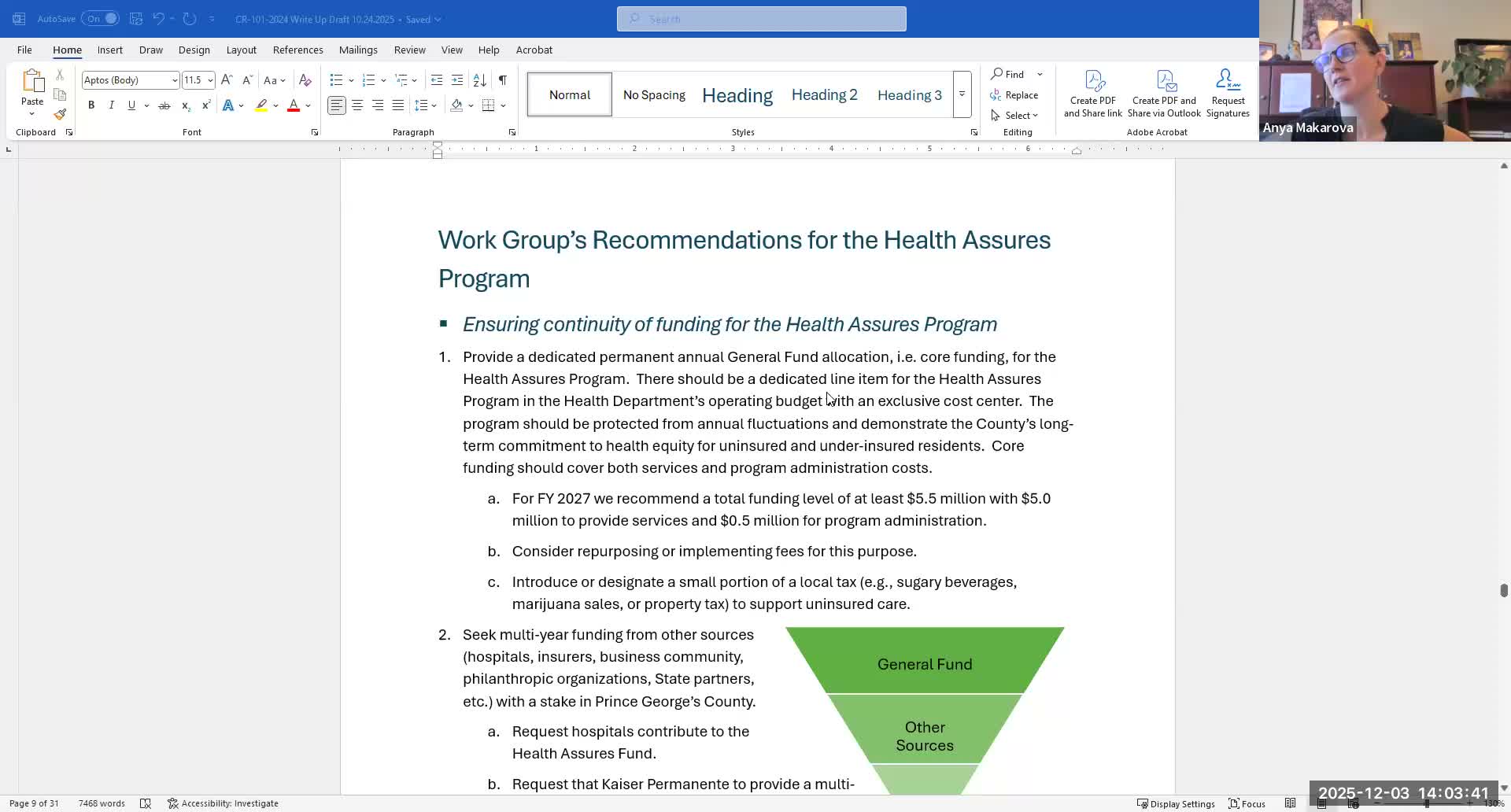
A Prince George’s County work group recommended establishing a permanent general-fund line for the county Health Insurance Program, proposed a FY2027 baseline of $5.5 million (about $5 million for services and $500,000 for administration), and endorsed an allocation model that prorates funds to federally qualified health centers based on qualifying visits and prior utilization.
Prince George’s County health-care stakeholders on the county’s Health Insurance work group on Tuesday recommended creating a permanent annual general-fund allocation to stabilize the county’s program for uninsured residents and proposed a $5.5 million FY2027 baseline, with $5 million for direct service reimbursement and $500,000 for administration.
The group’s draft report — reviewed in the meeting by committee staff — notes that Prince George’s County’s uninsured rate is substantially higher than the Maryland average and that the county accounts for a disproportionate share of the state’s uninsured population. Work-group staff said the county’s current Health Insurance Program has chronic funding shortfalls that leave federally qualified health centers (FQHCs) providing services beyond reimbursed levels.
“We did get the $2,000,000 that has been allocated,” the committee director said when recounting the immediate funding secured for the current year, while urging the work group to press for a dedicated line in the general fund to protect against annual fluctuations.
To distribute future funding more predictably and fairly, staff presented a utilization-based allocation model that prorates total program dollars across qualifying Health Insurance Program visits recorded by each FQHC. Under the proposed method, county program dollars are divided according to prior-year qualifying visits (unduplicated qualifying visits per site) so that each center’s allocation responds to actual demand rather than a static per-visit rate that can overstate true reimbursement when funds run out.
Sharon Zlisky, executive director of the Regional Primary Care Coalition, told the group that the program effectively operates as a capped grant: centers receive an allocation, bill eligible visits and collect data, and then funds can run out. “There’s always an issue with people saying that the $180 reimbursement is too high. It’s never a $180 reimbursement because if you spread it out over the whole year and all the visits, you end up with actually a very small level of, per visit reimbursement,” Zlisky said.
Work-group members said a predictable county commitment would allow leaders to seek multi-year partnerships with hospitals, insurers and philanthropic partners. Staff cautioned that recommended changes are most likely to affect FY2027 and later, noting that county contracts for FY2026 are only now being finalized and that the work group’s earliest practical impact on operations is therefore limited.
Members discussed administrative design choices the work group should make before recommending full implementation: whether the administrator should perform enrollment (versus qualification checks at each visit), how much care coordination to require of the administrator versus individual FQHCs, and whether to add finer-grained service categories (for example to distinguish more complex visits). Several clinicians and center representatives urged keeping categories simple while funding levels remain modest, and recommended monitoring service-type usage before adding complexity.
Staff emphasized data gaps that must be filled before finalizing recommendations, including site-level counts of county residents served by each FQHC and multi-year funding source details from the Office of Management and Budget and the health department. The draft report recommends the work group continue outreach to FQHCs and county offices so the final proposal can reflect verified utilization and contract timelines.
The work group set two operational priorities for the next draft: (1) recommend county budget language or a line-item allocation to enable timely contract execution and early-year disbursement, and (2) adopt the utilization-prorated allocation model as the default distribution method once reliable qualifying-visit data are available. The group will continue refining the report and pursue additional data between meetings.
The meeting closed with staff requesting any outstanding information from FQHCs and county offices and noting the next work-group meeting is scheduled for January 28 at 1:30 p.m.