Get Full Government Meeting Transcripts, Videos, & Alerts Forever!
Get email alerts on the Food Assistance topic
No spam. Unsubscribe anytime.
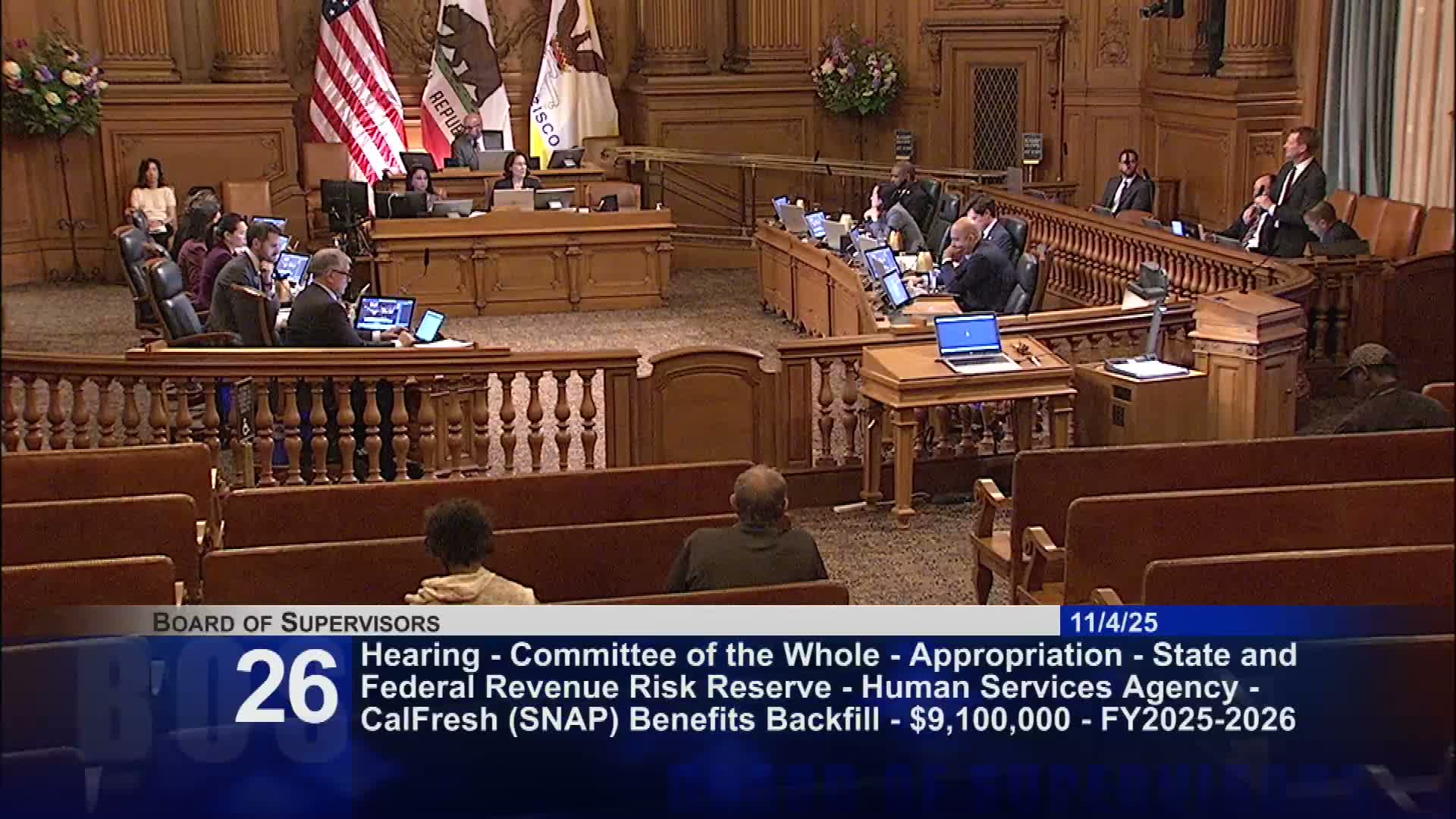
Board OKs first reading of $9.1M CalFresh reserve draw to pair with $9.1M private match
Summary
The board unanimously approved on first reading an ordinance to draw $9.1 million from the city’s state and federal revenue risk reserve to pair with a $9.1 million Crankstart donation for grocery‑card assistance to CalFresh recipients affected by a federal shutdown; HSA detailed distribution, activation and timelines. (Short: 2–3 sentences)
The San Francisco Board of Supervisors voted unanimously Nov. 4 to pass on first reading an ordinance that would appropriate $9.1 million from the city’s state and federal revenue risk reserve to the Human Services Agency (HSA) to backfill interrupted CalFresh benefits. The action sends the ordinance to a special board meeting on Nov. 10 for final consideration.
Trent Rohrer, HSA executive director, told the board the emergency plan pairs the city’s $9.1 million request with a matching $9.1 million donation from the Crankstart Foundation and a sole‑source implementation contract with the San Francisco Marin Food Bank and vendor GoodCard. Under the plan, the food bank and GoodCard will operate a joint account and issue virtual or physical grocery cards that recipients activate with an individualized code sent by mail; Rohrer said 153 households had already redeemed cards by midmorning the day of the presentation.
Rohrer said the program targets roughly 82,000 CalFresh households in San Francisco — approximately 112,000 people — whose federal SNAP benefits were delayed by a federal government shutdown. Benefits are tiered by household size: households of one or two are slated to receive $200, households of three to four will receive $350, and households of five or more will receive $500 on the grocery card. Rohrer said those amounts mean some households may receive slightly more or slightly less than their usual CalFresh allotment.
HSA described outreach and safeguards: the city mailed 82,000 activation letters in recipients’ preferred language, sent over 90,000 text messages to inform recipients of delays and the replacement card option, and established a call center and community‑based organization toolkits to help activation. For recipients without a fixed address — about 8,000 people who use general delivery and many of whom are experiencing homelessness — HSA will open distribution and activation kiosks at 1235 Mission St. beginning Thursday and will partner with Code Tenderloin and other CBOs to staff additional assistance desks.
Rohrer said GoodCard and the food bank are providing services pro bono; GoodCard will charge $5 to mail a physical card to cover its costs. If all 82,000 households requested physical cards, Rohrer estimated mailing costs at roughly $410,000. The board discussed contingencies for unused funds: Rohrer told the board recipients have until Dec. 31, 2025 to activate cards and until March 31, 2026 to spend the balances; any funds unspent as of April 1, 2026 will be split 50/50 between the city general fund and Crankstart, according to HSA’s presentation.
Supervisors praised the rapid interagency and philanthropic coordination. The board will consider the ordinance for final action at a Nov. 10 special meeting, and HSA continues to operate distribution and activation channels while the board completes the procedural steps.
Attribution: quotes and figures in this article were provided by Trent Rohrer, executive director of the Human Services Agency, during the Nov. 4 presentation to the Board of Supervisors.
Next steps: the ordinance was forwarded to a special meeting on Nov. 10 for final adoption and the HSA rollout is already underway.