Get Full Government Meeting Transcripts, Videos, & Alerts Forever!
Get email alerts on the Hydrogen Permitting topic
No spam. Unsubscribe anytime.
Building Inspection Commission unanimously backs expedited permitting for hydrogen fueling stations
Summary
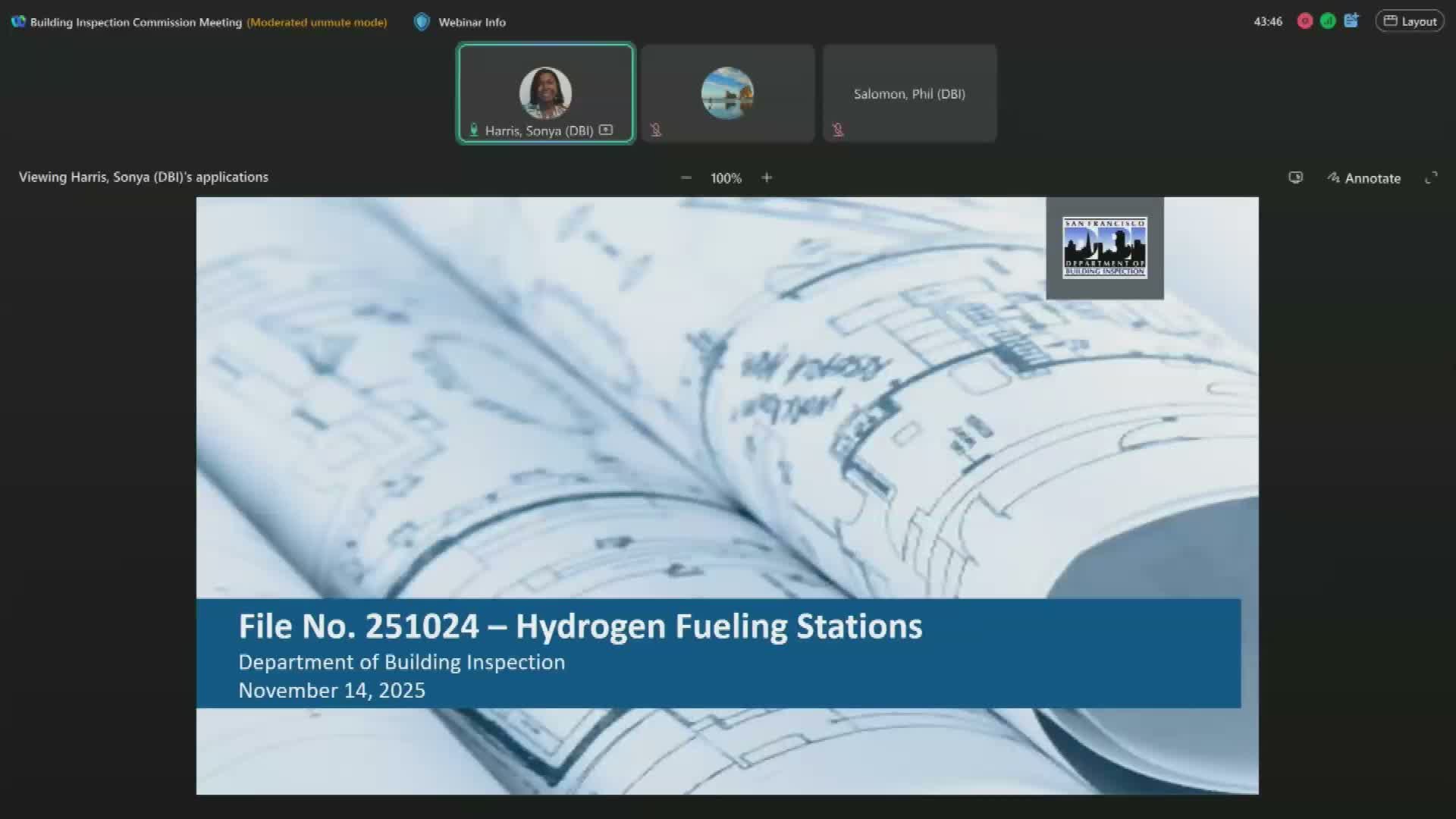
The San Francisco Building Inspection Commission voted unanimously to recommend File 251024 — an ordinance implementing state SB1418 to create an expedited, checklist-based permitting path for hydrogen fueling stations — to the Board of Supervisors.
The San Francisco Building Inspection Commission voted unanimously on Nov. 14 to recommend that the Board of Supervisors adopt File 251024, an ordinance that implements state Senate Bill 1418 by creating an expedited permitting process for hydrogen fueling stations.
Tate Hanna, the commission’s legislative affairs manager, told commissioners the city has created a prioritized review pathway and a checklist “which guides applicants through the process to ensure they’re providing sufficient information for the expedited review.” Hanna said DBI has no requested amendments and is recommending support.
Commissioners asked technical questions about how the hydrogen permitting process differs from electric vehicle (EV) charging permits. Hanna said the hydrogen rules are a standalone process and that projects could require multiple discipline-specific plan submittals — civil, architectural, fire, mechanical, electrical and plumbing — and those disciplines should be signed and stamped by the appropriate licensed professionals when required.
President Alexander Tuke moved to recommend the ordinance to the Board of Supervisors and Commissioner McLease seconded. A roll call vote was taken and commissioners voted unanimously in favor.
The recommendation next moves to the Board of Supervisors for consideration. The commission’s action was procedural: it asked the board to consider the ordinance and did not itself adopt local law.
Provenance: Commission discussion and the motion appear in the meeting record beginning with the ordinance presentation and Q&A (topic introduction) and concluding with the roll-call vote to recommend (topic finish).