Get Full Government Meeting Transcripts, Videos, & Alerts Forever!
Get email alerts on the Curbside Ev Charging topic
No spam. Unsubscribe anytime.
San Francisco commissioners hear progress report on curbside EV charging pilot
Summary
City staff and pilot vendors told the Commission on the Environment that a multi-vendor pilot has produced early utilization gains and identified barriers — notably permitting, grid access and siting conflicts — as the city plans a long-term program to prioritize residents without off-street parking.
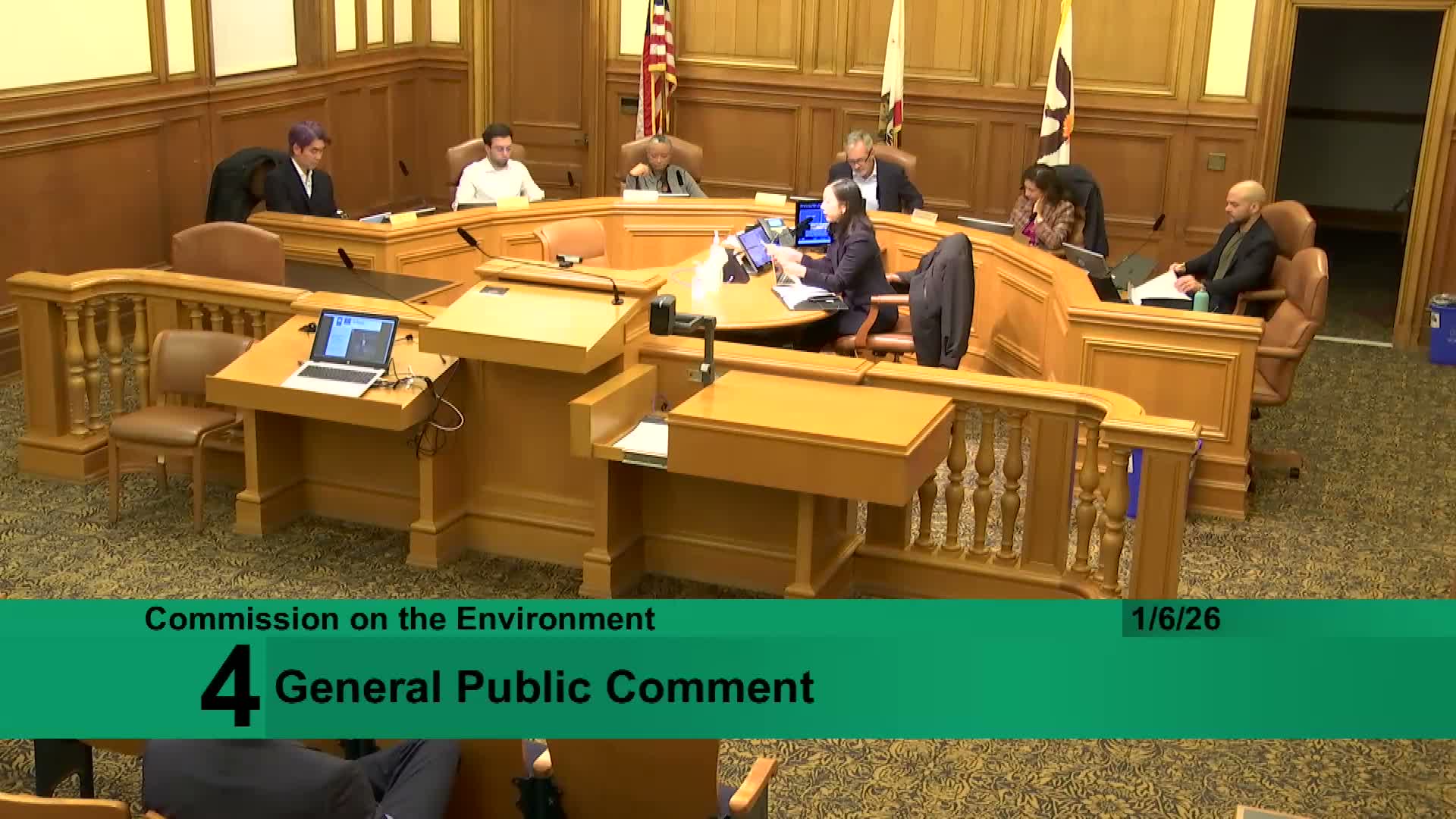
San Francisco's Commission on the Environment on Jan. 6 heard results from a city feasibility study and vendor reports on a curbside electric-vehicle charging demonstration, with staff urging a coordinated permitting pathway and community-centered siting rules to scale the pilot.
Nicole Appenzeller, the city's electric-vehicle ombudsperson at the Environment Department, said curbside chargers fill an ‘‘at-home'like’’ gap for the roughly 60% of San Franciscans who rent or live in multifamily housing without dedicated parking and described a rough target of 100 curbside chargers by 2030. Appenzeller said the city has completed a feasibility study, launched a mayoral demonstration pilot and secured $150,000 in Prop L funding to support early planning and a shift toward citywide deployment.
The feasibility analysis, presented by MTA staff, found suitable curb locations across every district but flagged three recurring barriers: complex permitting across multiple agencies, constraints from existing street furniture and curb uses, and challenges connecting to electrical service. The study recommends a long-term permitting pathway with a lead agency responsible for coordinating legislation, approvals and a predictable partnership model so vendors can plan deployments.
Representatives from three approved vendors described distinct technical approaches. Shannon Dulaney, director of public affairs for It's Electric, said her company's building-powered design avoids new grid connections by tapping a partner building''s excess panel capacity and reduces vandalism risk with detachable charging cables. Dulaney said the vendor model operates at no cost to the city and that the company "share[s] 20% of [revenue] back to the building owner." She also reported utilization rising from about 10% at launch to nearly 56% within six months at the pilot site.
Other vendors use pedestal chargers that require new electrical service or pole-mounted chargers that rely on utility pole infrastructure; staff said each approach raises different utility and sidewalk-access questions and will need site-by-site analysis.
Staff said the pilot has reviewed about 65 potential sites, with two sites in progress and one operational. Urban EV is seeking MTA board approval for a Dogpatch site, and Volt Post is exploring sites with SFPUC and PG&E in Treasure Island and Sunset. MTA's Taxi Access and Mobility Services team will lead program development, Public Works will handle right-of-way permits, the Environment Department will provide policy and equity guidance, and SFPUC will advise on utility requirements.
Tom Radulovich of Livable City, speaking during public comment, commended the work but urged the commission to ensure curbside charging does not preclude other public-right-of-way priorities such as street trees, stormwater infrastructure or traffic calming. "If your priorities are clear, if you say, hey, greening, stormwater management, traffic safety are always higher priorities, and we will bump this thing if we need to," Radulovich said, asking for upfront clarity on incompatible uses and who would pay to relocate chargers if priorities change.
Staff outlined next steps: finalize the remaining pilot sites, develop clear upfront siting criteria and community engagement practices, and create a long-term permitting and operating framework that addresses access, pricing, maintenance and licensing. City leaders emphasized that curbside charging is one component of a broader charging network that also includes home, workplace, fleet and off-street public chargers.
The commission did not take formal action on the curbside program at the meeting; staff said they are working to open a longer-term permitting pathway by the coming summer.