Get Full Government Meeting Transcripts, Videos, & Alerts Forever!
Get email alerts on the Climate Resilience topic
No spam. Unsubscribe anytime.
Environment commission reviews flood, heat and neighborhood resilience plans after civil grand jury report
Summary
San FranciscoCommission on the Environment heard three interagency presentations on flood mapping and disclosure, heat-and-air-quality resilience, and a Yosemite Slough strategy for Bayview-Hunters Point; staff outlined policy and pilot actions, and public commenters urged a turf moratorium at Crocker Amazon Park.
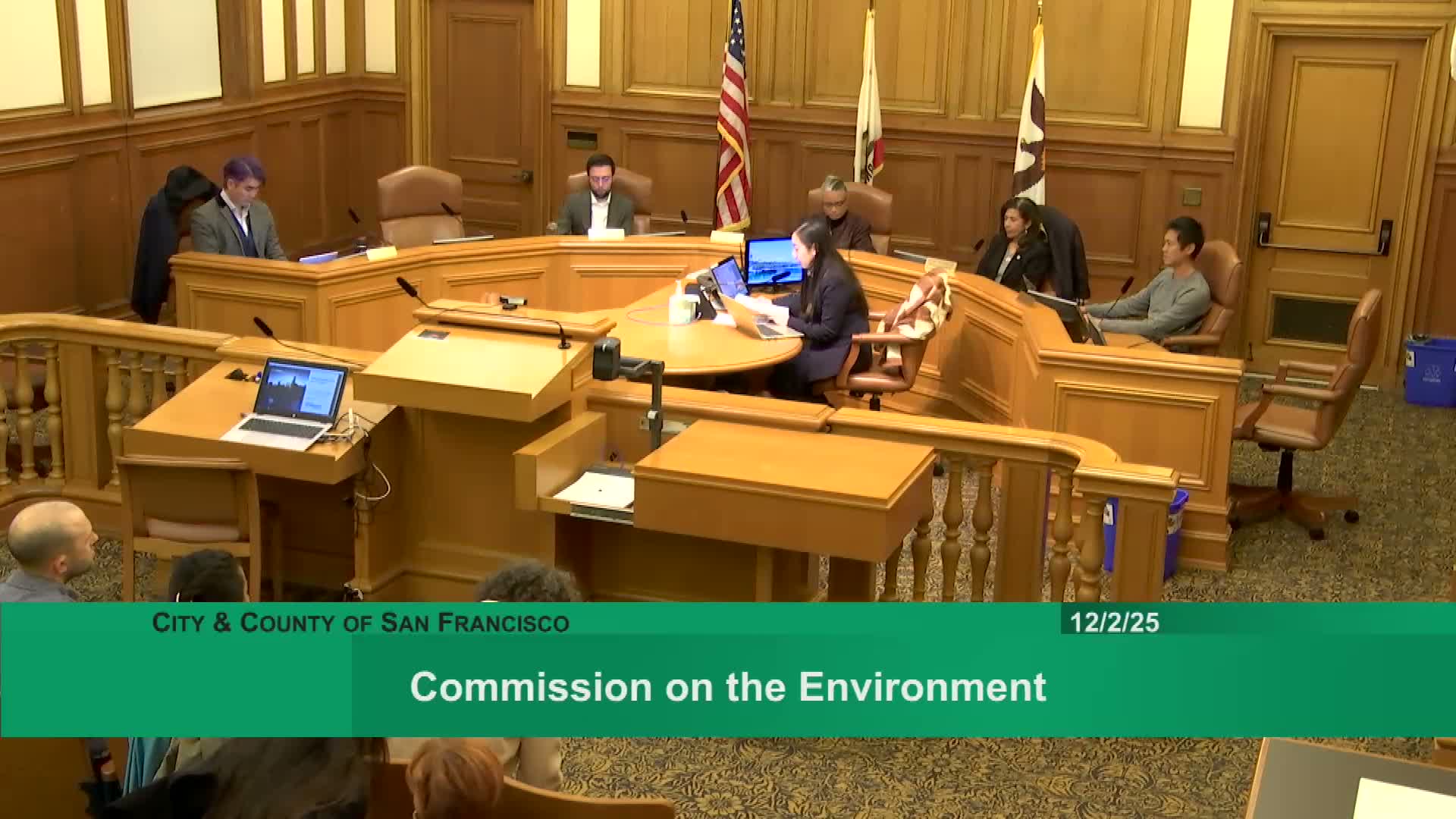
San FranciscoCommission on the Environment on Dec. 2 heard interagency briefings on flood, heat and neighborhood coastal resilience in response to a civil grand jury report on flood management.
The first presentation, from Sarah Minnick of the San Francisco Public Utilities Commission, focused on precipitation-driven flooding. Minnick described a city-developed 100-year storm flood-risk map (created where FEMA data fell short), a proposed flood-risk disclosure ordinance for sellers and lessors, and a draft flood-resilient building-code proposal intended to align with the California Building Code and FEMA guidance. She said the PUC has "over $600,000,000 worth of projects in our 10-year CIP on flood resilience," and that the agency has distributed about "$26,000,000 so far" through green-infrastructure grants; the floodwater grant program provides awards up to $100,000 per property and has funded 47 grants to date. Minnick said staff expect to bring a local code proposal to the Board of Supervisors in spring 2026 and then pursue an exemption from the state building commission if needed.
Matt Wolf of the Department of Public Health framed heat and wildfire smoke as growing public-health threats and described the Heat and Air Quality Resilience Project, a cross-sector effort co-managed with the Office of Resilience and Capital Planning and the Department of Emergency Management. Wolf noted San Franciscohistorically averages "about 7 to 10 days over 85 degrees" and said projections show both more frequent days above 85 degrees and a small but rising number of days above 95 degrees by the end of the century. The projectwhich Wolf said began in 2021has four objectives: adapt buildings, improve the exterior built and natural environment, make emergency response more equitable, and improve governance and data. He described outcomes including a green-infrastructure priority map used to secure federal Inflation Reduction Act funding for 3,500 trees in Bayview-Hunters Point, heat-sensor deployment in libraries and health centers, community-led preparedness research and a plan for clinical-discharge guidance to avoid sending patients back to overheated homes.
Daniel Veil of the Planning Department presented the Yosemite Slough Neighborhood Adaptation Strategy, a planning effort to protect Bayview-Hunters Point against an end-of-century projection of roughly 3.1 feet of sea-level rise. Veil described two high-level adaptation scenariosa textured, "living" seawall and an "ecotone" levee with planted slopespaired with wetlands restoration and stormwater management. He said the strategy is intended to integrate with Port, State Parks and EPA efforts and that the department will submit the strategy to the state in January to seek funding and to position the neighborhood for future federal and regional work.
Public commenters raised related local concerns. Bob Hall of Keep Crocker Real told the commission that planned artificial-turf expansion at Crocker Amazon Park would replace "20 acres of functioning grass and 120 trees" with plastic and cited studies on turf surface temperatures and microplastic shedding; Wesley Saunders, also with Keep Crocker Real, said turf reduces percolation and increases stormwater runoff. Emily Gazzardi urged stronger treatment of food and diet as a climate-mitigation strategy in the Climate Action Plan.
Commissioners pressed staff on coordination and governance: members suggested an aggregate vulnerability or gap assessment across existing agency plans and a public dashboard to track progress and key performance indicators. Minnick, Wolf and Veil said the presentations are part of ongoing interagency coordination and identified near-term next steps: Minnickto pursue local code adoption and state engagement in 2026; Veilto submit the Yosemite Slough strategy to the state next month; and DPHto continue community research, sensor deployment and implementation of the heat plan.
The commission did not take formal action on the presentations; staff were asked to return with further prioritization, coordination plans and funding needs.