Get Full Government Meeting Transcripts, Videos, & Alerts Forever!
Get email alerts on the Small Business topic
No spam. Unsubscribe anytime.
Board rejects legacy-business zoning ordinance after extended debate
Summary
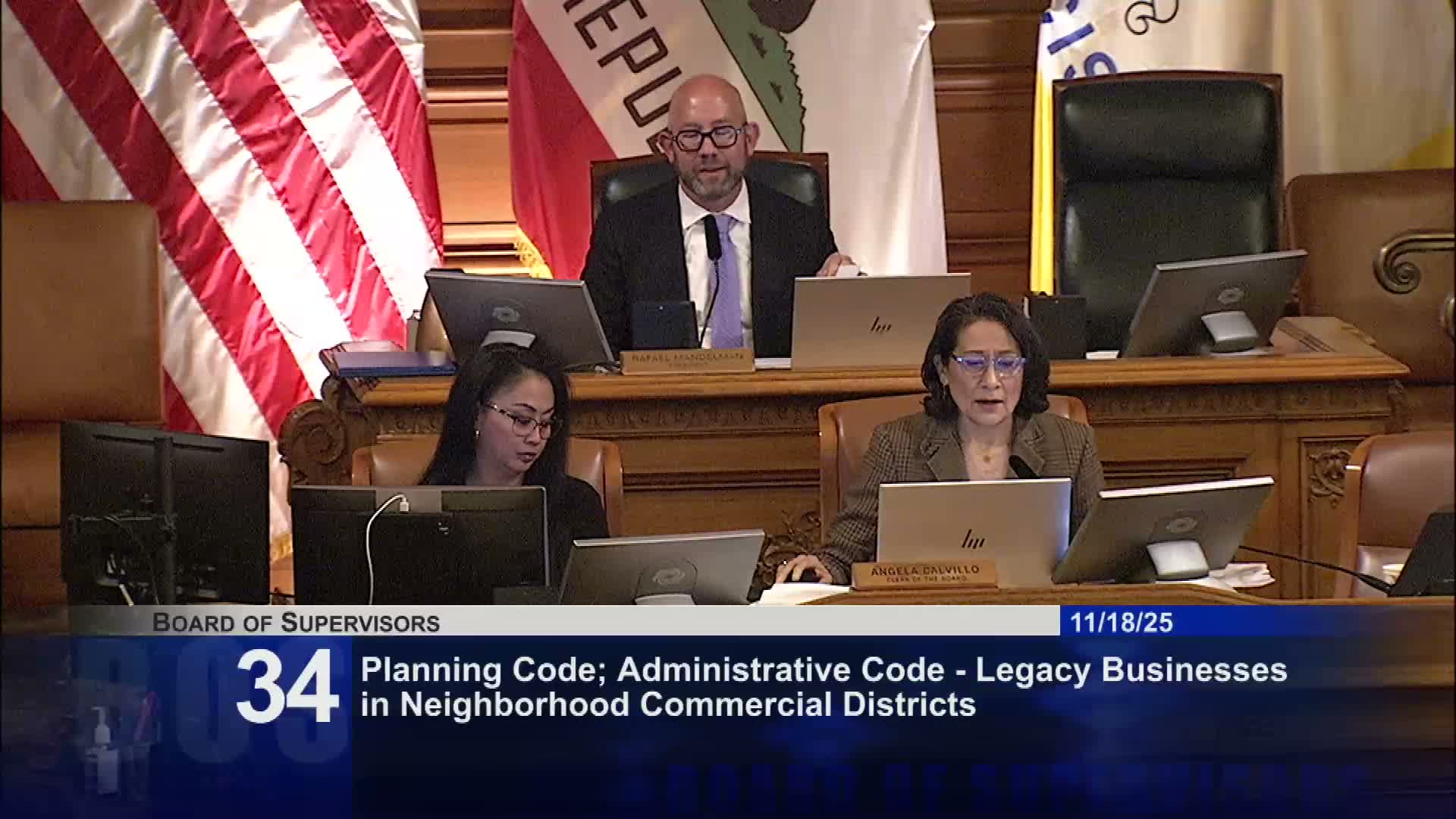
After more than an hour of debate, the San Francisco Board of Supervisors defeated an ordinance that would have defined and regulated ‘legacy businesses,’ with opponents saying the measure risked creating new barriers for small businesses and posed implementation challenges for the Planning Department.
The San Francisco Board of Supervisors voted down an ordinance on Nov. 18 that would have defined “legacy businesses” and required conditional use authorization before replacing those businesses in certain neighborhood commercial districts.
Supervisor Chien, the ordinance’s sponsor, told colleagues the measure sought to protect long‑running neighborhood businesses as cultural assets and preserve jobs, and proposed amendments to exempt micro and small businesses and storefronts that had been vacant for three or more years. Chien said the amendments reflected feedback from the Small Business Commission and aimed to balance protection for incumbents without blocking new entrepreneurs.
Opponents — including Supervisor Mahmoud, Supervisor Sauter, and Supervisor Sherrill — argued the measure, even as amended, would create perverse incentives for landlords to displace businesses before they became eligible for protection and would impose a conditional‑use process the Planning Department and Small Business Commission found difficult to administer. Mahmoud said the ordinance failed to distinguish between displacement by landlords and voluntary business exits and warned it would “create negative incentives” and prolong vacancies.
Supervisor Chan moved the amendments that added exemptions for micro and small businesses; that motion passed. The roll call on the amended ordinance recorded six ayes and four noes; the president announced that the ordinance failed. The board did not adopt the proposed permanent conditional‑use requirement.
The debate highlighted tensions between competing policy goals: preserving long‑lived neighborhood firms and avoiding regulatory steps that could slow storefront turnover or block essential services such as pharmacies and groceries. Several supervisors urged alternative tools — including funding support and targeted relief programs — rather than a zoning‑based conditional‑use requirement.
The item concluded without passage; the board moved on to other business.
The matter will return to committee or future agendas only if a supervisor reintroduces it.