Get Full Government Meeting Transcripts, Videos, & Alerts Forever!
Get email alerts on the Housing Family Zoning topic
No spam. Unsubscribe anytime.
Board approves family zoning package on first reading after heated debate over tenant protections and state compliance
Summary
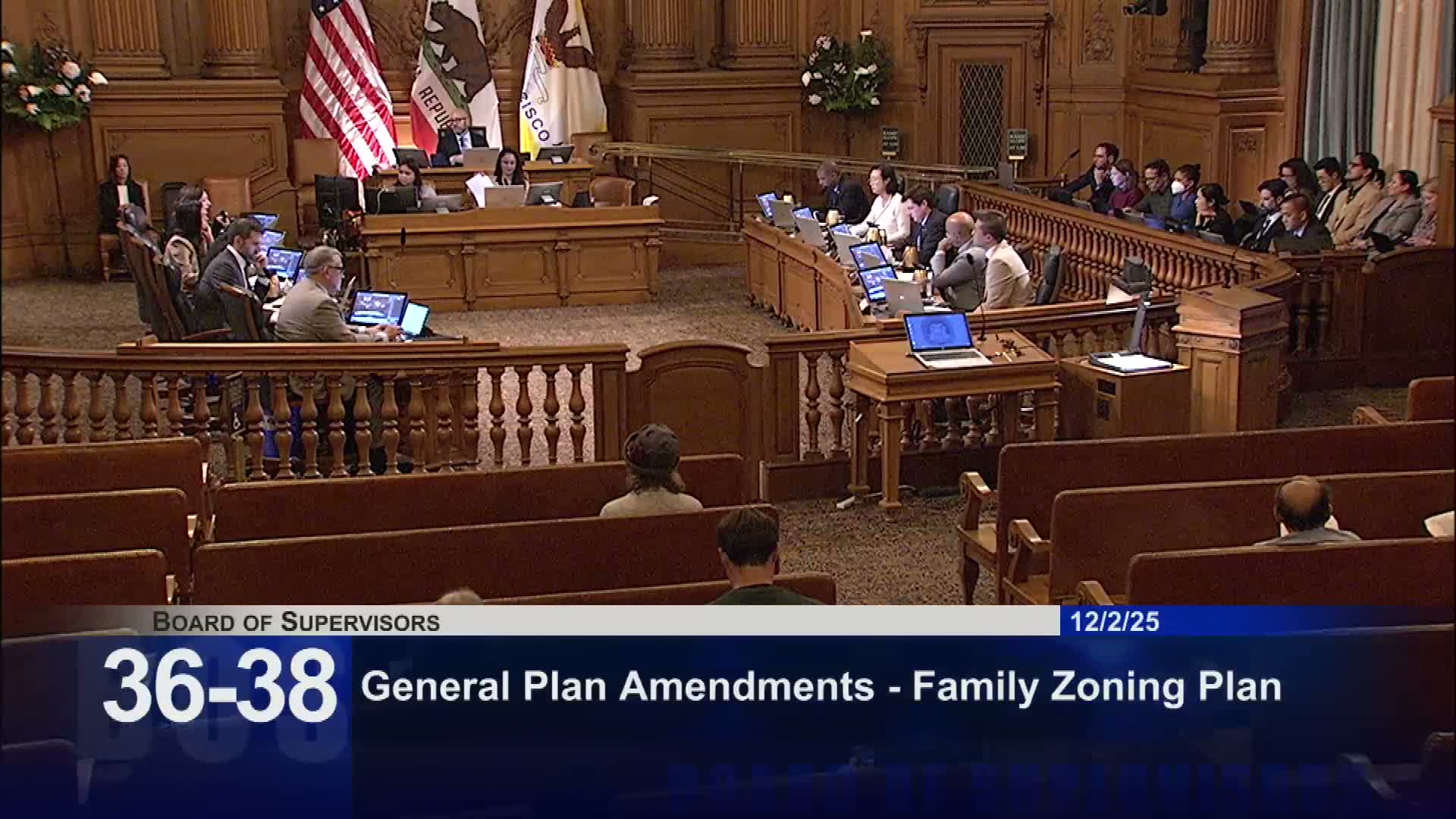
After hours of floor debate and a failed late amendment to exempt rent‑controlled units, the San Francisco Board of Supervisors passed the Family Zoning Plan (items 36–38) on first reading, with supporters saying it creates capacity needed to meet state housing requirements and opponents warning it risks displacement and loss of local controls.
The San Francisco Board of Supervisors on Dec. 2 passed on first reading a package of ordinances known as the Family Zoning Plan, which rezones parts of the city to add housing capacity and create a local density program intended to meet the city’s state-mandated housing targets.
Chair Ahsha Safaí Melgar, who led the Land Use and Transportation Committee process, said the package is the product of extensive community engagement and amendments and is intended to produce the additional capacity the city must show in its housing element. "Rezoning itself will not solve our housing crisis... but it is an absolutely necessary step," Melgar said.
The package, taken together as items 36–38, adjusts the general plan and zoning maps in multiple neighborhood plans and creates the Housing Choice San Francisco program, which includes provisions to incentivize family-sized units and to align with transit-oriented community policies. Planning staff told the board that the changes are designed to deliver the roughly 36,000 units of capacity required by the housing element and to preserve access to state funding contingent on compliance.
Supervisor Matt Dorsey, a supporter, said the plan is the "linchpin" of a citywide affordability strategy and emphasized that paired tenant protections and demolition controls would limit displacement. "We can do both: build more homes and protect renters," Dorsey said.
But several supervisors raised concerns. Supervisor Susan Chan offered a last‑minute amendment intended to remove from the local density program any sites that contain rent‑controlled units, arguing it would better shield tenants from demolition; she characterized the amendment as a policy choice to protect rent‑controlled households. Planning staff and the city’s advice from the Department of Housing and Community Development (HCD) warned that removing that capacity without a commensurate increase elsewhere risked decertification of the housing element — a result that could trigger the builders’ remedy, allow projects with greater height and density under state law, and make the city ineligible for certain state grants.
Lisa Chen of the Planning Department explained HCD’s review and cautioned the board that the city was already close to the minimum capacity threshold. "If we do make future changes that reduce capacity and don't provide commensurate increases, it could take us out of compliance," Chen said, adding that noncompliance could jeopardize roughly $100 million a year in housing-related funding.
The Chan amendment failed on roll call, 4–7. On the final roll call for items 36–38, the ordinances passed on first reading with seven ayes and four noes; Supervisors Fielder, Walton, Chan and Chen voted no. Supporters said the package preserves local control and added tenant-protection measures and that follow-up legislation and collaboration with state and community partners will be used to strengthen demolition controls and historic-preservation protections.
The board’s approval advances the plan to additional steps required under the city process. Supporters and opponents alike said follow-up work will be required on financing, on concrete delivery mechanisms for affordable housing, and on navigation of state law limits.
What’s next: The Family Zoning Plan advances after first reading; the board and planning staff signaled they will pursue additional legislation and state advocacy to shore up tenant protections, and supervisors said they expect subsequent hearings and implementation work over the coming year.