Get Full Government Meeting Transcripts, Videos, & Alerts Forever!
Get email alerts on the 111 Taylor Center topic
No spam. Unsubscribe anytime.
San Francisco hearing spotlights complaints, family grief and oversight gaps at 111 Taylor Street reentry center
Summary
A Nov. 6 hearing of the San Francisco Government Audit & Oversight Committee examined years of complaints — including the July 2025 death of resident Melvin Bulawan — alleging neglect, restricted freedoms and poor living conditions at 111 Taylor Street, operated by GEO Group; agencies, GEO and dozens of residents and advocates testified and the committee continued the item for further review.
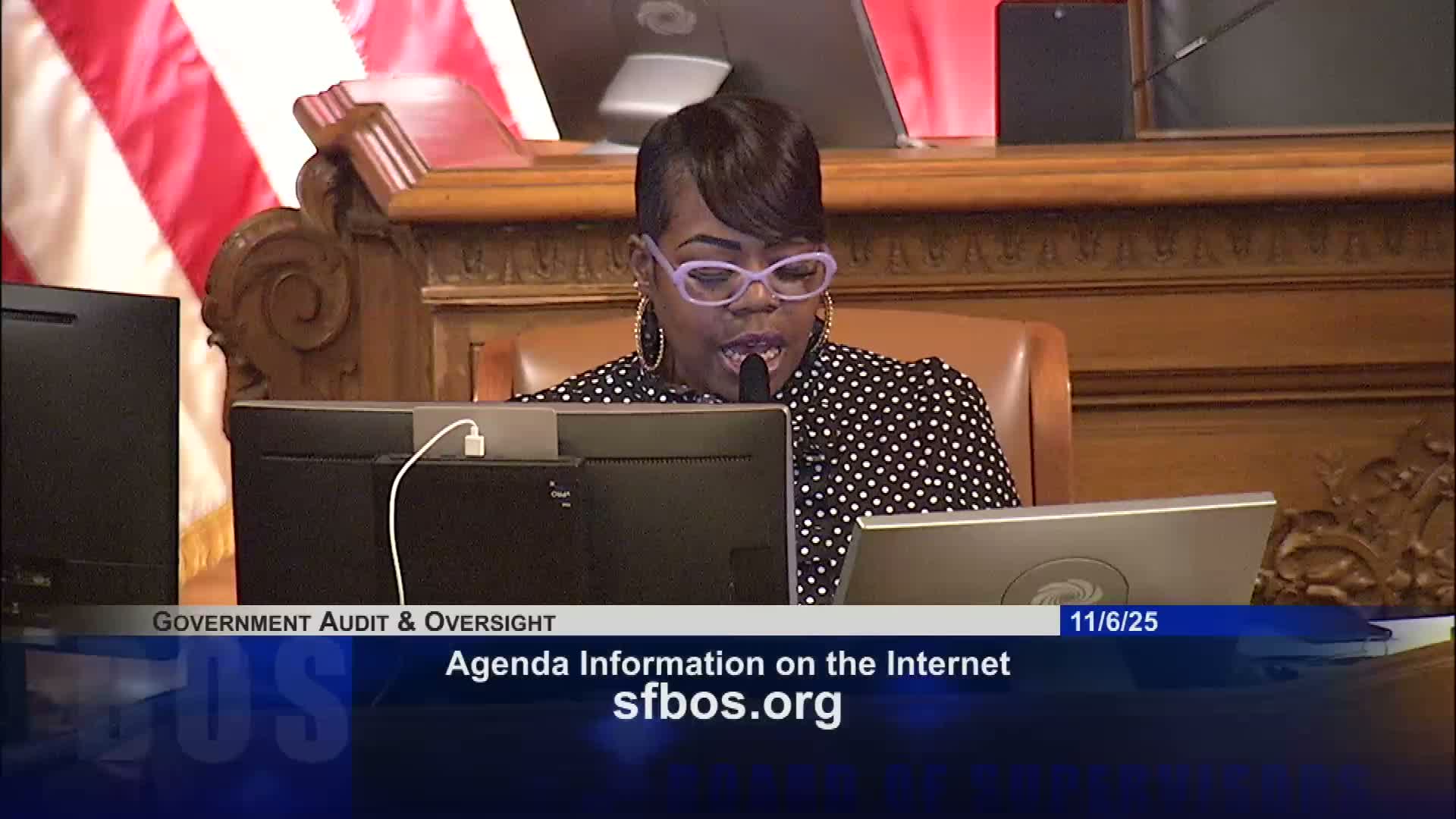
San Francisco supervisors heard anguished testimony and sharp disagreement on Nov. 6 as the Government Audit and Oversight Committee examined long‑running complaints about living conditions, oversight and civil‑rights concerns at 111 Taylor Street, the residential reentry center operated by GEO Group.
Chair Supervisor Jackie Fielder convened the hearing after community complaints and testimony about the July 2025 death of Melvin Bulawan, who family members say told them he was "anxious" and "scared" days before he was found dead near the facility. "I'm anxious," Bulawan told his son, "I'm scared. I'd rather go back to jail than stay here," his son Andrew testified during the hearing. Andrew said he called the facility repeatedly seeking a wellness check and that staff hung up before he could finish a sentence.
The Nut Graf: The committee gathered city departments, federal probation and pretrial officials, the San Francisco Public Defender's Office, GEO Group representatives and more than three dozen public commenters to weigh competing accounts about whether Taylor Street functions as a community reentry program or, in practice, a carceral site. Testimony ranged from data on the city's reentry programs to first‑person accounts of alleged poor food, restricted movement, and retaliation. Supervisors voted to continue the item to the call of the chair so the committee can review records and hear additional stakeholders.
What officials said
Victoria Westbrook, reentry division director at San Francisco Adult Probation, described the city's reentry portfolio and said the department does not contract with GEO or Taylor Street. Westbrook said the city funds 13 transitional housing programs across six districts, partners with multiple community‑based providers, and tracks outcomes — reporting thousands of CASC visitors and hundreds of housing placements in the prior year. She told supervisors that many of the locally funded programs are structured, drug‑ and alcohol‑free, and that stays of 12–18 months generally produce better outcomes for people exiting incarceration.
Nadia Iqbal, a deputy public defender who said she has worked in parole court for 18 months, described repeated client complaints about 111 Taylor that she said resemble "extensions of prison," including strict curfews, round‑the‑clock counts and limits on where residents may work or with whom they may speak. Iqbal referenced a short film produced by her office documenting conditions during the pandemic and said the public defender's office supports community calls for GEO Group to be removed and the site converted to community‑based services.
Federal probation and pretrial officials — who said they place some people at Taylor Street as an "alternative to detention" — described their oversight relationship: pretrial can set individualized conditions and curfews for people on supervision, and both agencies said they conduct site visits and coordinate with the Bureau of Prisons on contract oversight. Chief pretrial staff said the facility is an important resource that, in many cases, keeps people in the community rather than in custody.
GEO Group's response
Molly Rosegraves and Maria Richard, representing GEO Reentry Services and Taylor Street Center, outlined the program's partnerships with health and employment providers, said the facility has operated in San Francisco for decades, and emphasized audits and inspections by multiple agencies (fire, public health, third‑party PREA audits). Maria Richard said participation is voluntary and argued Taylor Street provides individualized case plans and paths to increased community access as residents meet milestones.
Complaints, community testimony and disputed facts
Family testimony and scores of public speakers described persistent problems at the building: alleged pest infestations, spoiled or inadequate food, searches and pat‑downs, nightly breathalyzer checks, limits on phone and media access, reports of retaliation, and complaints that some residents lack access to on‑site licensed medical staff. Multiple commenters urged the city to subpoena records — incident reports, PREA audits and inspection results — and to transition the building away from a private contractor.
GEO disputed several specifics presented by community witnesses. The company said it had responded to recent fire and building‑inspection notices and that many complaints were being addressed or closed. GEO also declined to discuss specific ongoing investigations and said it follows Bureau of Prisons, CDCR and local inspection protocols.
Formal actions and next steps
The committee voted unanimously to continue the item to the call of the chair to allow further review and coordination with agencies and stakeholders. Supervisors also forwarded five settlement ordinances (items 2–6) on the consent portion of the agenda to the full Board of Supervisors with a positive recommendation.
What remains unresolved
The hearing left several open questions: the exact circumstances that led to Bulawan's death and whether reporting and notification protocols were followed in that case; the full content of incident logs and PREA investigations at Taylor Street; how federal contracting and state parole placements interact with the facility's classification under San Francisco's planning code; and whether the city should require additional independent oversight or pursue a change in zoning or contracting to remove GEO Group.
The committee's continuance means supervisors will have additional opportunities to request records and require follow‑up testimony. For now the most recent procedural step is the committee's vote to continue the item to the call of the chair so that absent parties and records can be made available for further review.