Get Full Government Meeting Transcripts, Videos, & Alerts Forever!
Get email alerts on the Medicare Partd Tiering topic
No spam. Unsubscribe anytime.
Kaiser to reclassify 45 HIV drugs to specialty tier in 2026; SFHSS told 86 members will be affected
Summary
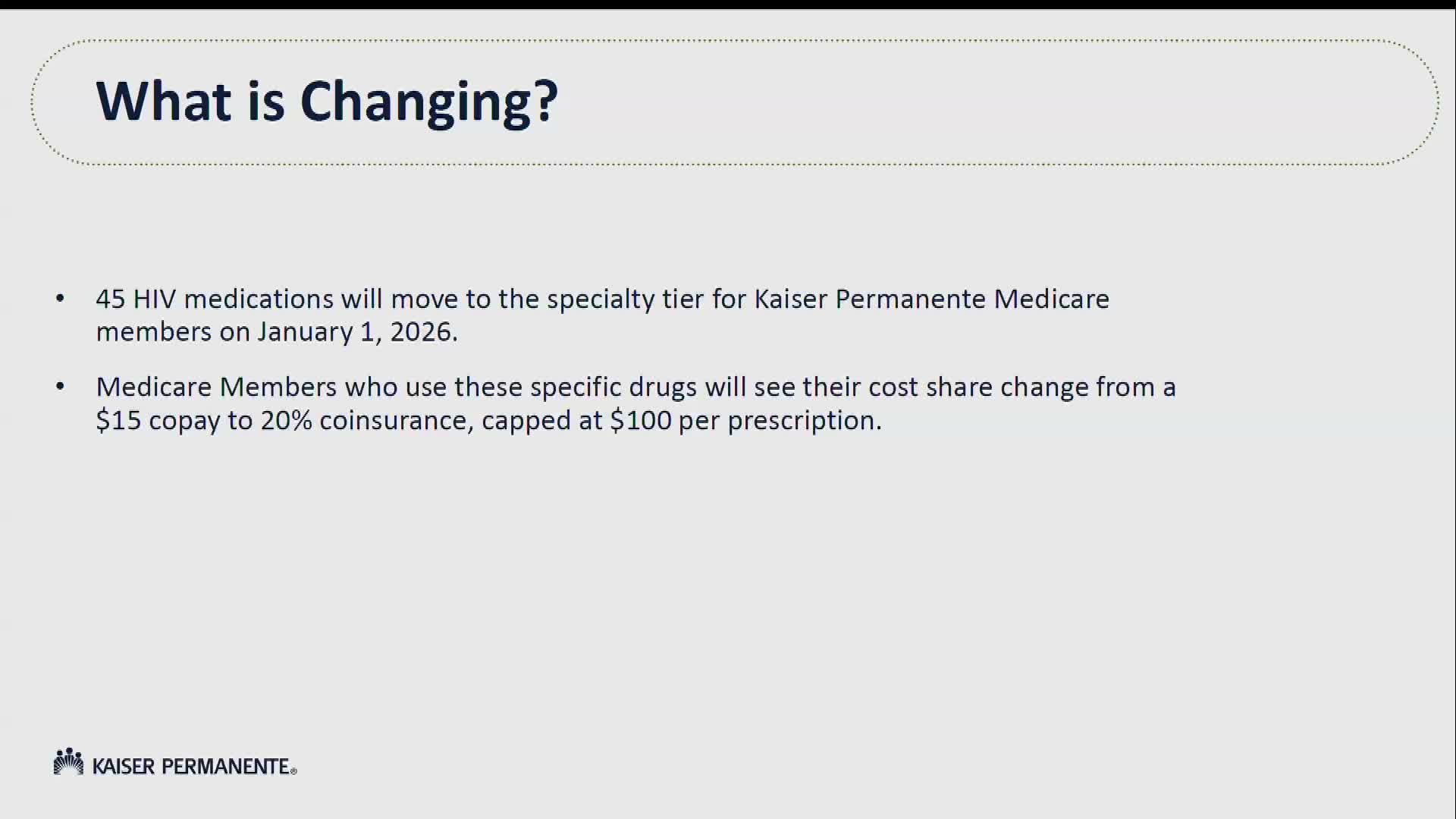
Kaiser Permanente told the San Francisco Health Service System board that, effective Jan. 1, 2026, 45 high-cost HIV drugs will move to a specialty tier under the Medicare Part D formulary, changing member cost-sharing to 20% coinsurance (capped at $100 per prescription); SFHSS staff said 86 members will be affected and Kaiser described assistance options.
Kaiser Permanente representatives told the San Francisco Health Service System board on Dec. 11 that 45 high-cost HIV medications will move to a specialty tier on Jan. 1, 2026, a change that will shift cost-sharing for affected Medicare Advantage members.
"Effective 01/01/2026, 45 high cost specialty drug, HIV drugs, are gonna move" from their prior brand-name tier to a specialty tier, Ramiro Salas, director for Kaisers California group Medicare, said during the presentation. Salas said memberscost share will change "from $15 per prescription to a 20% coinsurance with a maximum of $100 per prescription." He added the plan-wide annual out-of-pocket prescription cap is $2,100.
Kaiser said the move aligns its products with CMS thresholds and market practice. Salas cited a CMS pricing threshold that has risen over time and said failing to migrate certain drugs risks adverse selection that would raise costs for all members.
SFHSS Executive Director Ray Guillen told the board the departments data shows 86 HSS members will be impacted by the change, with 76 in Northern California, nine in Southern California and one in Hawaii; 16 members take more than one of the affected drugs. "There will be 86 of our members are currently being impacted by this change," Guillen said.
Kaiser said it had notified impacted members and provided routes for assistance, including a Medicare prescription payment plan that spreads costs over 12 months and Kaiser financial-assistance programs. Salas said other state and federal programs (for example, ADAP) are available to some members.
Board members pressed Kaiser on whether other drug classes had already been migrated. Salas replied that several non-HIV specialty migrations occurred in 2024 and that Kaiser had deliberately delayed moving these 45 HIV drugs until it could analyze options. "We made this change thoughtfully, later than other carriers," Salas said.
Members of the public, including Dr. Teresa Palmer, urged the board to pursue additional mitigation steps such as contracting with more in-city skilled-nursing facilities so members could remain close to family. The board and staff said they would keep monitoring member calls and supports.
The presentation left open follow-up questions about outreach effectiveness and what additional local protections, if any, the board might request from carriers.
The board received the presentation and moved on to subsequent agenda items.