Get Full Government Meeting Transcripts, Videos, & Alerts Forever!
Get email alerts on the Behavioral Health Center topic
No spam. Unsubscribe anytime.
Residents, staff and union urge Health Commission to halt privatization plans at Behavioral Health Center
Summary
Dozens of residents, family members, clinicians and SEIU representatives told the San Francisco Health Commission that proposed renovations and possible contracting out of ARF/RCFE services would harm long-term residents, risk evictions and strip continuity of care. Speakers asked the Department of Public Health to keep civil service staff with residents and allow displaced residents to return.
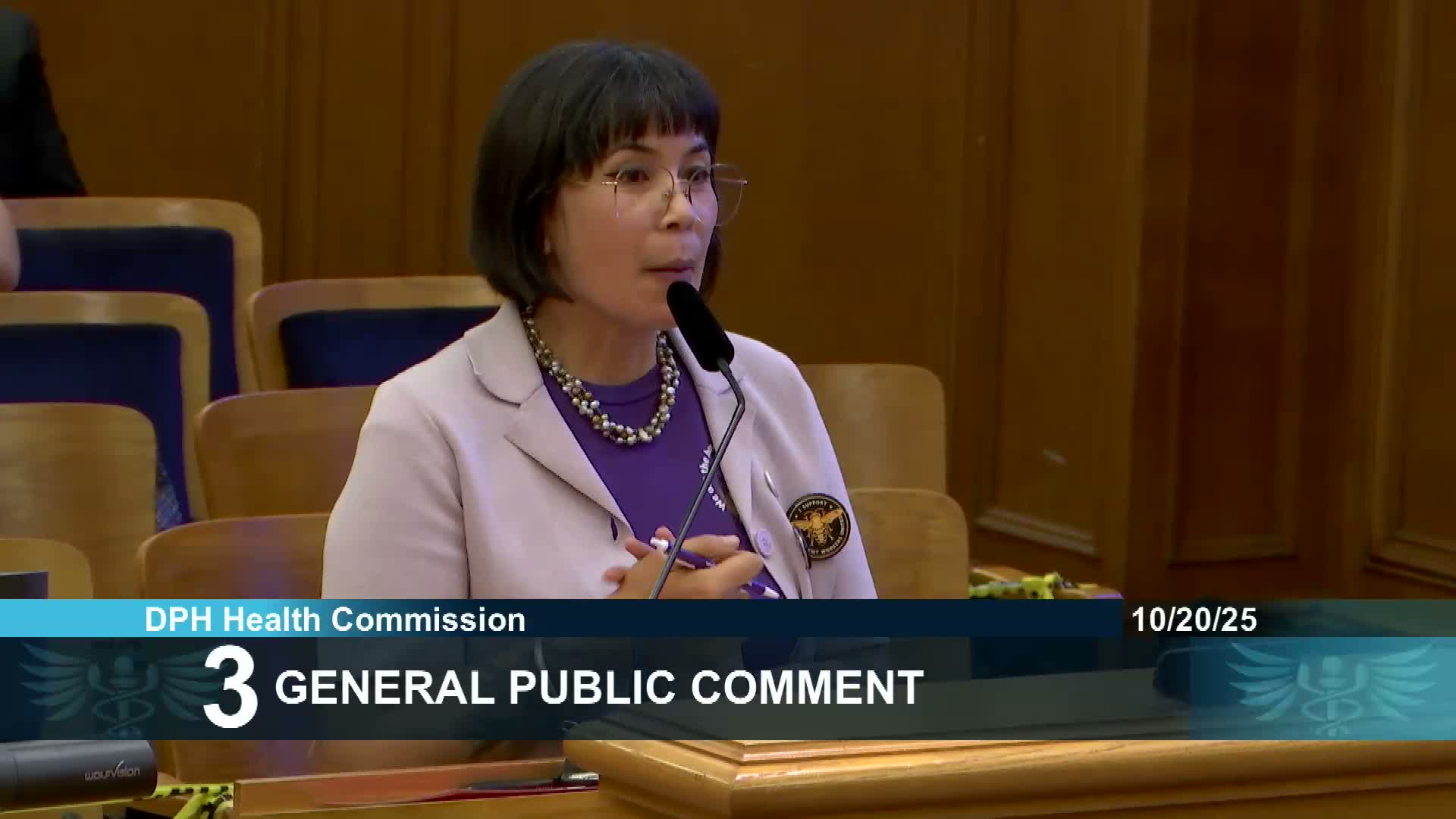
Dozens of residents, family members, clinicians and union representatives told the San Francisco Health Commission on Oct. 6 that proposed renovations and possible privatization of services at the Behavioral Health Center (BHC) would harm long-term residents and disrupt care.
"We are proposing to keep the ARF and RCF residents together with their civil service care providers," said Elizabeth Travelzite, a field representative with SEIU Local 10 21, urging the Commission to support the union's proposal to preserve current staffing and permit residents displaced by renovations to return. Travelzite said privatization would jeopardize resident health and violate collective bargaining agreements.
Family members and residents described specific harms they attribute to recent relocations. Antoinette, a family member of an RCFE resident, said her brother found stability at the BHC after years of poor placements and begged the Commission not to "move my brother and the other residents and privatize their care." Marcus Heisman, who identified himself as an ARF resident for 11 years, said ARF is "my home" and warned that closure or relocation would lead to homelessness and instability.
Sarah Clark, a registered nurse at the BHC for eight years, cited past transfers at Laguna Honda and said she had seen "transfer trauma" in which moved patients later declined. Clark told commissioners that, in 2022, Laguna Honda relocated 57 patients and that, in her account, 12 of those died within 70 days of transfer; she used that example to argue the Commission should avoid repeat transfers without strong protections.
Speakers described cases in which the city facilitated moves to private board-and-care facilities that later evicted or failed to meet residents' needs. Yvonne Chan asked the Commission to adopt more rigorous screening and language-access supports when matching residents to outside facilities, saying her sister was moved into a private facility that later said it could not safely care for her and issued an eviction notice.
Multiple speakers urged that any renovation plan include transfer of existing civil service staff to new sites or that the city preserve civil service staffing models to ensure continuity, de-escalation skills, and specialized care. A union representative said negotiations are ongoing with Director Tsai and the city's human resources team and asked that, while talks continue, DPH allow a recently displaced resident to return to the RCFE; the speaker said an eviction deadline was approaching on the 24th of the month.
Commission staff and the president noted that there was no action on the Commission agenda related to the BHC that day, and that the Brown Act limits the Commission's ability to act on items not posted on the agenda. Commissioners did not take formal action on the appeals during the meeting.
The public comments underscore the central concern shared by family members, staff and residents: maintaining continuity of care and relationships with experienced civil service staff is critical for a vulnerable population that speakers said would suffer from outsourcing.
The Commission heard the comments during the general public comment period and did not vote on changes to ARF/RCFE policy at this meeting. No formal policy change was adopted during the session; speakers asked the Commission and DPH leadership to prioritize negotiation outcomes and consider immediate operational steps to prevent evictions and placement failures.