Get Full Government Meeting Transcripts, Videos, & Alerts Forever!
Get email alerts on the Family Zoning Plan topic
No spam. Unsubscribe anytime.
Committee votes to send core Family Zoning package to full Board after large public turnout; duplicate file tabled
Summary
After hours of presentations and more than two dozen public speakers, the committee sent key family‑zoning items (5–7 and 9) to the Board with positive recommendations, tabled duplicate Item 8, and recorded several 2–1 committee votes reflecting Vice Chair Chen’s persistent concerns about displacement and feasibility.
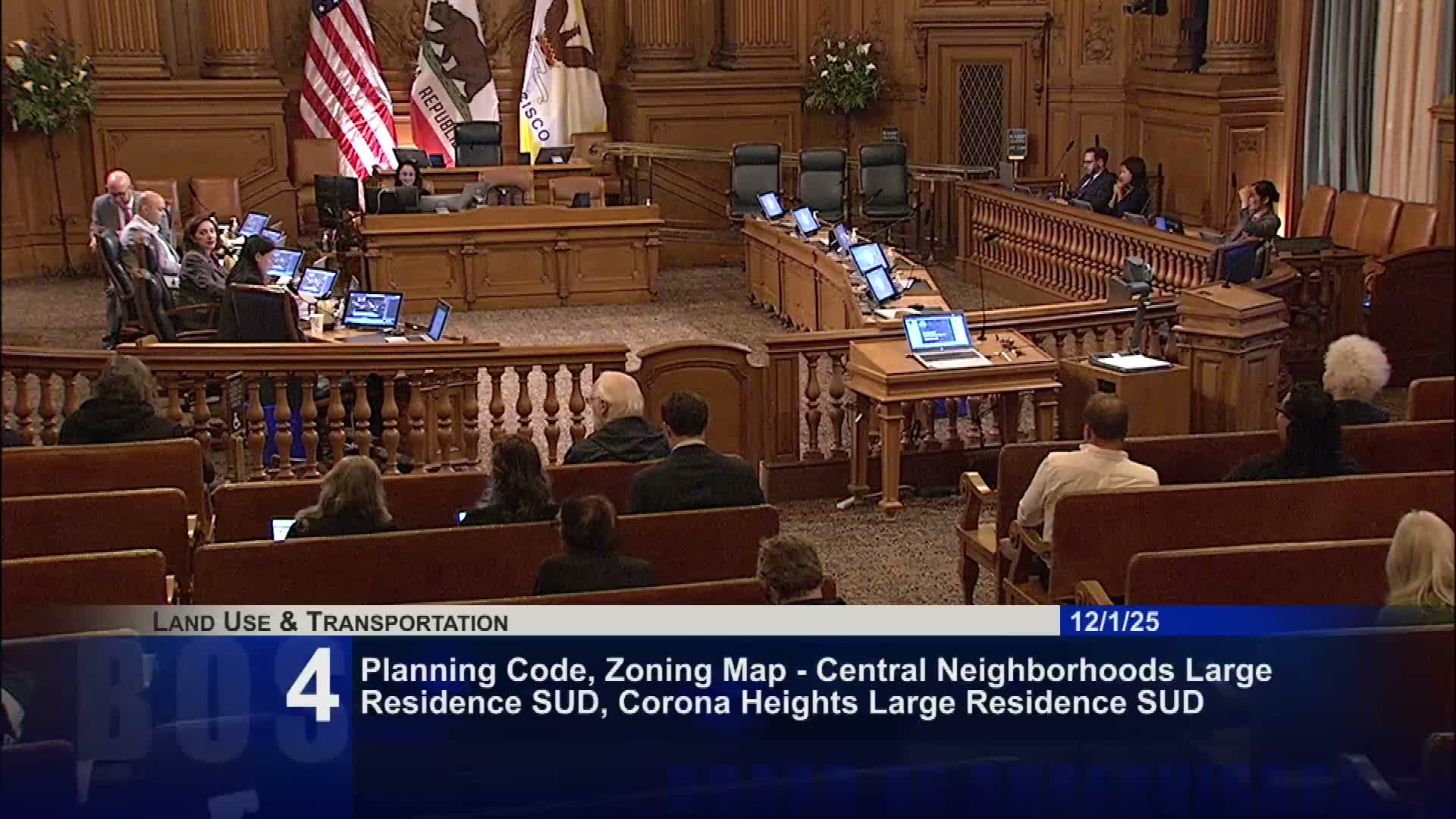
The Land Use and Transportation Committee on Dec. 1 advanced the core elements of the city’s Family Zoning / Housing Choice San Francisco rezoning package to the full Board after extensive staff presentations and a large public-comment period that included both supporters and opponents.
Clerk-read items 5–9 covered amendments to the general plan, zoning map changes, creation of the Housing Choice San Francisco program, and associated local coastal program amendments. President Mandelmann and Planning Department staff described planning-commission recommended protections tied to lot mergers and historic resources: a lot‑merger prohibition would apply only to housing-development projects that contain known historic resources unless the project preserves the resource in accordance with objective preservation design standards. Planning staff said they had narrowed the draft definition to rely on the existing ‘‘historic building’’ definition in section 102 and clarified that preservation design standards should prevail where necessary, provided they do not result in demolition of protected resources.
Public comment was long and sharply divided. Housing advocates and some neighborhood groups urged the committee to move the plan forward to create housing capacity, while preservationists, small-business groups, and many residents warned the rezoning would incentivize demolition of rent-controlled units, threaten small commercial storefronts, and lacked sufficient affordability guarantees or funding. Common public demands included stronger PEG-specific demolition protections, mandatory buyout compliance, deeper replacement affordability in priority equity geographies, and calls for supplemental environmental review.
Procedurally, attempts by Vice Chair Chen to refer items 5–9 to the full Board without recommendation failed (1–2). The committee tabled duplicate Item 8 (2–1). Supervisor Mahmood moved multiple actions: to adopt cleanup commercial-space amendments, to forward files 5, 6 and 7 as committee reports with positive recommendations, and to send item 9 (the local coastal program resolution) to the Board with a positive recommendation; those motions passed (committee tallies recorded a mix of 2–1 and 3–0 results depending on the motion). The meeting closed with items 5–7 and 9 slated for Board consideration and Item 8 held for further work.
Next steps: items will appear on the Board of Supervisors agenda for further debate and votes; duplicate item 8 will be revisited later.