Get Full Government Meeting Transcripts, Videos, & Alerts Forever!
Get email alerts on the Hospital Acquisition topic
No spam. Unsubscribe anytime.
UCSF reports increased volume and major investments a year after acquiring Dignity Health hospitals
Summary
UCSF Health told the San Francisco Health Commission that emergency visits and inpatient discharges rose in the first year after acquiring St. Mary's and St. Francis, and outlined investments in beds, imaging, IT (Epic) and planned safety upgrades to psychiatric units that will require state review.
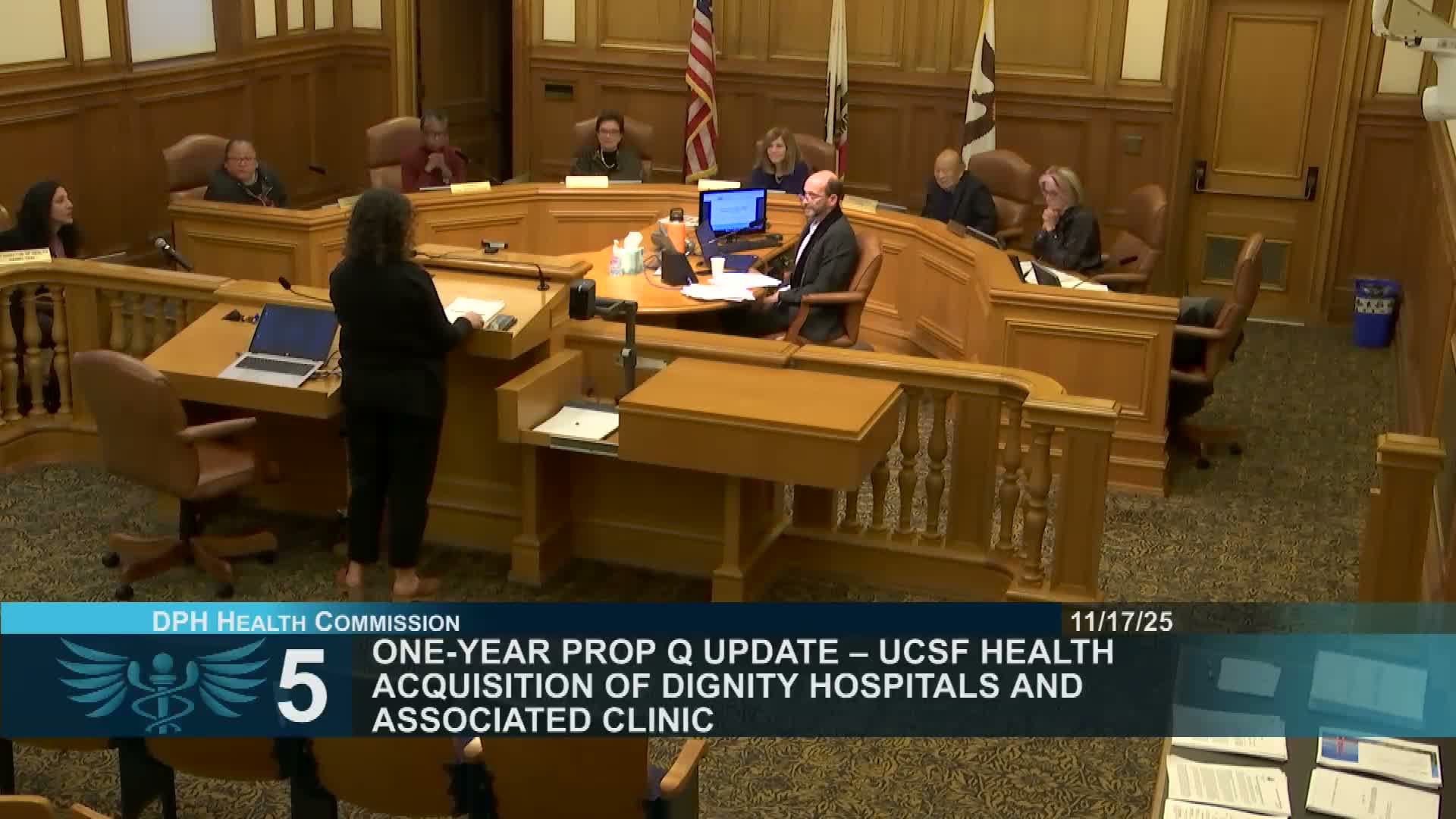
UCSF Health reported to the San Francisco Health Commission that, in the first year after acquiring Dignity Health St. Mary's and St. Francis, emergency encounters and inpatient discharges rose and the system has made substantial near-term investments.
Miranda Brillante of the Department of Public Health summarized data comparing 2019'2023 with August 1, 2024'July 31, 2025. She said emergency encounters increased 7% at Hyde and 39% at Stanyan compared with 2023, and inpatient discharges rose 21% at Stanyan while remaining steady at Hyde. DPH found patient demographics largely unchanged but noted a higher share of Medicare-funded encounters and more patients over 65 in some settings.
Josh Adler, UCSF Health executive vice president and clinical chief officer, said the hospital system reopened two closed units to add capacity for roughly 60 patients, doubled cardiac catheterization procedures at the Stanion campus, added consultative specialists and five new primary-care physicians, and invested roughly $63 million in facilities and $72 million in information technology. "We put in a huge effort with training and preparation," Adler said of the Epic electronic-records launch on Oct. 4.
Adler told commissioners the system is pursuing behavioral-health capacity improvements but faces safety-related facility limitations in psychiatric units. He estimated about a $5 million investment is needed to address ligature and elopement risks and other safety upgrades; those plans must be submitted to the Health Care Access and Information (HCAI) division, with review typically taking six to 12 months and construction another several months. "We've identified needed safety upgrades in the hospital psych units and report that once construction is completed, they will be able to expand volume in the units," Miranda Brillante told the commission.
Adler said some specialized services that are typically found only at tertiary centers (for example, neurosurgery and cardiac surgery) will continue to be handled at UCSF's academic campuses, and a small number of services such as radiation oncology will be consolidated elsewhere in the city so patients can receive care on modern equipment. He said UCSF is working with referring providers, including those who serve Chinatown, to ensure referral pathways remain convenient for patients.
Public commenters and hospital staff raised concerns about recent layoffs and the closure of certain service lines, including radiation oncology, and asked how the commission will provide oversight concerning commitments made in the Attorney General agreement that approved the acquisition. Adler said UCSF is trying to renew crucial clinic leases and, where necessary, find nearby locations to preserve access and to honor Medi-Cal acceptance commitments.
The commission asked UCSF for continued data updates every six months through June 2027 as required under the Prop Q resolution. The next formal comparative update is expected in about a year.