Get Full Government Meeting Transcripts, Videos, & Alerts Forever!
Get email alerts on the Rezoning Family Zoning topic
No spam. Unsubscribe anytime.
Land Use committee advances Family Zoning package, accepts sponsor amendments and schedules follow-up hearings
Summary
City planning staff presented the Family Zoning rezoning package and an affordable-sites strategy; after hours of public comment the committee accepted sponsor amendments (including protections for some rent‑controlled buildings and small‑business provisions), duplicated files for technical review, and continued key items to Nov. 3 and Dec. 1.
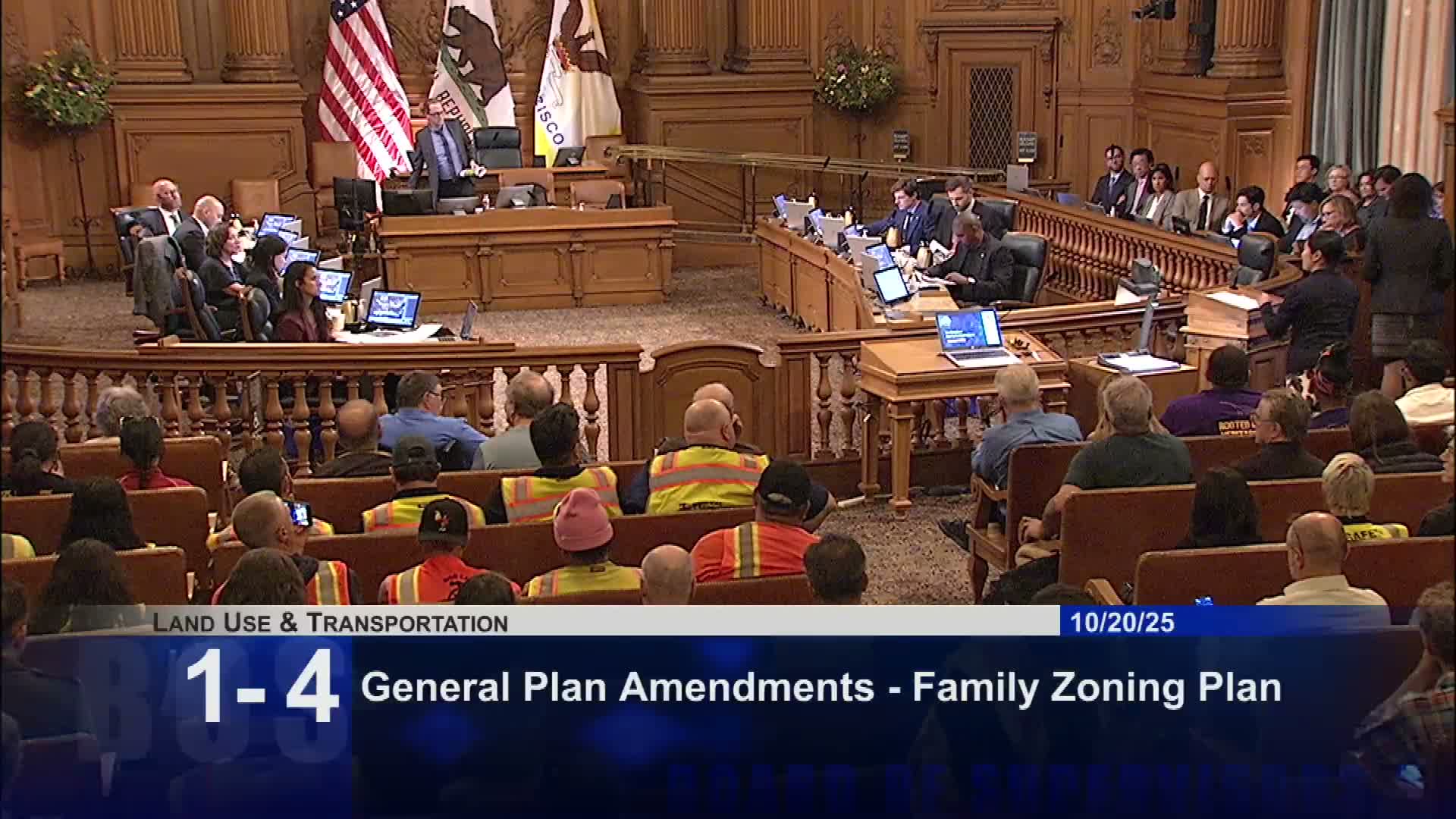
Supervisor Mirna Melgar convened the Land Use and Transportation Committee on Oct. 20 for a six‑hour hearing on the mayor’s Family Zoning rezoning package and related affordable‑housing strategies. Planning staff and the mayor’s housing office described the package as a citywide rezoning designed to create capacity to meet the state Regional Housing Needs Allocation (RHNA) and avoid state enforcement measures.
"This project is many, many months and, sometimes evenings, in the making," Rachel Tanner, director of long‑range planning, told the committee as she introduced principal planner Lisa Chen and James Pappas, who presented an analysis of sites for 100% affordable housing. Chen said the rezoning would add mid‑rise corridors, create a new residential transit‑oriented commercial (RTOC) district and a Housing Choice San Francisco local program that offers a menu of incentives in exchange for abiding by local design standards.
Chen warned of legal and fiscal consequences if the city fails to provide the capacity required by state housing law: "If we fail to adopt a rezoning that meets state requirements, we could lose local control, lose control over local permitting, and the builder's remedy would kick in," she said, summarizing advice from the California Department of Housing and Community Development (HCD). Planning posted a preliminary HCD letter on Sept. 9, Chen said, and the department issued an EIR addendum in September 2025 explaining why the rezoning does not require a new EIR.
James Pappas presented the Affordable Sites Analysis and Strategies (ASOS). He said the city currently has over 12,000 units of 100% affordable housing in the pipeline across 59 sites but that financing and construction costs — not land supply — are the biggest obstacles to building them out quickly. "Lack of sufficient funding remains the largest barrier to building affordable housing," he said.
The board’s legal adviser (recorded as Deputy City Attorney Bridal Rusty) reminded the committee that by charter the board has 90 days to act on the general plan amendment transmitted by the Planning Commission on Sept. 22, otherwise it is deemed approved, and that the board may amend the planning code and the zoning map but cannot amend the general plan amendment itself.
Supervisors debated multiple proposed amendments before public comment. Supervisor Bilal Mahmood said he would not support amendments that would refer the package back to the Planning Commission because the city faces a December deadline tied to HCD review. Vice Chair Supervisor Cheyenne Chen outlined tenant protections and map and policy changes she proposed to reduce displacement risk and expand family‑sized units. President Mandelmann and others urged stronger historic‑resource protections and cautioned that relaxing local controls could accelerate state density‑bonus projects with greater heights.
Public comment ran for many hours and featured a wide range of positions: labor and environmental groups, neighborhood associations, small‑business advocates, housing providers and hundreds of residents either urging passage to produce more housing or warning the rezoning could lead to demolition, displacement and loss of neighborhood character.
After the presentations and public testimony the committee took procedural actions. Chair Melgar said she would accept certain sponsor amendments that had been vetted with the mayor’s office (including an exclusion from the local program for rent‑controlled buildings with three or more units and language to prohibit hotel conversions into streamlined Housing Choice SF projects). The committee duplicated the ordinance files so one copy could carry the package of supervisor amendments for board consideration and another could carry items that require re‑referral to the Planning Commission (notably a proposed lot‑merger carve‑out tied to historic contributors). The committee continued the parent files and the duplicate that contains the bulk of the amendments to Nov. 3 to allow city attorneys and staff to integrate technical fixes and submit materials to HCD and continued the Planning Commission referral file to Dec. 1 to permit any additional review.
No final adoption or up‑or‑down vote on the ordinances occurred on Oct. 20; rather, the committee set a path to incorporate supervisor amendments, conduct follow‑up legal and technical review, and revisit the items on Nov. 3 and Dec. 1.
What happens next: planning staff said it will continue refining maps and analyses (including SB 79 interaction) and city attorneys will vet amendment language; HCD has signaled the city must avoid reducing housing capacity unless it compensates elsewhere.