Get Full Government Meeting Transcripts, Videos, & Alerts Forever!
Get email alerts on the Street Resurfacing topic
No spam. Unsubscribe anytime.
Public Works outlines street resurfacing plan, says citywide pavement condition index stands at 75
Summary
Project manager Paul Radice told the San Francisco Public Works Commission that the city's Payment Condition Index is 75, the resurfacing program has resurfaced more than 9,000 blocks over 15 years, and maintaining current conditions will require roughly $80–$90 million annually while reaching a 'state of good repair' would require about $150 million a year.
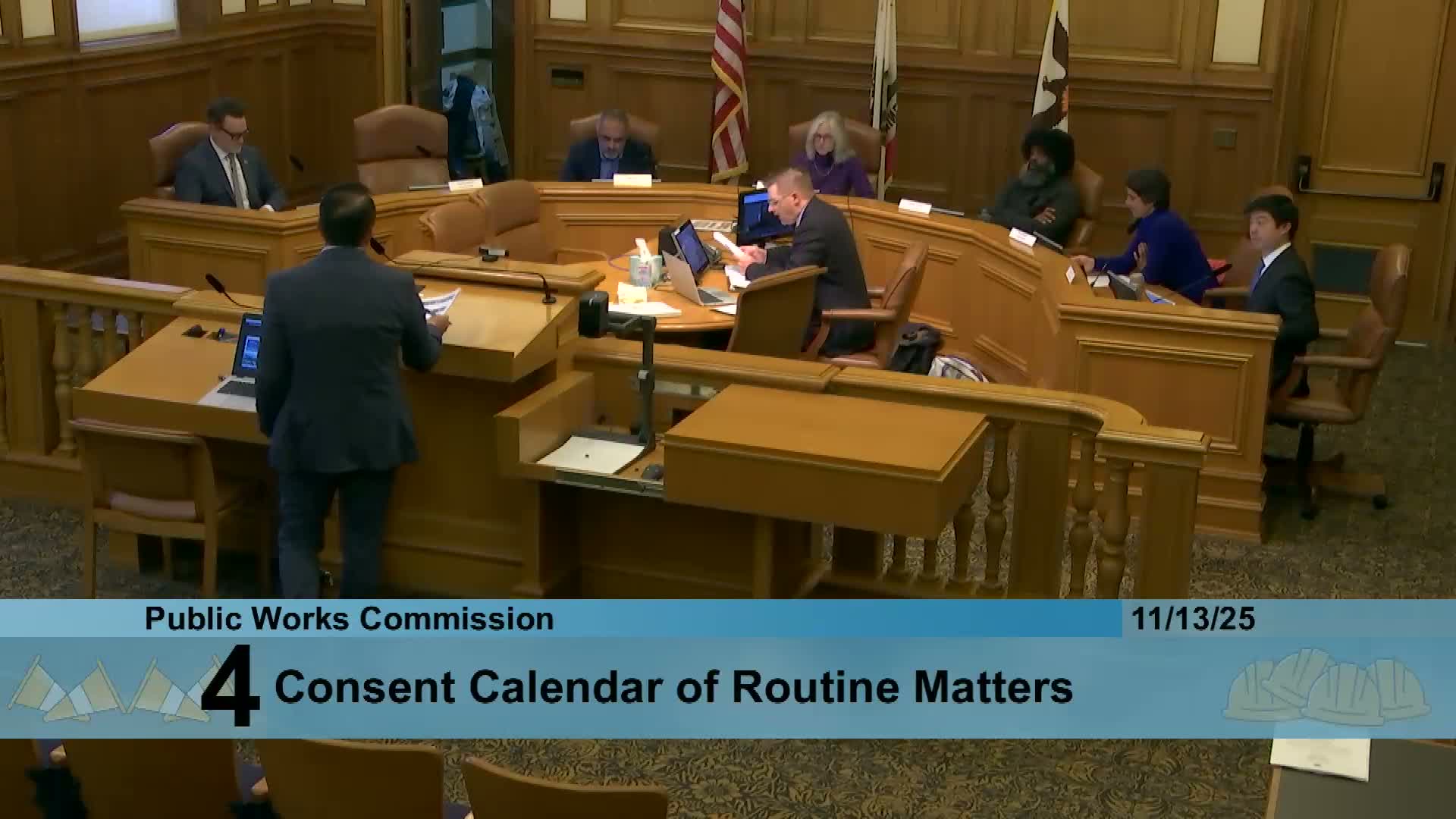
Paul Radice, a project manager for San Francisco Public Works, gave an annual update on the city's street resurfacing program, saying the city's Payment Condition Index (PCI) is currently 75 and outlining the program's selection criteria, costs and coordination measures.
"This is our street resurfacing program philosophy. Right road, right treatment, right time for the right price," Radice said, summarizing the approach the department uses to prioritize resurfacing candidates. He told the commission the program uses six selection criteria, including PCI score, multimodal routes, project readiness and geographic equity.
Radice said the city has resurfaced 9,148 blocks over the last 15 years and currently maintains roughly 13,000 street segments. He summarized the per-block average cost structure and funding needs: "The ones in the light green are about $50,000 a block" for lower-cost maintenance, rising to roughly $260,000 on average for projects that include curb ramps and base repairs. Radice also listed line-item components including staff time (~$50,000), curb ramps (~$60,000), localized base repairs (~$55,000), paving (~$65,000) and miscellaneous items (~$30,000).
On funding and long-term targets, Radice said the city is aiming to hold the PCI near its current level and that the "state of good repair" — an upper PCI target where preventative maintenance would be far more affordable — would cost substantially more than current budgets. He described three funding scenarios shown in the department's presentation and estimated maintaining the present PCI requires roughly $80–$90 million annually while reaching and sustaining the higher target could require on the order of $150 million a year.
Radice described a five-year moratorium policy that discourages utility cuts on newly paved streets unless the work qualifies as an emergency or a new service. He said the permits team evaluates excavation permit requests and checks the moratorium database to determine whether proposed work on a recently paved street meets the moratorium's exception criteria.
The presentation included district-by-district photos and results: District 4 (Sunset) was listed with a PCI of 80, District 11 had a recent $30 million Mission/Geneva project, and the presentation showed examples of concrete and asphalt resurfacing across the city. Radice said the commission helped award about 21 contracts totaling $133 million covering roughly 805 blocks over the last two years.
Chair Post and commissioners asked about public access to the data and materials; Radice and Deputy Director Robertson said the department maintains an interactive map, a FAQ section and project-level information on the Public Works website and that presentation slides and PCI data can be located via agenda and presentation archives.
The commission opened the item to public comment; no speakers signed up. Radice closed by thanking staff and contractors who deliver the paving projects.
The commission did not take a separate vote on the informational presentation. The resurfacing briefing will remain available in the department's public materials and the commission will continue to consider funding and contract awards through future agenda items.