Get Full Government Meeting Transcripts, Videos, & Alerts Forever!
Get email alerts on the Public Space P0pos topic
No spam. Unsubscribe anytime.
Planning Commission approves closing 1 Montgomery rooftop to public, requires free downtown events and reporting
Summary
The Planning Commission approved a request to remove public access to the rooftop terrace at 1 Montgomery Street in exchange for a minimum public‑benefit program that includes four free downtown events annually, annual reporting and enforcement triggers. The vote was 5–1 on Dec. 18, 2025.
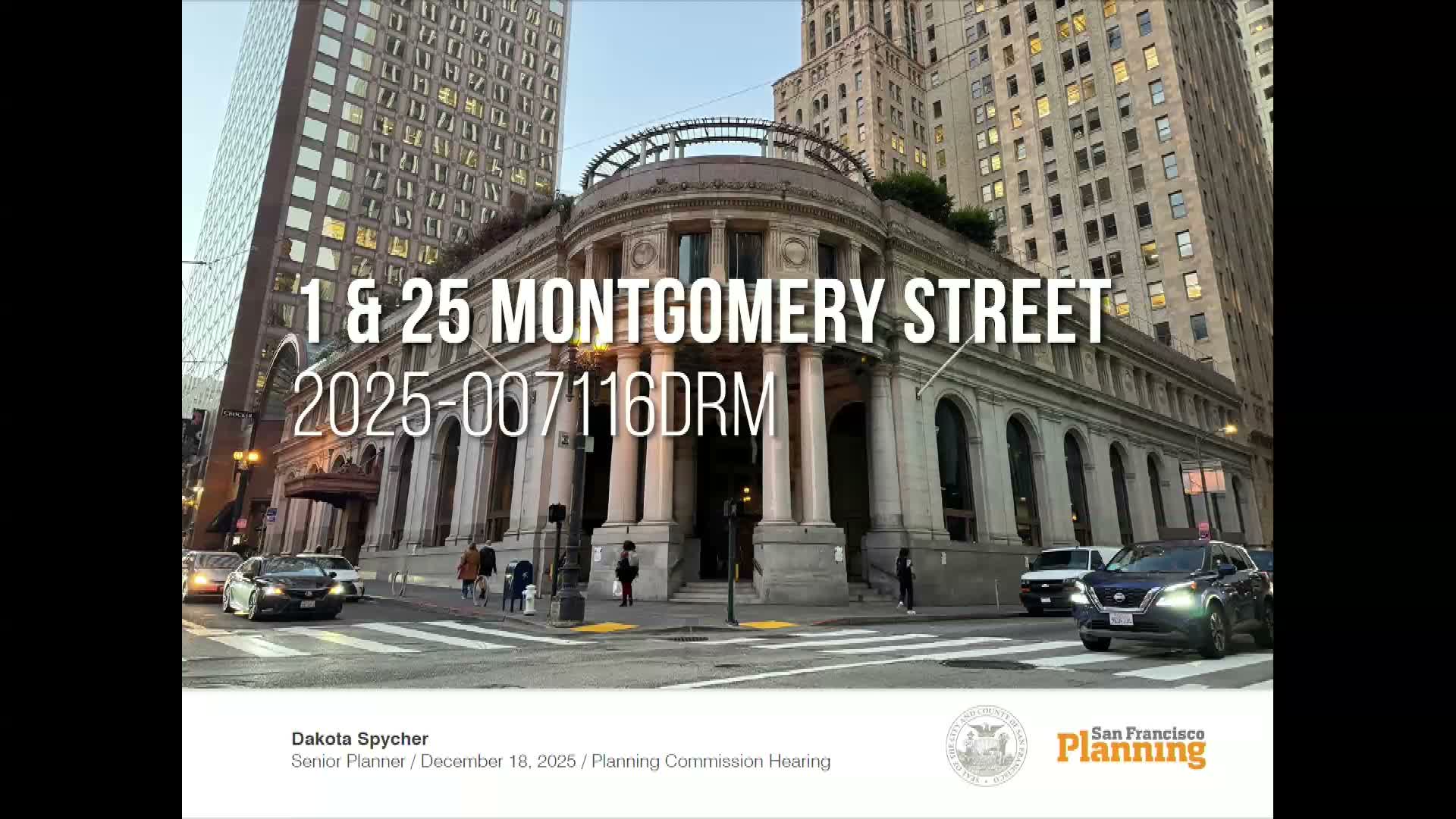
The San Francisco Planning Commission voted 5–1 on Dec. 18 to allow the owner of 1 Montgomery Street to close the rooftop terrace that has been subject to prior public‑access conditions, replacing the rooftop requirement with a package of downtown events and reporting requirements.
Staff told commissioners the rooftop terrace is roughly 7,500 square feet and that the sponsor has agreed to host a minimum number of free public events downtown each year; the original proposal required three downtown events (minimum 1,000 people per event and a cumulative 10,000 attendees annually). During the hearing the sponsor agreed to add a fourth large downtown event and to withdraw an option to pay an in‑lieu fee to permanently release the open‑space obligation.
Dakota Speicher of the Planning Department framed the request as a modernization of an old condition of approval, noting staff had received about 21 letters opposing the change and roughly 30 letters supporting it. Ben Van Houten of the Office of Economic and Workforce Development described similar programming as a tool for downtown recovery and said the department supported the proposed conditions.
Sponsor testimony emphasized security, investment and programming. Ghazi Shami, founder and CEO of Empire (the project sponsor), described plans to convert the landmark building into a mixed cultural and office use and said the rooftop had been closed for years. Shami told the commission the proposal would bring a private investment (described in testimony as about $40 million) and a sustained slate of cultural events that would draw downtown visitors and support small businesses. He also said his offices had experienced security incidents elsewhere and that securing the rooftop entrance, which routes through the tenant space, posed operational problems for an active company: “We want to bring arts and entertainment to an area dominated by tech, AI, and finance,” he said, while adding he had “no desire to ever fee out.”
Supporters at the hearing included numerous labor leaders and community groups who emphasized commitments to union labor, local jobs and apprenticeships. Jay Anthony Menhevar of Norco Carpenters Local 22 said Empire’s project would create union jobs and restore a long‑vacant landmark. Speakers for community organizations said the sponsor had committed to programming that would expand access beyond the downtown 9‑to‑5 office population.
Opponents urged compromise to preserve rooftop access, saying the terrace is one of the city’s premier privately owned public open spaces (POPOS) and warning against setting a precedent for closing public amenity spaces. One commenter urged a compromise that would allow limited closures instead of a full conversion to private access.
Commissioners debated enforcement and precedent. Staff explained the sponsor would submit annual reports with attendance figures and the methodology used to determine attendance; failure to meet conditions would be brought back to the commission for possible revocation of the approval. Commissioners asked how attendance would be estimated; the sponsor said methods could include ticketed RSVPs, photographic sampling and third‑party estimates used at prior events. Planning staff confirmed under the code the monetary in‑lieu fee referenced in materials would be calculated by square footage of removed open space and that the fee option in the packet was an existing code mechanism for other downtown projects.
After an initial tie vote, the sponsor offered to add one more large downtown event per year and to remove the in‑lieu fee buy‑out option from the proposal. The commission then approved the amended motion by a 5–1 vote, with one commissioner dissenting.
The commission’s action changes the public‑benefit condition attached to the original approval for the rooftop terrace. Planning staff will require the sponsor to file annual reports documenting event attendance and methodology; staff said noncompliance would trigger a public hearing before the commission to determine whether to revoke the modified approval and restore public access. The decision does not change Planning Code requirements that govern newly required POPOS in projects that are subject to current code provisions.
The commission adjourned after the vote; staff will monitor compliance and return the item to a future hearing if enforcement is required.