Get Full Government Meeting Transcripts, Videos, & Alerts Forever!
Get email alerts on the Budget topic
No spam. Unsubscribe anytime.
San Francisco DAS warns of sharp budget shortfall; IHSS costs drive pressure
Summary
City and DAS officials told the Department of Disability and Aging Services Commission that a projected $937 million biennial citywide deficit, growth in IHSS MOE costs and federal changes tied to HR 1 create significant pressure on the DAS budget and may force prioritized cuts this year.
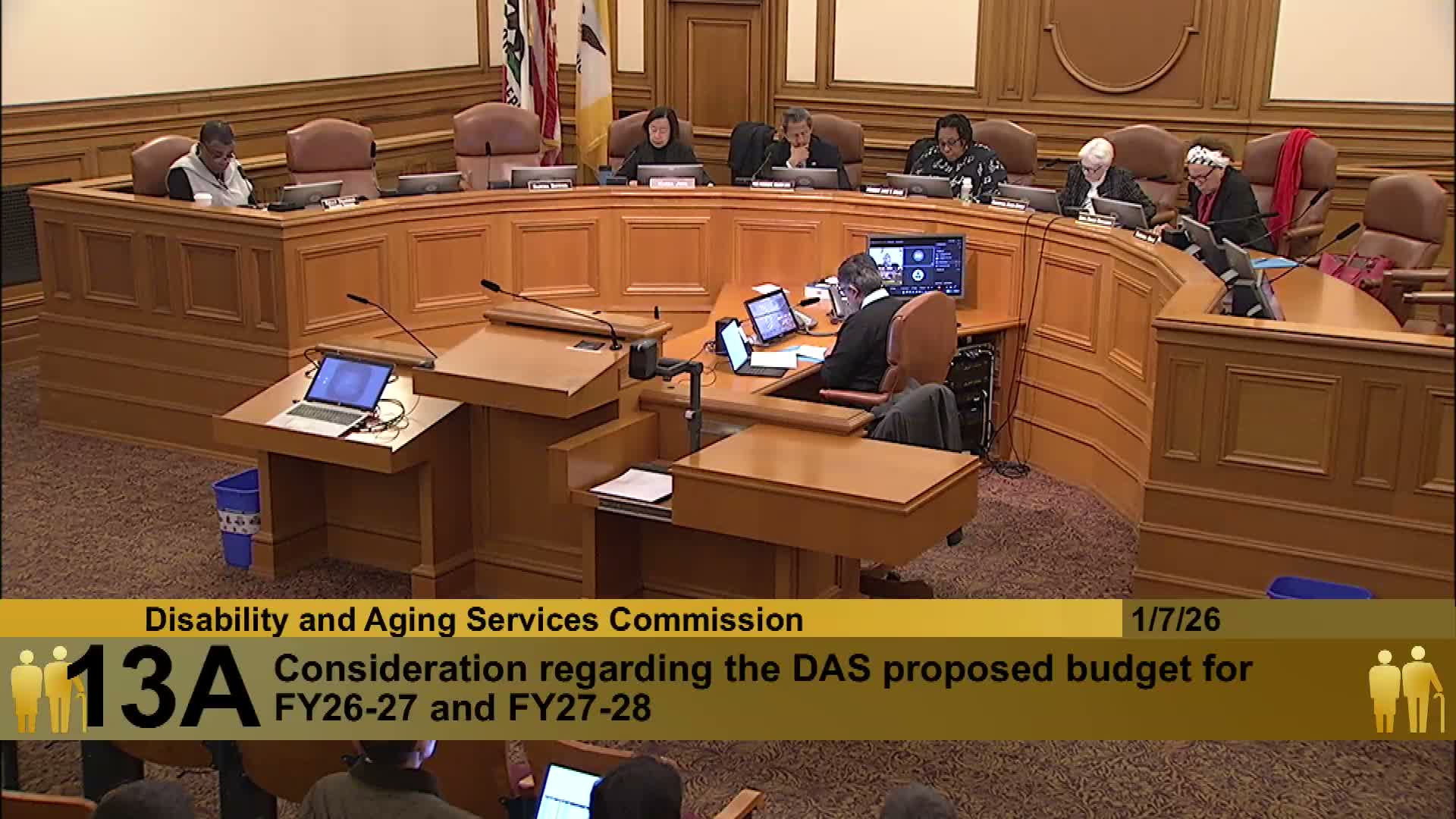
Deputy Director Dan Kaplan and Executive Director Kelly Dearman told the San Francisco Department of Disability and Aging Services Commission on Jan. 7 that the city faces a projected $937,000,000 biennial deficit and that DAS is already bracing for substantial cuts.
The presentation laid out the department's current $548,000,000 budget, noting that IHSS-related aid programs make up roughly two-thirds of DAS spending and that federal, state and local revenues each cover material shares. Kaplan said IHSS-related costs are largely driven by a statutory local maintenance-of-effort (MOE) that grows at 4% annually and by wage and benefits changes negotiated in labor contracts.
"This is going to be a tough budget year," Kaplan said, summarizing a fiscal picture where revenue growth is outpaced by expense growth. He told commissioners the mayor's office has set an initial target of $400,000,000 in ongoing citywide savings and is using a new process that distinguishes "core" services from discretionary ones when identifying reductions.
Why it matters: DAS programs — from IHSS to Adult Protective Services and the public conservator's office — provide services that staff described as central to keeping vulnerable San Franciscans out of institutions. Reductions to grant-funded services, nutrition programs and other discretionary activities could reduce direct supports for older adults and people with disabilities.
Kaplan outlined several drivers of the gap, including potential federal policy changes from HR 1 (federal tax and benefit legislation) that, he said, would reduce federal funding and change eligibility redeterminations for Medi-Cal and CalFresh (SNAP). "HR 1 ... makes some big reductions in many parts of the federal government," Kaplan said, citing potential lost administrative matches and benefit funding that could translate into millions in local shortfalls. Staff said the city expects to learn more when the governor releases the state budget later this week.
Kelly Dearman described program-level impacts and rising caseloads. She said integrated intake and referral increased by 11%, APS reports rose by over 10%, and IHSS caseloads grew by roughly 1,600 people. Dearman also told the commission that the IHSS team addressed a CFCO reassessment backlog such that by November 2025 "99% of the CFCO caseload was compliant."
Commissioners asked how the mayor's office will identify discretionary programs and how community input will be incorporated. Kaplan said the mayor is centralizing the $400 million target and will coordinate with departments to identify least-damaging reductions. Dearman emphasized that many DAS programs are core to the city's health and safety mission and voiced caution about cuts.
Budget specifics cited at the meeting included: a DAS current-year budget of $548,000,000; revenue shares of approximately 24% federal, 37% state and 39% local; a projected IHSS MOE growth estimate of $20,300,000 for fiscal year 2026–27; and a citywide biennial deficit estimate of $937,000,000.
Next steps: Staff said DAS will return with a second, more detailed budget presentation on Feb. 4 and will submit formal budget documents to the mayor's office by Feb. 23 as part of the city's budget process.