Get Full Government Meeting Transcripts, Videos, & Alerts Forever!
Get email alerts on the Public Art Removal topic
No spam. Unsubscribe anytime.
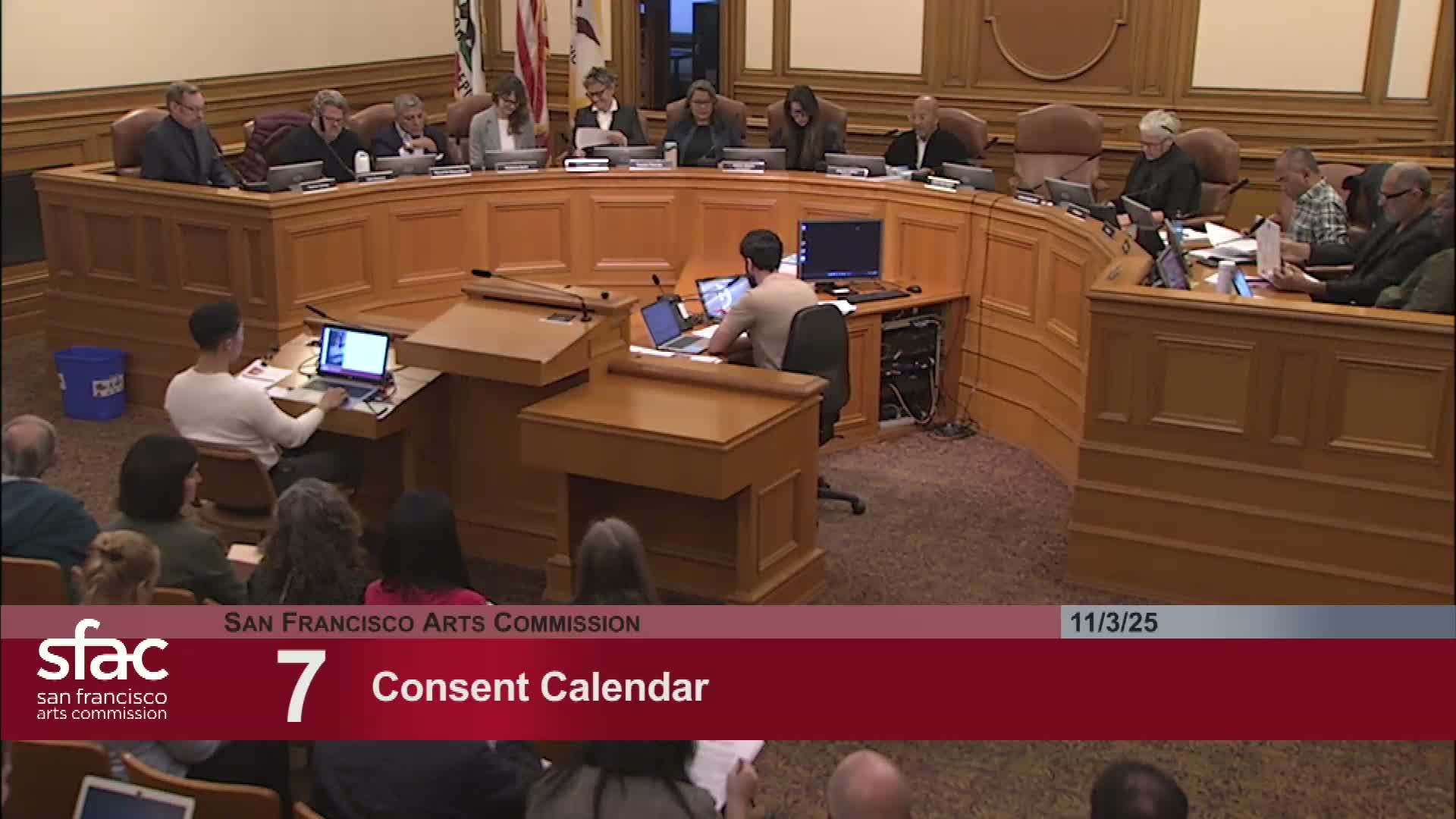
Arts Commission approves emergency removal of Vaillancourt Fountain, citing structural hazards
Summary
On Nov. 3, 2025 the San Francisco Arts Commission voted to approve the emergency removal and off‑site storage of the Embarcadero (Vaillancourt) Fountain by Armand Vaillancourt, citing a structural conditions assessment and a Planning Department CEQA emergency exemption; votes split but the motion carried.
The San Francisco Arts Commission on Nov. 3 approved an emergency motion to remove and place in secure storage the Embarcadero (Vaillancourt) Fountain by Armand Vaillancourt, citing severe structural deterioration and immediate public‑safety concerns.
Ioana Goodwin, project manager for the Recreation and Park Department, told commissioners the 50‑year‑old fountain has suffered "cracking, spalling, corrosion of internal steel" and other damage that makes the structure unsafe to access for maintenance. Goodwin said the fountains final water pump failed in May 2024 and that non‑destructive testing showed missing reinforcement and a missing post‑tensioning rod; she said one cantilevered, 10‑ton concrete arm is now resting on another, introducing unintended loads.
"Taken together with repeated breaches of the citys security measures, these conditions represent a life‑safety emergency," Goodwin said, describing disassembly and secure storage as the only practical way to allow engineers to quantify internal corrosion and evaluate options for restoration, relocation, repurposing or reassembly.
The Department of Building Inspection reviewed and "concurred with the independent structural assessment," Goodwin said. The Planning Department has issued a CEQA emergency exemption for the proposed removal, and staff characterized todays vote as the approval action required for CEQA purposes under San Francisco Administrative Code Section 31.04(h) and the Planning Departments cited CEQA guideline section.
Engineering consultants working for the city said internal inspection is effectively impossible without selective demolition. "The fountain is a composite structure — the steel lining, the concrete encasement and the tension rods are embedded together — and taking out any part without taking down all of it becomes a structural challenge," Jeff Brink of DCI Engineers told the commission.
The Recreation and Park Department estimated full, ground‑up restoration at roughly $29,000,000 and estimated the proposed disassembly and off‑site storage at approximately $4,400,000. Goodwin said disassembly would start no sooner than 90 days after required notice under the California Art Preservation Act and that the city would store and evaluate components for up to three years while options are explored.
The proposal and vote drew sharply divided public comment. Joel Koppel, speaking for the San Francisco Electrical Contractors Association, urged removal on safety grounds: "Someone could easily climb over the fence. Someone could hurt themselves." Several business and downtown groups, including the San Francisco Chamber of Commerce and Advance SF, supported removal and relocation to enable the Embarcadero Plaza/Sue Bierman Park renovation and downtown revitalization.
Opponents warned that removal risks permanent loss. "Keep Vaillancourt in place — this is a reminder of the precariousness of San Francisco," said Bridget Boylan, a nearby resident. Chanel Viancourt, who identified herself as the artists granddaughter, said the possible removal left her "extremely heartbroken" and urged more time and fundraising for restoration.
Some public speakers and commenters questioned the project's timeline and the use of a CEQA emergency exemption. Jack McCarthy and Matt Joseph argued the exemption was inappropriate for a condition they said resulted from long‑term neglect and that removing the fountain may be a premeditated way to avoid fuller environmental review.
After discussion and a roll call, commissioners voted; named aye and nay responses are recorded in the transcript and the chair announced that the motion carried. The action approves removal and off‑site storage of the Vaillancourt Fountain to protect public safety and authorizes the notice required under the California Art Preservation Act; the Planning Departments CEQA emergency exemption was affirmed for this action.
The city said Recreation and Park will fund consultant support, disassembly and secure storage for up to three years; the Arts Commission will retain oversight and review future recommendations for restoration, relocation or other options. Work plans will include documentation, cataloging and photographic records to facilitate potential future reassembly or conservation.
Next steps identified by staff include required notice to the artist and interested parties under the California Art Preservation Act, development of a disassembly plan with a qualified conservator, and a period of testing and analysis while the fountain remains in secure storage. The commission did not vote to deaccession the work from the collection; commissioners emphasized that removal for safety reasons is not equivalent to permanent removal from the public art inventory.