Get Full Government Meeting Transcripts, Videos, & Alerts Forever!
Get email alerts on the Infrastructure Policy topic
No spam. Unsubscribe anytime.
Public Works director outlines new vending penalties, tree in-lieu option and $535M earthquake bond plan
Summary
Director Carla Short told the commission the Board of Supervisors approved local implementing legislation for a state vending law (signed by Mayor Lurie), described a developer tree-planting in-lieu fee proposal under the Permit SF reforms, and previewed a proposed $535 million EASER 2026 bond for seismic upgrades and first-responder facilities.
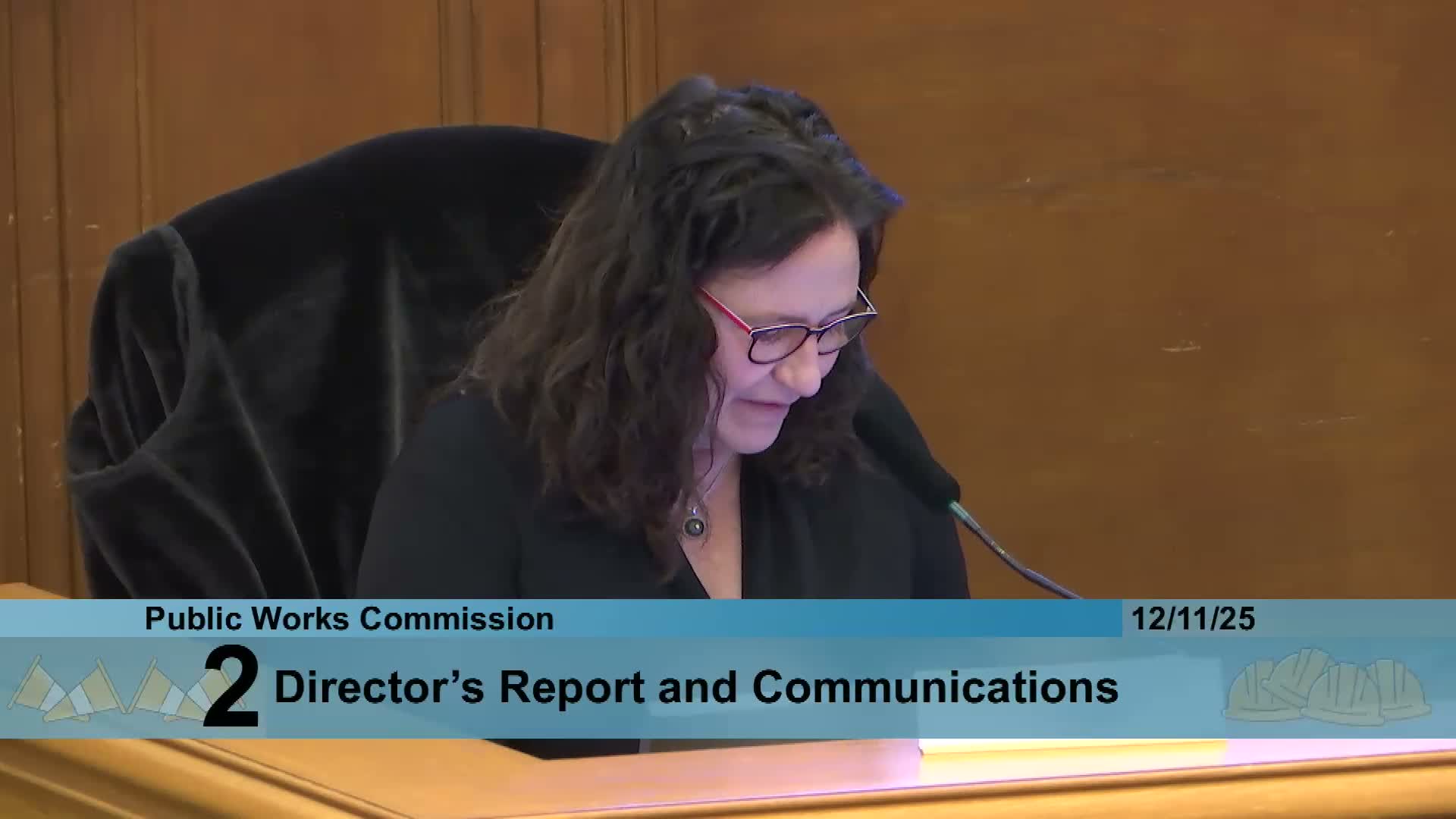
Carla Short, director of San Francisco Public Works, used the commission’s Dec. 11 informational item to highlight policy changes and capital plans the department expects to carry into 2026.
Short said the Legislature’s recent state bill expanding tools to address illegal sidewalk vending required accompanying local legislation. “The board gave final approval to the legislation this week and Mayor Lurie signed it into law yesterday,” Short said, describing an enforcement ladder that begins with written warnings and escalates (within an 18-month window) to infractions and, for fourth or subsequent violations, misdemeanor charges punishable by up to six months in jail and fines not to exceed $1,000.
Short also described proposed Permit SF reforms supported by the mayor that would give developers a new option when projects trigger tree-planting requirements: instead of planting on-site, applicants could pay an in-lieu fee that the city would use to plant trees in neighborhoods with the greatest need. “Our tree planting requirements remain,” Short said, “but larger projects may choose to pay the in-lieu fee rather than go through a multistep permitting process.” She added the city may still plant in front of the paying property, but is not required to do so; the approach is intended to increase strategic investment in underserved areas.
On capital planning, Short highlighted the capital planning committee’s approval of a proposed $535,000,000 Earthquake Safety and Emergency Response bond dubbed EASER 2026. If authorized by the Board of Supervisors, the measure would go to voters and fund seismic upgrades, repairs and replacements for first-responder facilities and critical infrastructure, including a replacement for the nearly 110-year-old Potrero Bus Maintenance and Storage Yard to preserve Muni’s post-quake transit capacity.
Short also noted personnel and program updates: the department received a platinum well-being award; staff filled several key superintendent roles (including Maura Wayne as building and street repair superintendent); and Public Works partnered with community groups to plant 15 trees in South of Market as part of volunteer events.
Why it matters: the vending enforcement change expands local penalties tied to a state bill; tree in-lieu fees shift planting decisions toward a citywide equity lens; and the EASER 2026 bond would be a major capital ask for voters that funds seismic resilience for public safety assets.
Next steps: the Board of Supervisors will consider the tree/permit changes and the EASER 2026 bond must be authorized by the Board to reach the ballot.