Get Full Government Meeting Transcripts, Videos, & Alerts Forever!
Get email alerts on the Electric Vehicle Transition topic
No spam. Unsubscribe anytime.
Public Works warns EV rules collide with San Francisco’s steep hills and aging fleet
Summary
Public Works’ fleet manager told the Sanitation and Streets Commission that state and local rules requiring zero‑emission purchases are straining an aging, customized municipal fleet: many electric models fail on steep streets, procurement lead times are years long, and charging infrastructure and credit allocation remain unresolved.
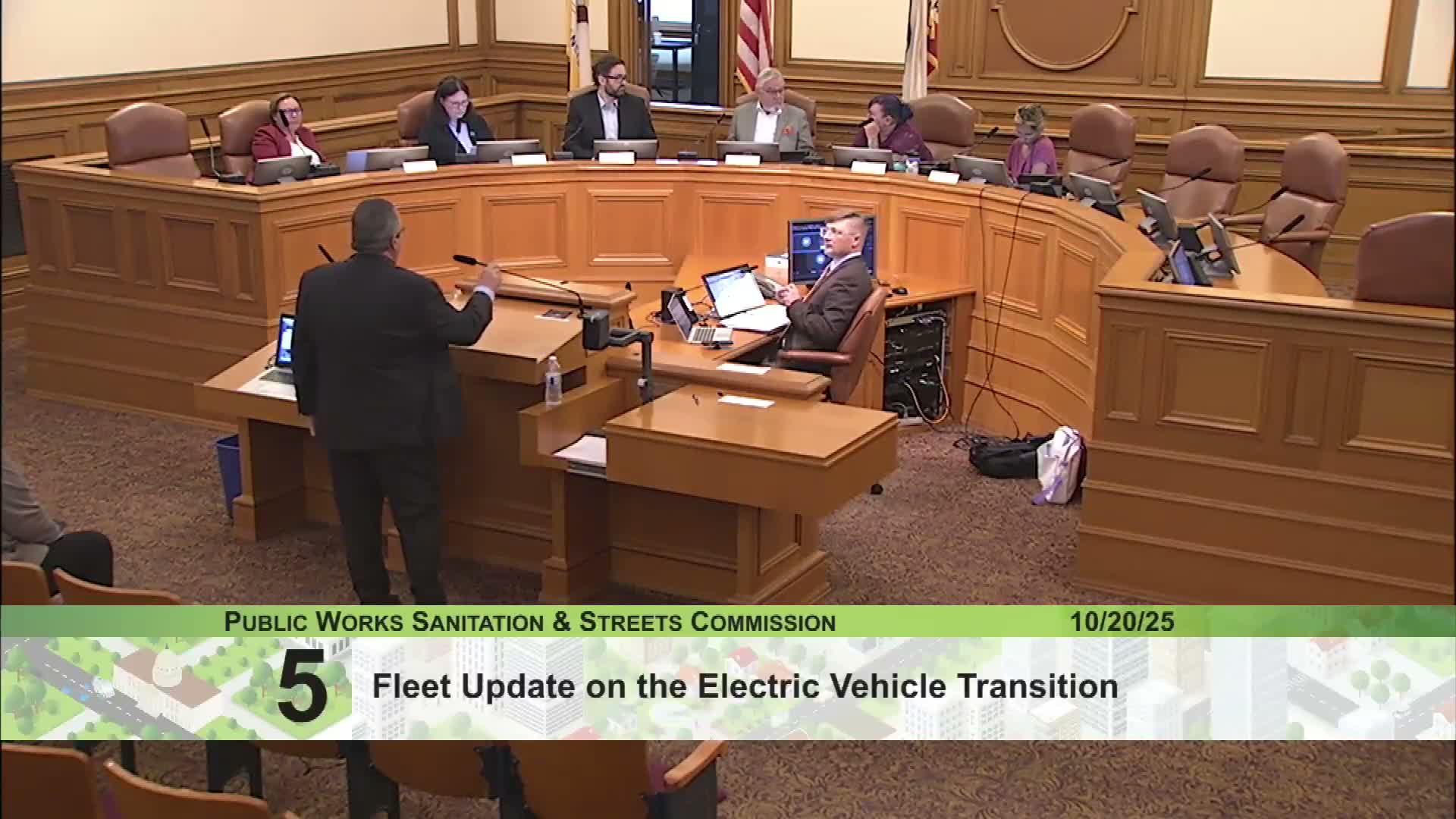
John Leal, heavy equipment operations supervisor, told the Sanitation and Streets Commission on Oct. 20 that statewide and local rules are forcing major changes to the city’s vehicle acquisitions but that technical, procurement and infrastructure barriers remain.
Leal said California Air Resources Board rules and a Board of Supervisors clean‑air requirement now require the city to buy zero‑emission vehicles for many new purchases: "starting January 2027 we'll have to purchase all electric vehicles 100%." He warned that some electric replacements tested so far cannot operate safely on San Francisco hills: "We have tested a lot of sweepers and they won't make it up the hills — they make it up the hill but they won't stop and start back again going up the hill." The inability to restart on grades, he said, poses operational and safety risks for field crews.
Why it matters: the city runs a large, specialized fleet with long‑lived equipment and many bespoke vehicle needs. Leal said the fleet program manages roughly 1,000 vehicles and a multi‑million‑dollar fuel and maintenance budget; many units are decades old and replacements often require custom buildouts, which lengthen delivery times.
Leal described two procurement paths: vehicles on existing city contracts follow about 13 steps and typically take roughly a year and a half from approval to service; specialized equipment not on contract can require about 19 steps and take three to five years. "So it's just a nonstop process," he said, noting the department still receives equipment ordered years earlier. That timeline, he said, complicates compliance with near‑term purchase mandates.
Commissioners and staff pressed on practical gaps beyond vehicle availability: electric pickups on the market are often unibody or have smaller beds that cannot accept municipal dump beds; many heavy pieces of equipment (backhoes, loaders, cement mixers) have no readily available EV versions; and charging capacity at operations yards is already constrained. Leal said the city has a short‑term arrangement to use Blue Dot’s public charging network but cautioned that the network lacks capacity for the fleet’s scale and that charging during paid shifts raises labor‑law and scheduling concerns.
Leal also raised a regulatory credit issue: San Francisco earns "credits" when departments purchase EVs; if other city departments hold credits, Public Works may be unable to buy the ICE replacements it needs now. He suggested centralized coordination of credits so needed purchases can proceed.
What’s next: staff said these topics are on a citywide EV working‑group agenda and that the commission requested a future update after the joint January budget meeting to outline procurement, charging, and funding plans.
The commission did not take any formal action on the EV briefing; the discussion concluded with staff agreeing to return with additional details as they coordinate with city partners and unions.