Get Full Government Meeting Transcripts, Videos, & Alerts Forever!
Get email alerts on the Early Intervention topic
No spam. Unsubscribe anytime.
SFPD early intervention system shows alerts concentrated in Tenderloin, Tenderloin and Southern top indicators
Summary
SFPD’s Early Intervention System (EIS) reported 555 indicator points in Q1 and 562 in Q2 of 2025, with Tenderloin generating the largest number of alerts; department staff said EIS is non‑punitive and used to prompt station‑level supervisor interventions, but commissioners pressed for clearer ways to measure effectiveness.
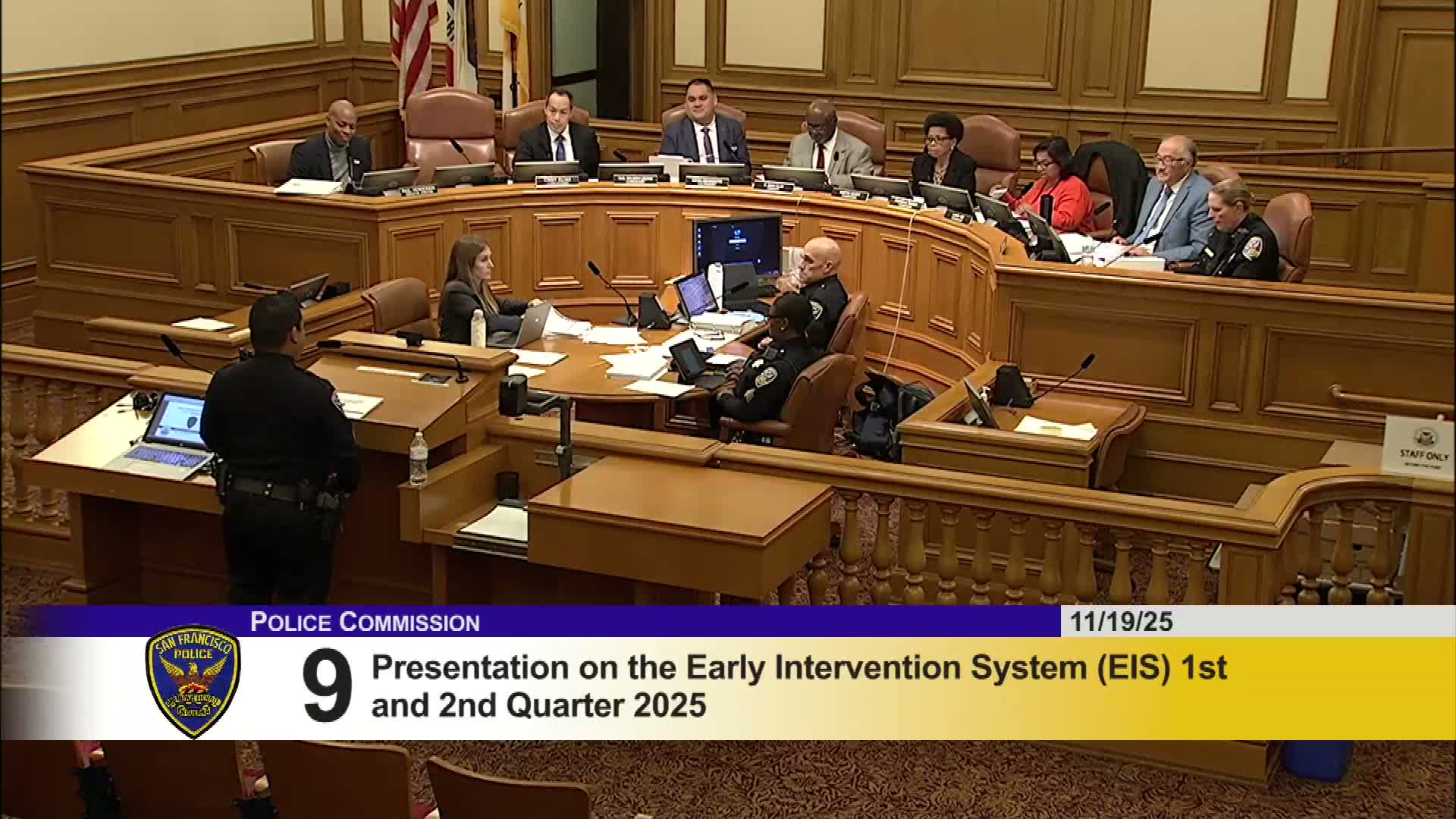
SFPD Sergeant Darren Naval presented the department’s Early Intervention System (EIS) data for the first two quarters of 2025 at the Police Commission’s Nov. 19 meeting. Naval said the system recorded roughly 555 indicator points in Q1 and 562 in Q2; indicators include uses of force, officer‑involved shootings, vehicle pursuits and other tracked events.
Naval reported that Tenderloin Station accumulated the most indicator points (104 in Q1, 146 in Q2) and that Southern Station was among the higher‑scoring stations in Q2 (85). The EIS generated 198 alerts in Q1 (from 149 members) and 206 alerts in Q2 (from 147 members). Naval emphasized that EIS is intended to be non‑punitive: alerts are meant to inform supervisors so they can address potential issues before an adverse event.
Commissioners asked how the department evaluates whether EIS prevents adverse events and how station‑level performance improvement plans (PIPs) are tracked. Naval said PIPs and interventions are handled at the station level and are not currently aggregated in a force‑wide public report. He also confirmed that the department is evaluating Benchmark (the current vendor) and other vendors for data capture and is working toward better system integration; SFPD is also negotiating a new records management system that may help de‑silo data.
Director Paul Henderson and other commissioners urged clearer public reporting on interventions and how the department measures the EIS’s effectiveness. Sergeant Naval said analysts are working on metrics and acknowledged the difficulty of proving negative outcomes (that an intervention prevented a later adverse event).