Get Full Government Meeting Transcripts, Videos, & Alerts Forever!
Get email alerts on the Transit Funding topic
No spam. Unsubscribe anytime.
SFCTA highlights SB 63, safety cameras, vehicle purchases and Caltrans rehabilitation projects
Summary
At its Oct. 28 meeting, the San Francisco County Transportation Authority noted Gov. Newsom signed SB 63 and discussed regional funding prospects, SFMTA safety camera results, recent vehicle purchases and upcoming Caltrans freeway rehabilitation work.
At its Oct. 28 regular meeting, the San Francisco County Transportation Authority chair and executive director highlighted recent state action and local project work that they said will affect transit operations and street safety.
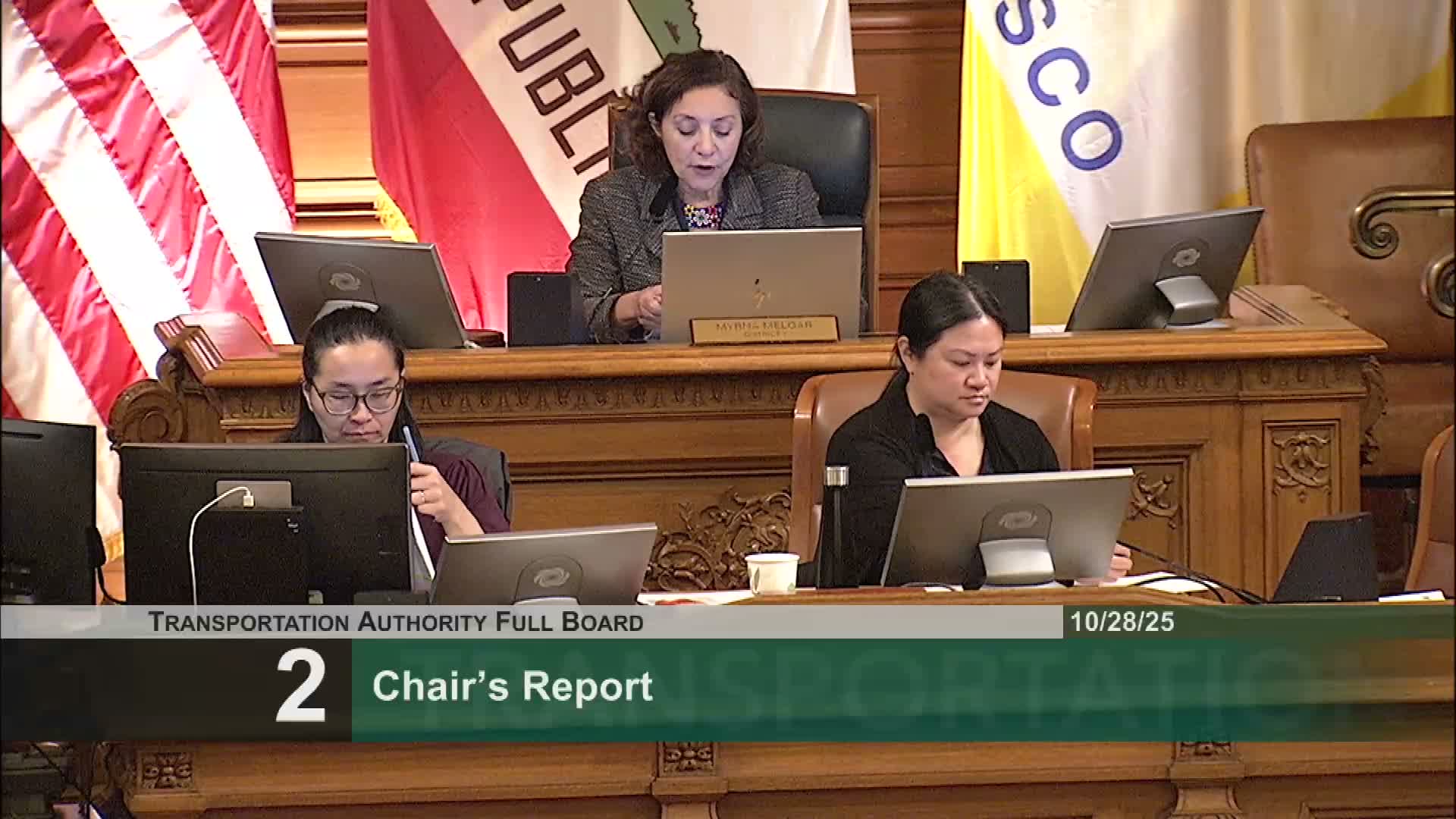
Chair Mirna Melgar opened by thanking Gov. Gavin Newsom for signing SB 63, saying the bill “will allow voters to consider approval of transit operating funds to sustain and enhance Muni, BART, Caltrain, and other critical transit services across the Bay Area, next year.” Melgar also noted regional coordination on a possible local Muni parcel‑tax measure and thanked regional partners for their work.
Executive Director Chang told the board SB 63 “will be a lifeline, of course, to maintain and improve transit across the region,” and said state lawmakers and transit operators are discussing bridge loans to cover short‑term operating needs until any new revenue measures take effect.
The board heard preliminary safety and delivery results from local agencies. Melgar cited SFMTA’s speed safety camera program and reported “a decrease in speeding of 72% on average at the monitored locations.” She also said the Geary Boulevard quick‑build project is showing about a one‑third reduction in collisions along that corridor.
Chang updated the board on vehicle procurements supported by local sales tax programs: SFMTA placed 30 new 32‑foot neighborhood buses into service with $16,200,000 in sales tax funding, and 18 new paratransit vehicles entered service with $2,300,000 in local funds; one paratransit vehicle is electric and will be tested for battery range and maintenance needs. Chang also said BART received 54 expansion cars as part of its core‑capacity fleet and that the authority provided $35,000,000 in Prop L funds toward vehicle purchases.
On state‑led highway work, Chang described a multi‑year Caltrans rehabilitation program starting in San Francisco with repaving on 19th Avenue and the US‑101 hospital‑curve (Bayshore) project. He said initial work will include overnight lane shifts and the agency will hold community outreach (a Caltrans presentation was scheduled that evening at the Potrero Hill Neighborhood House).
Why it matters: SB 63, if placed on a ballot and approved by voters, would create a new source for operating support across Bay Area transit agencies. Local investments in vehicles, safety cameras and quick‑build projects are intended to improve reliability and reduce collisions, but the board signaled ongoing need for coordination with state agencies on funding and construction impacts.
Next steps and outreach: Plan Bay Area 2050 staff are expected to present to the board in November; a Plan Bay Area webinar was scheduled Oct. 29, and a District 2 quick‑build survey is open through Nov. 15. Caltrans outreach on the US‑101 hospital curve project was scheduled the same evening.