Get Full Government Meeting Transcripts, Videos, & Alerts Forever!
Get email alerts on the Regional Planning topic
No spam. Unsubscribe anytime.
MTC presents Plan Bay Area 2050+ to SF Transportation Authority, acknowledges big fiscal trade-offs
Summary
MTC/ABAG officials outlined Plan Bay Area 2050+, highlighting a Transit 2050+ vision, targeted growth geographies in San Francisco, an $80 billion transportation revenue shortfall since 2021 forecasts, and a resilience project list that estimates roughly $27 billion needed in San Francisco for sea-level rise protections.
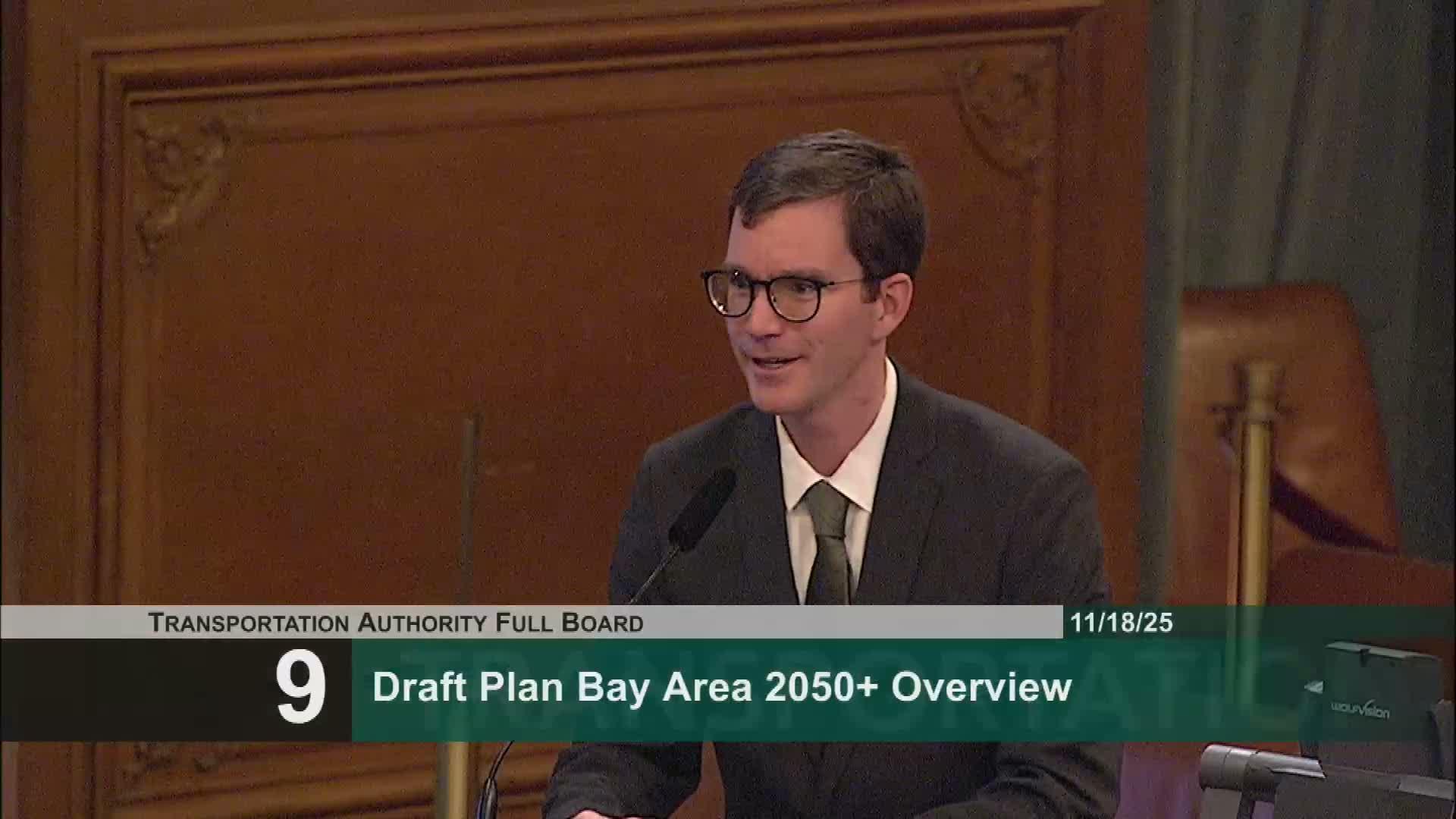
Dave Vaughton, director of regional planning for the Metropolitan Transportation Commission (MTC) and the Association of Bay Area Governments (ABAG), presented Plan Bay Area 2050+ to the San Francisco Transportation Authority on the plan's goals, fiscal limits and near-term priorities.
Vaughton said the update is a focused iteration of the 2021 plan intended to guide transportation, housing, economic development and environmental resilience across the Bay Area. "Plan Bay Area 2050 plus seeks to create a more affordable, connected, diverse, vibrant, and healthy Bay Area for all who call it home," he said. He described the plan as a "regional vision" that does not override local land-use authority or allocate money directly to projects.
Why it matters: the plan establishes a blueprint for where the region will prioritize housing and transit investment over the next 25 years and feeds into possible regional ballot measures. Vaughton told the board the region is facing substantially lower revenue than previously forecast: "This cycle, they were $80,000,000,000 less than expected," prompting trade-offs on what the plan can fund.
Key details: Vaughton highlighted several elements relevant to San Francisco. The plan identifies "growth geographies" where the region expects about 95% of new homes and 72% of new jobs; much of San Francisco is designated a growth geography. Transit priorities include a Transit 2050+ vision that emphasizes fast, frequent, all-day service and includes strategies such as a five-minute Muni network within the city and frequency increases for regional rail including Caltrain. He noted the plan would devote roughly three-quarters of funding to operations and maintenance, 16% to building the fast-frequent network, 8% to climate initiatives and local active-transportation investments, and just under 1% to freeway capacity projects.
On resilience, Vaughton said the plan includes a resilience project list to address up to 4.9 feet of sea-level rise and estimated San Francisco's funding need at about $27,000,000,000 to protect key waterfront areas including the Embarcadero, Hunters Point, Treasure Island and Ocean Beach.
Public reaction and next steps: Chair Mirna Melgar asked how the plan connects to OBAG (One Bay Area Grant) funding and to any potential regional revenue measure. Vaughton said OBAG is one of the funding sources that can help implement strategies and that a potential 2026 regional measure would focus primarily on keeping existing transit systems running as a prerequisite to any system expansion. Vaughton said the draft plan, draft EIR and draft implementation plan were released for public review earlier in the fall and that the public comment period closes December 18; he said the commission and board could consider final action in early 2026.
Public comment at the meeting included both support and objections. San Francisco resident Dan Stedjink urged the board to support the plan locally but warned it may be a poor fit for other counties; Elizabeth Henry of Shift Bay Area and Catalyst said the plan's population projections and outreach claims were "totally unrealistic" and that she only learned of the draft in October.
What happens next: MTC and ABAG will continue public engagement through the CEQA process and consider revisions before a potential winter 2026 action by the commission and board.