Get Full Government Meeting Transcripts, Videos, & Alerts Forever!
Get email alerts on the Capital Planning topic
No spam. Unsubscribe anytime.
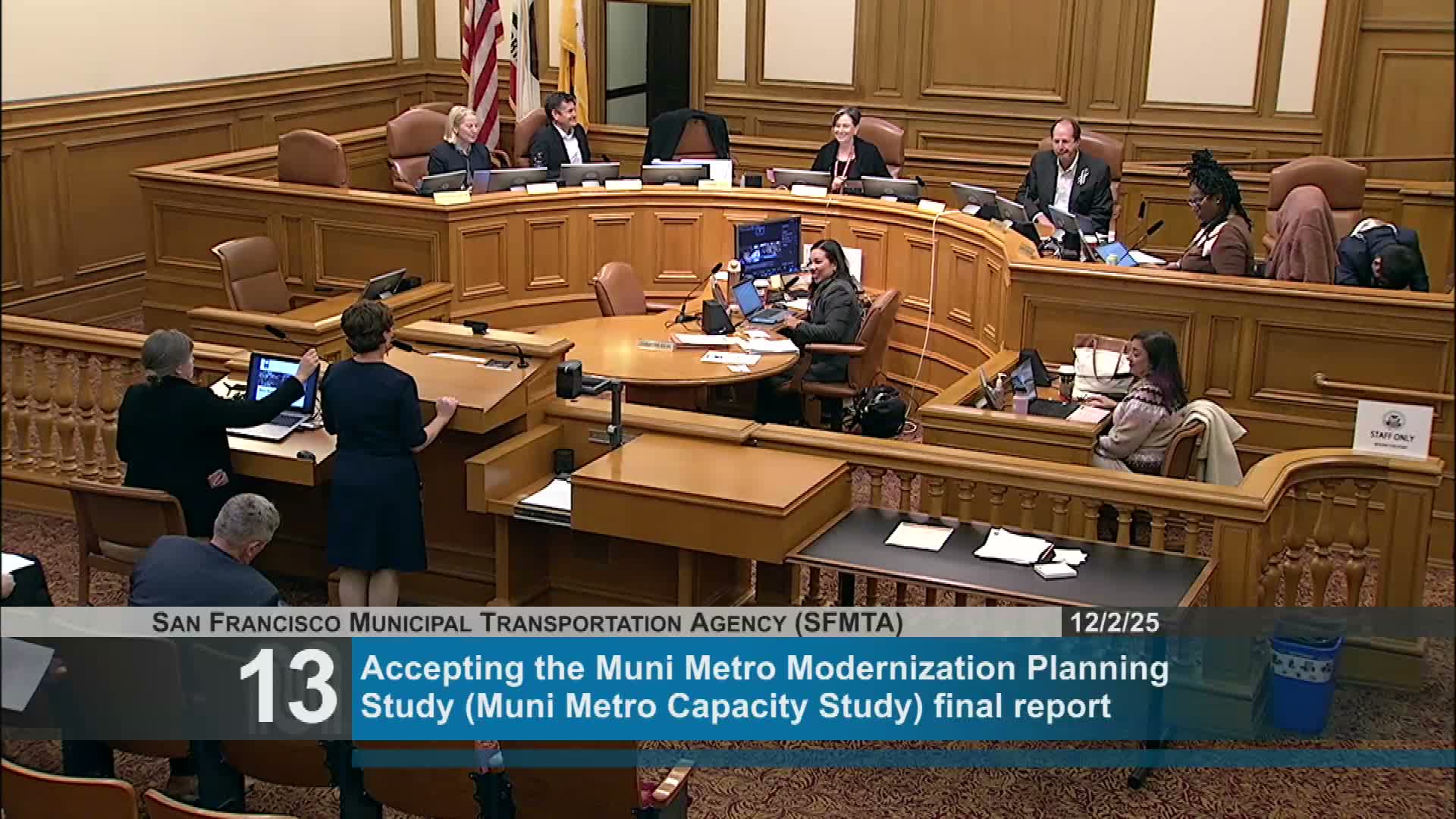
Board accepts Muni Core Capacity Study to pursue long-range upgrades, including planning for 3-car trains
Summary
Board accepted a 10'15-year core-capacity study recommending asset renewal, expanded transit-priority infrastructure and planning for three-car trains on the M and N lines to address projected peak-period crowding and to position the agency for large federal Core Capacity grants.
Planning staff presented a 10'15-year capital-program study focused on the Muni Metro system'wide capacity and aging-infrastructure needs and the board voted to accept the final report as a planning milestone.
Staff framed the study around three major elements: (1) rail asset and infrastructure renewal on surface corridors, (2) expanded transit-priority infrastructure such as signal priority and signal upgrades where stop-controlled intersections impede reliability, and (3) planning and infrastructure work to support 3-car trains on the M (Ocean View) and N (Judah) corridors to add 50% capacity per train slot where needed. "Every train that goes from 2 cars to 3 cars is 50% more capacity for that slot in the subway," a staff presenter stated.
The study uses ridership scenarios (low, medium, high) to prioritize investments that would be needed in different growth outcomes and emphasizes flexibility and staged planning. Staff noted the study is an important planning milestone for pursuing Federal Transit Administration Core Capacity grant opportunities that can be large (staff noted grants could bring in "1000000000 dollars plus"). The board accepted the report after public comment in support from working-group members and transit advocates.
Acceptance of the study does not commit the agency to specific projects today; it authorizes additional planning and moves the study recommendations into subsequent project development and community outreach steps required by federal project-development pipelines.