Get Full Government Meeting Transcripts, Videos, & Alerts Forever!
Get email alerts on the Fare Policy topic
No spam. Unsubscribe anytime.
SFMTA outlines fare, cable-car and parking changes to close budget gap
Summary
SFMTA staff proposed fare-policy changes including fare capping, ending the Clipper discount, a $15 "Cable Car Plus" pass, decommissioning Muni Mobile and targeted parking adjustments, estimating about $10.3 million in new revenue in year one and $19 million in year two; board members and advocates raised equity and data concerns.
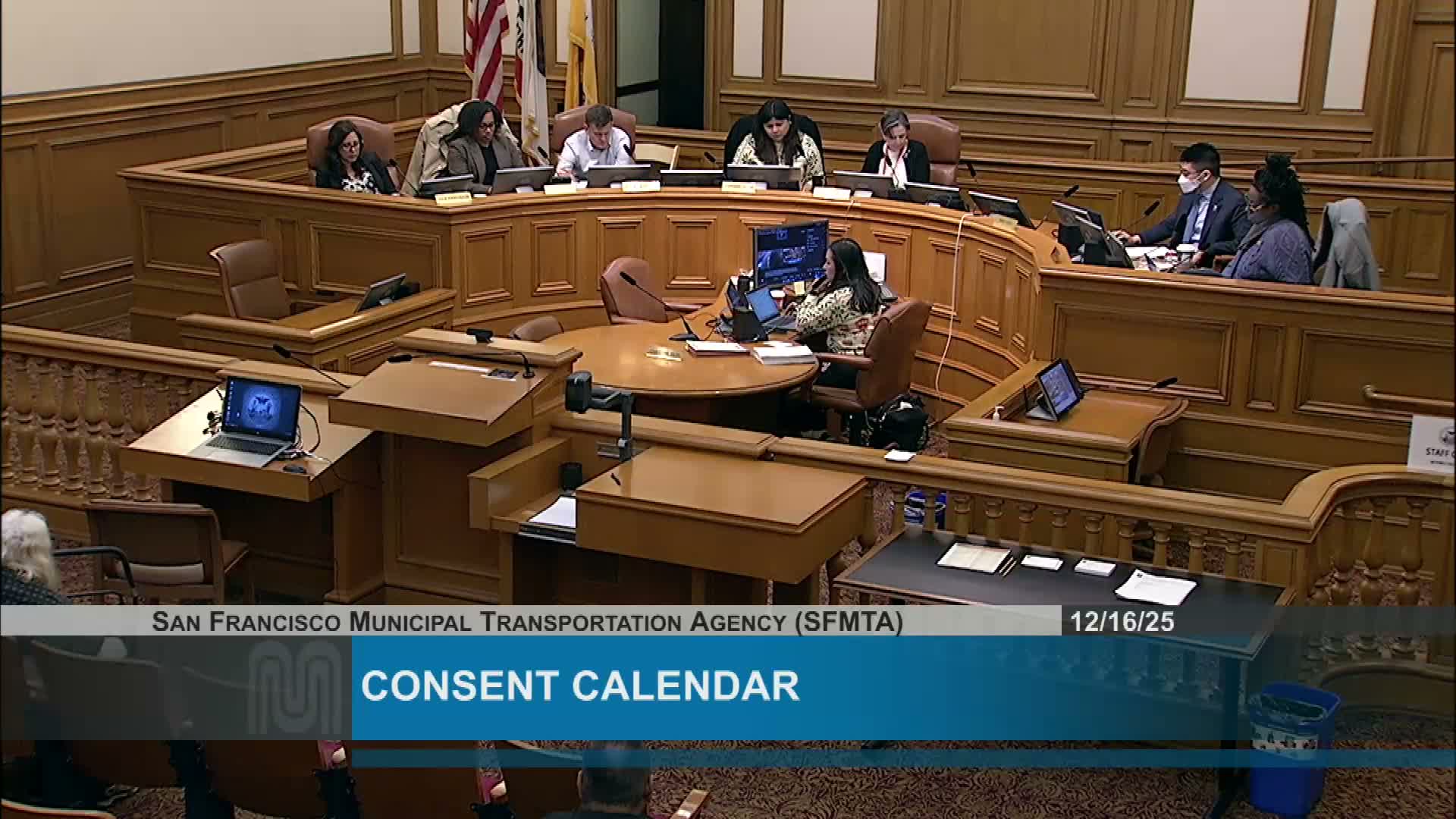
The San Francisco Municipal Transportation Agency on Tuesday presented a package of fare and parking proposals aimed at narrowing a projected budget shortfall and simplifying payments for riders.
Diana Hammonds, director of revenue development and reporting for the MTA, told the Board of Directors the proposal bundles several measures: implementation of fare capping, elimination of the long-running Clipper discount, decommissioning the Muni Mobile app in favor of Clipper 2, a proposed $15 ‘Cable Car Plus’ pass that would cover one or two cable-car trips plus Muni rides, and modest, targeted parking revenue changes. Hammonds said the combined measures are estimated to generate about $10.3 million in the first year and $19 million in the second year of the budget cycle.
Why it matters: The agency said the changes are intended to stabilize long-term operating revenue as ridership and costs evolve. Hammonds framed the package as a mix of internal savings and new revenue sources that work together with an anticipated regional sales tax and a local parcel tax proposal the agency is developing.
Key proposals and numbers - Cable Car Plus: Replace the $9 single-ride cable-car ticket with a working proposal for a $15 pass that can be used for one cable-car trip or two and for unlimited Muni rides that day; staff said the change would improve cost recovery on a service that covers less than half its operating cost under the current single-ride price. Hammonds described the change as: "to replace this with a single option of a $15 pass that you can use for 1 cable car trip, or you can use it for 2." - Fare capping and Clipper changes: Staff recommended fare capping (a daily cap after two trips) and also proposed eliminating the Clipper discount in the first year and resuming indexing in year two; Hammonds said the recommended fare package could yield roughly $7.7 million in year one and $10.7 million in year two when combined with other measures. - Muni Mobile decommissioning: With Clipper 2 enabling tap-to-pay and credit-card acceptance at the fare box, staff estimate approximately $1.6 million in annual savings by retiring the agency's standalone mobile purchase app and consolidating on Clipper. - Parking revenue: Small, staged parking meter increases (an additional $0.25 in the second fiscal year), increases to late-payment penalties (keeping base fines largely unchanged), higher meter-use fees for construction and a pass-through model for online credit-card fees were proposed; selective reductions were recommended for several commonly contested citations (for example, reducing a curb-your-wheels citation from $73 to $48). Parking proposals were estimated to generate about $3.3 million in year one and $8.3 million in year two.
Public response and board questions Public commenters and transit advocates generally welcomed some measures, such as fare capping, but expressed strong concerns about the $15 cable-car pass and the impact of fare and metering changes on low-income riders. Dylan Fabris of San Francisco Transit Riders said the group supports fare capping but warned a $15 cable-car price could suppress spontaneous local trips. Multiple speakers urged stronger enforcement of loading zones and raised questions about how parcel-tax revenue estimates climbed dramatically in staff presentations and media reports.
Board members pressed staff on data and equity. Director Chen and others asked how often tourists take multiple cable-car trips in a day; Hammonds said reliable data are limited because many visitors use paper tickets and historic systems did not capture repeat rides. Directors also asked about sequencing and communications: staff said decommissioning Muni Mobile is primarily a communications and transition task and that some fare changes could be phased to align with the budget schedule, potentially as early as Sept. 1 under the next fiscal cycle.
Next steps Hammonds said staff will return with more detailed pricing scenarios and implementation timelines at a board workshop and in January's follow-up materials. Several directors asked staff to model family or visitor packages and to clarify impacts for Lifeline, youth and senior riders. The board did not adopt any fare or parking changes at Tuesday's meeting; staff sought initial feedback to refine proposals ahead of the April budget approval and May submission to the mayor.