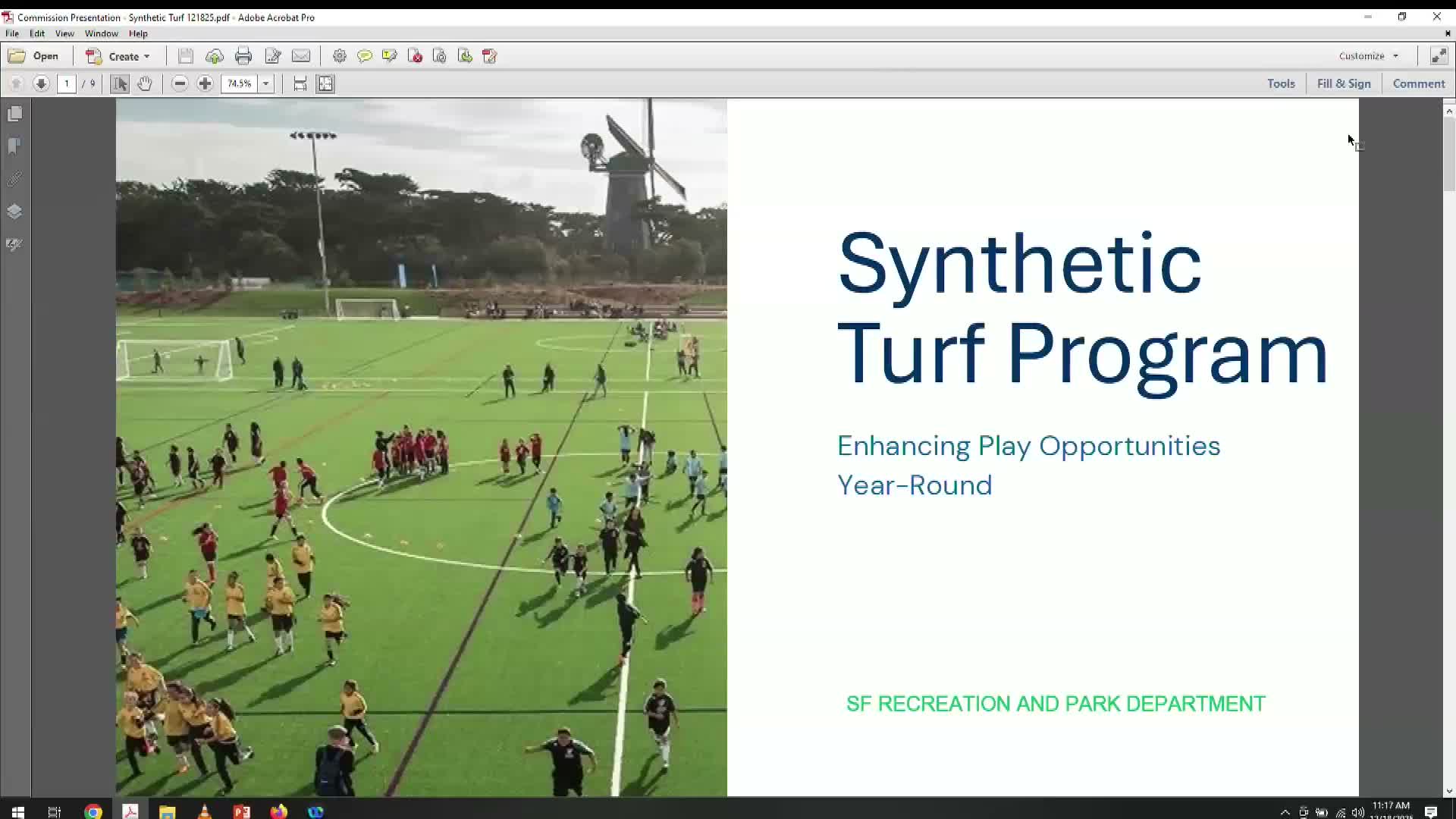
Rec and Park defends current turf testing protocols as community presses for stricter PFAS and microplastics review
Loading...
Summary
The commission heard a technical briefing on synthetic turf testing, recycling and product changes, and received sustained public concern about PFAS, microplastics, heat and tree removal at Crocker Amazon; staff committed to an interagency protocol review and a follow-up in the new year.
The San Francisco Recreation and Park Commission spent a large portion of its meeting reviewing the department’s synthetic turf standards and hearing residents’ concerns about a proposed Crocker Amazon project.
At the start of the discussion Dan Maurer, capital planning manager for Rec and Park, described the agency’s long experience with artificial turf, noting the department has 12 synthetic fields and has moved away from crumb-rubber infill toward cork and sand “since about 2017.” He said the city performs third‑party lab testing of turf materials for heavy metals, SVOCs, PAHs, PFAS and other constituents before approving products and that Rec and Park has pursued mechanical recycling processes rather than chemical recycling for old turf.
“Every time we do a new project I commission David to come forward and help us, update our policies and procedures,” Maurer said, referring to the department’s external consultant. “We test fields and field product materials prior to doing a project.”
Dr. David Teeter, the department’s long-time environmental consultant, told commissioners the department uses modified Department of Toxic Substances Control screening levels and EPA regional screening levels as benchmarks and described the city’s testing protocols as among the most stringent in the U.S. “We test for heavy metals, semi‑volatile organic compounds, PFAS,” Teeter said. “Our testing protocols are constantly evolving with new regulations and as new methods come online.”
Community members who spoke during public comment said the testing and recycling assurances still fall short. Speakers raised worker safety, microplastic shedding, PFAS exposure, heat-island effects and the planned removal of hundreds of trees in Crocker Amazon as key concerns.
“You can’t just pass on our pollution overseas,” one speaker said, criticizing recycling claims and noting turf removed from a Franklin Square project was shipped abroad. Another caller urged a moratorium on new plastic fields, arguing the “cure is worse than the problem.”
Commissioners acknowledged the depth of public concern and asked for clearer timelines and specifics about what the department tests. Commissioner Williams (who has environmental expertise) recommended a staff-led review of the department’s PFAS testing parameters and the broader specification, and offered to work with staff to codify next steps.
Rec and Park committed to convene city agencies, including the Department of the Environment and the Public Utilities Commission, to review testing and percolation plans and to return with a more detailed timeline and protocol review in the coming months. Maurer said much of that work will resume after the holiday period.
The commission did not take an immediate policy vote; commissioners instructed staff to continue the interagency review and to provide a clearer public update on the testing scope and schedule.