Get Full Government Meeting Transcripts, Videos, & Alerts Forever!
Get email alerts on the Wastewater topic
No spam. Unsubscribe anytime.
County adopts 10‑year wet‑weather design storm as wastewater planning standard
Summary
Public utilities staff told the commission a 10‑year design storm balances cost and protection; the board unanimously adopted the 10‑year wet‑weather level of service to guide sewer collection, rehabilitation and capacity planning.
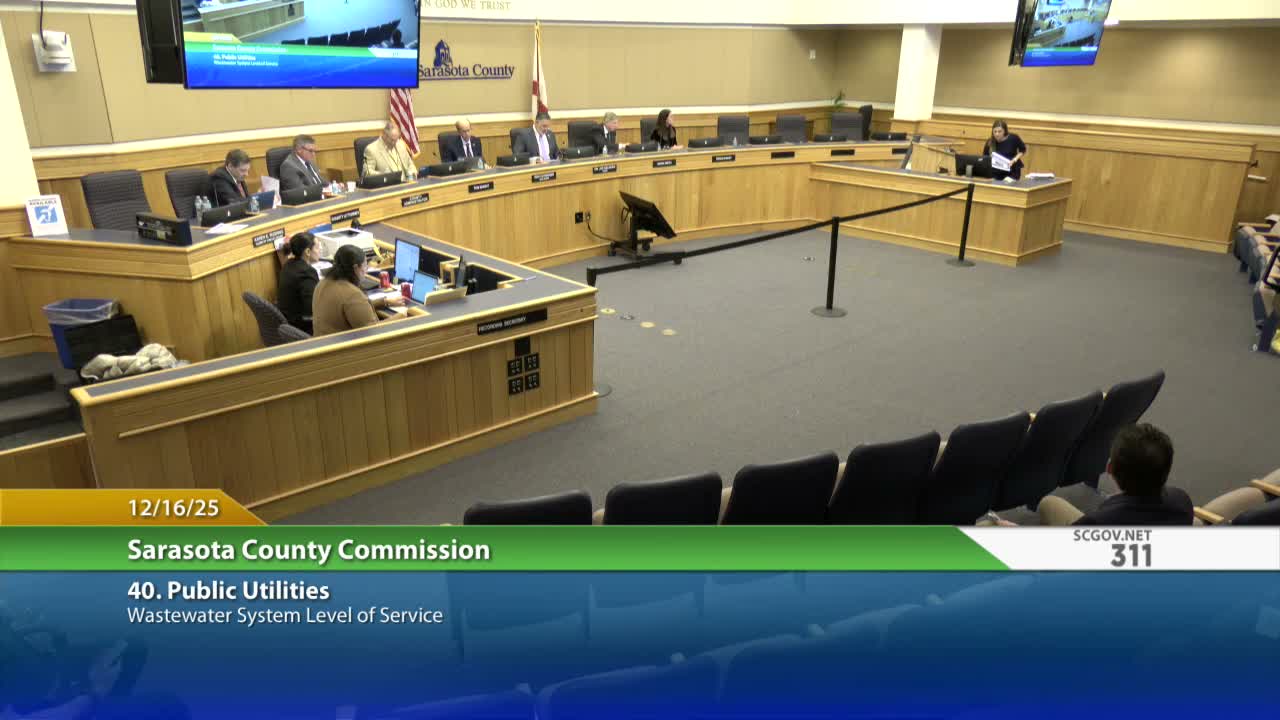
Sarasota County on Dec. 16 adopted a countywide wet‑weather design standard for wastewater collection systems, endorsing a 10‑year design storm as the county’s level of service for wet weather. Public Utilities Director Brooke Bailey and consultant Hazen presented field data from metering and hydraulic models demonstrating that a 10‑year event gives a cost‑effective balance between performance and construction cost.
Why it matters: the adopted 10‑year standard will be used in capital planning, permitting and design for sewer collection improvements and rehabilitation. Bailey told the board the 10‑year design gives materially better protection than a 2‑ or 5‑year approach while avoiding the exponentially higher costs associated with 25‑year design levels.
What the board heard: Bailey summarized pilot work on Siesta Key and countywide sanitary sewer evaluations, and described the tradeoffs between 2‑, 10‑ and 25‑year design choices. "We really think that that 10 year is the most cost effective level of service for us," she said, citing model validation against smart‑cover meter data.
Board action and next steps: the board voted to adopt the 10‑year wet‑weather design storm. Staff will return with comprehensive plan and code updates along with a prioritized Capital Improvement Plan (CIP) to implement improvements over the next 10–20 years. Bailey and staff emphasized that upgrades for existing systems will be funded from county resources while developers will be responsible for new‑development impacts.
Quote: "When we take a step back and look at the other utilities within the region…surrounding utilities are planned to a 10‑year level of service," Bailey said during her presentation.
The commission approved the recommendation by unanimous vote.