Get Full Government Meeting Transcripts, Videos, & Alerts Forever!
Get email alerts on the Park Safety Boating topic
No spam. Unsubscribe anytime.
After heated testimony, commission directs staff to pursue idle/no‑wake zone at South Lido and return with ordinance language
Summary
Following months of complaints about high‑speed vessels at Ted Sperling Park (South Lido), commissioners directed staff to return with ordinance language establishing an idle/no‑wake (minimum‑wake) zone and a permitting and enforcement plan; staff will coordinate FWC/DEP/USCG/Army Corps reviews and a public education period.
Sarasota County commissioners voted Nov. 18 to pursue an idle/no‑wake boating regulation near Ted Sperling Park (South Lido Beach) and directed staff to return at a future meeting with draft ordinance language, permitting steps and an enforcement plan.
Parks staff proposed two alternatives: a 300‑foot vessel exclusion (no motorboats within 300 feet of shore) or a more limited idle/no‑wake zone. Staff, the Sarasota Police Department Marine Unit, the Sheriff’s Office, the Florida Fish and Wildlife Conservation Commission (FWC) and the West Central Florida Interlocal Navigation District (WCIND) provided written feedback and in‑person comments. FWC told staff it requires ‘‘substantial competent evidence’’ before approving an exclusionary zone and recommended the county evaluate other options; WCIND and marine‑industry representatives suggested an idle/no‑wake zone is a more implementable first step and could be supported with buoy markers; Sarasota PD proposed a 60‑day education period followed by enforcement.
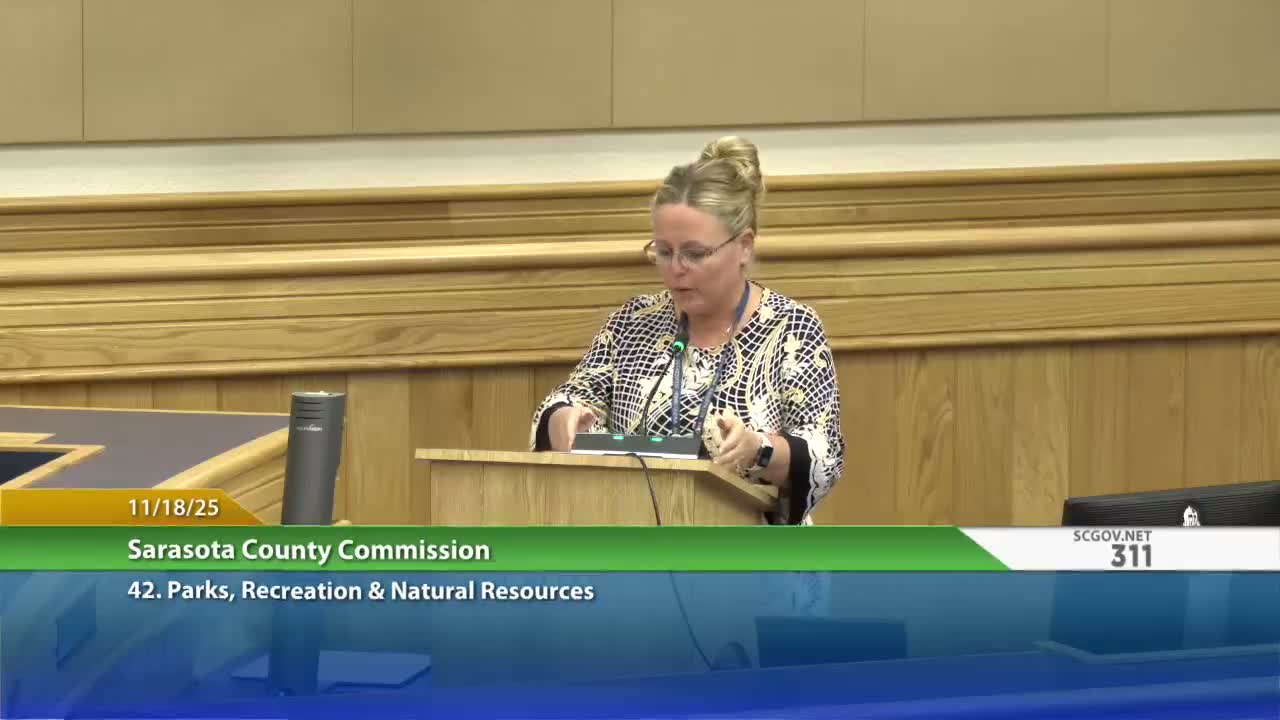
Several dozen residents and neighborhood organizations testified, presenting video and photo evidence of high‑speed recreational behavior, noise, frequent 911 calls and safety incidents. Neighbors described visitors anchoring near shore, loud music, and conflicts between swimmers and motorized vessels. Boating‑industry advocates urged more measured steps that keep public access while reducing conflict, and law enforcement described livery (rental) permit requirements and possible enforcement options (including undercover operations to find unpermitted rentals).
Commissioners balanced access, environmental concerns and enforceability. After discussion, the board voted 4–1 to return with idle/no‑wake language (option B) rather than adopt an exclusionary 300‑foot zone immediately; staff said FWC review of evidence can take 9–12 months and that DEP, Army Corps and USCG permits could also be required. Estimated procurement and installation of buoys or pilings could range from roughly $70,000 to $135,000 depending on marker type; staff recommended waiting to execute procurement until regulatory approvals are clearer.
What’s next: staff will draft an ordinance for the idle/no‑wake zone, coordinate permits with FWC/DEP/Army Corps/USCG, develop signage and an education campaign, and return to the board (staff estimated the earliest possible hearing in January). Enforcement work and targeted livery/rental compliance checks were discussed as complementary steps.