Get Full Government Meeting Transcripts, Videos, & Alerts Forever!
Get email alerts on the Immigration Enforcement Responses topic
No spam. Unsubscribe anytime.
Hawaii County committee backs resolution urging state protections against federal immigration enforcement
Summary
After extensive public testimony urging stronger local safeguards, the county committee approved Resolution 399-25 calling on the State of Hawaiʻi to adopt measures limiting certain federal immigration enforcement practices and to protect sensitive community spaces.
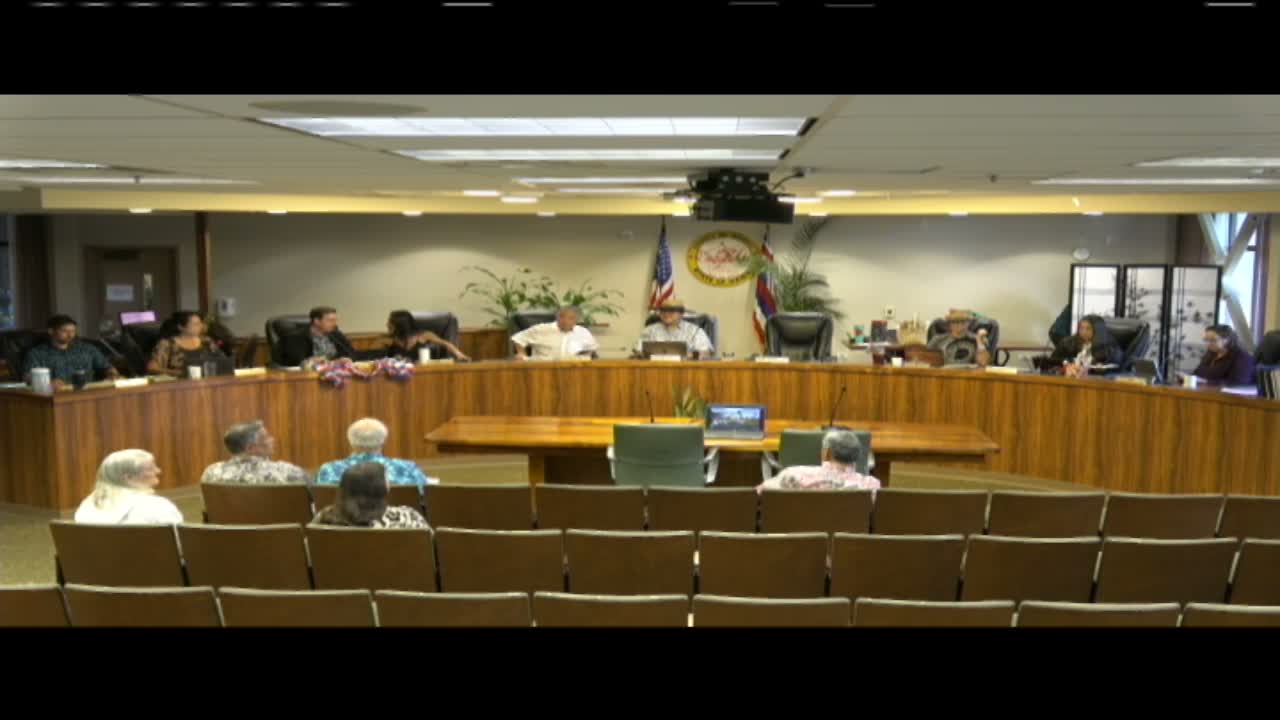
The Committee on Government Operations and External Affairs on Dec. 2 forwarded Resolution 399-25 to full council with a favorable recommendation after extensive public testimony and discussion. The resolution urges the State of Hawaiʻi to adopt protections aimed at reducing community harms from federal immigration enforcement and lists eight recommended actions for state consideration.
Public testimony opened the committee meeting and featured several speakers urging broad protections. Sam Guckenheimer of Kona Indivisible said he supported the measure and pointed the committee to a toolkit titled “No Secret Police, No Troops in Our Streets,” which contains model provisions including task-force bans and limits on National Guard deployments. “We wholeheartedly support resolution 399-25,” Guckenheimer said.
Other testifiers asked the council to push for the severance of memoranda of understanding (MOUs) between local jurisdictions and federal immigration agencies. Corey Harden urged the council to add an amendment requiring counties to terminate MOUs with ICE, Homeland Security Investigations and Customs and Border Protection, arguing current MOUs restrict oversight and can prohibit body-worn cameras. “The MOUs that we have now require police to follow ICE policies,” Harden said, and he urged local governments to consider policies like Chicago’s that restrict the use of public spaces for civil immigration enforcement staging.
Council members framed the resolution as a message to the state rather than a change in county law. Council member Jen Kaguada, a co-author, said the resolution is intended to ask the state legislature and governor to consider protections that the county cannot unilaterally enact. Council member Villegas, a co-author, noted the proposal is driven by rising community concern and urged colleagues to send a clear statement to Olympia and to the state capital.
The resolution’s eight requested actions include: discouraging the use of masks to conceal the identities of immigration officers in public operations; requiring officers to identify themselves; protecting sensitive community spaces such as schools and places of worship; prohibiting fulfillment of ICE detainer requests by state law-enforcement agencies; restricting the sharing of privileged or confidential information with federal immigration authorities; discouraging unmarked vehicles in enforcement operations; and asking the state to prohibit MOUs that cede local control.
Supporters told the committee the measure is more than symbolic: Patty Cook of Waimea argued that recent joint federal task-force activity on Kauaʻi showed real civil-rights harms. “The violation of civil rights … is extraordinary,” she said, urging council members to press state leaders to take action. Speakers who favor stronger measures specifically requested that the state provide statutory tools and guidance so local agencies are not placed in difficult legal or funding positions.
Opponents were not recorded in committee testimony on this item. Several council members noted federal executive orders and guidance that condition certain federal funds on cooperation with federal enforcement; those members urged caution and legal review as the county frames its requests to the legislature.
The committee voted to forward Resolution 399-25 to full council with a favorable recommendation. The full council will consider the measure and any further action at a subsequent meeting.