Get Full Government Meeting Transcripts, Videos, & Alerts Forever!
Get email alerts on the Stormwater Policy topic
No spam. Unsubscribe anytime.
Sarasota commissioners weigh 16 stormwater policy options; staff told to pursue design/permitting with WCIND
Summary
Staff outlined 16 potential changes to Sarasota County stormwater regulations — from changing design rainfall to raising freeboard and runoff controls — and commissioners gave preliminary direction and asked for further legal and technical analysis; they unanimously authorized staff to work with WCIND on Phillippi Creek design and permitting.
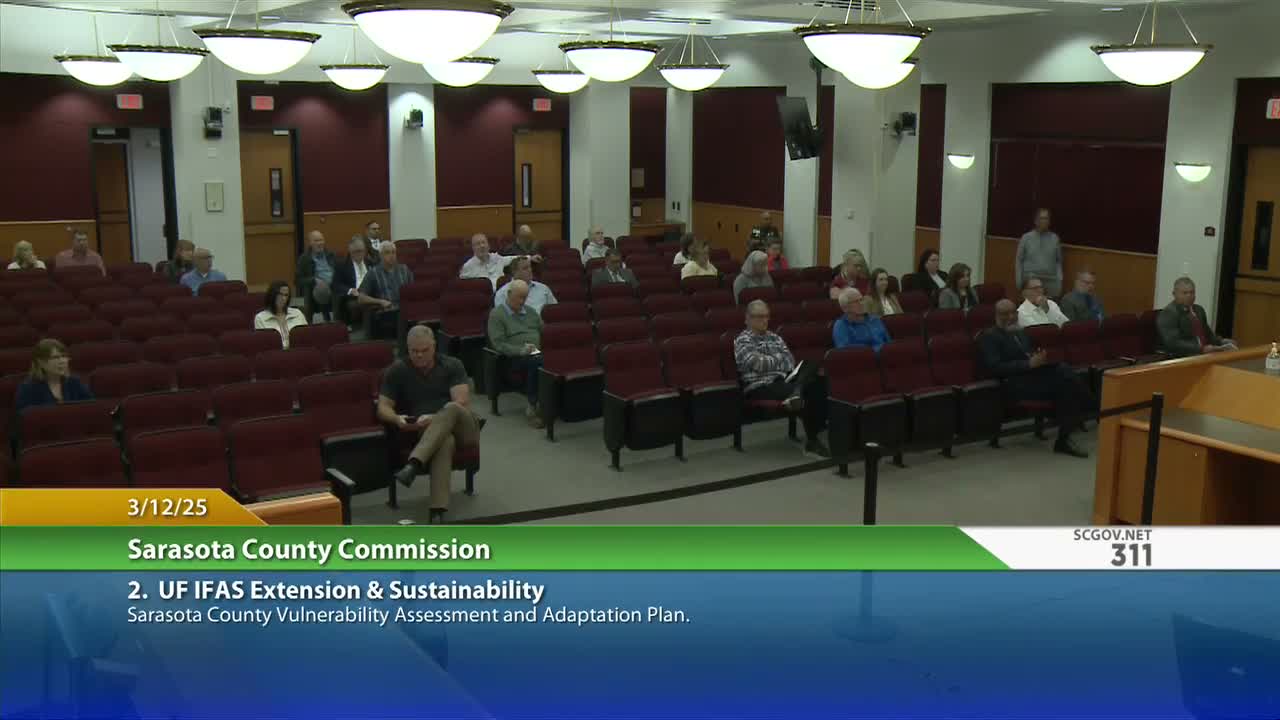
Sarasota County public works and stormwater staff presented a set of 16 regulatory options on March 12 that would change how development and redevelopment are regulated for flood risk and stormwater resilience.
Spencer Anderson, Public Works director and county engineer, framed the options as a policy workshop rather than immediate rule changes. Paul Simonek, the stormwater senior manager, outlined the county’s current practice — using Southwest Florida Water Management District rainfall curves (the SWFWMD/Swiftmud standard currently used) and regulating the 1% annual chance (10 inches in 24 hours) event — and explained possible alternatives: adopting NOAA Atlas 14 curves, adding a 0.2% (500‑year) design event, instituting multi‑day event modeling, or using future predictive rainfall curves.
Other options included establishing maximum impervious area caps, requiring low‑impact development best‑management practices, increasing structural freeboard, tightening lot drainage plan requirements, setting minimum culvert sizes, applying safety factors to stormwater calculations, requiring no net increase in runoff volume from development, requiring stormwater concurrency at rezoning, and restrictive measures for floodplain development. Staff cautioned several options could trigger legal challenges or raise takings claims.
Commissioners went through the options one by one and recorded initial guidance (yes/maybe/no) while often deferring specifics until staff returns with legal analyses, modelling updates (NOAA/Atlas 14) and the detailed cost and implementation impacts. Several commissioners emphasized the difference between rules that apply only to new development and the much harder question of retrofitting existing neighborhoods.
Commissioners also discussed operational actions staff already has underway: increasing maintenance cycles, improving monitoring stations, automating some pump‑station operations, and working on a countywide prioritization for capital projects.
The board concluded by moving a motion (moved by Commissioner Smith, seconded by Commissioner Mast) authorizing staff to work with WCIND on design and permitting up to Beniva and to bring back any ratifications needed; the motion passed unanimously. Staff said feasibility study results, permit timelines and funding options will be returned to the board.
Why it matters: changes to design rainfall, freeboard or runoff volume rules could significantly affect how new development is designed and could raise construction and compliance costs; any changes will require legal review and public outreach before adoption.