Get Full Government Meeting Transcripts, Videos, & Alerts Forever!
Get email alerts on the Disaster Recovery topic
No spam. Unsubscribe anytime.
Long Term Recovery Group urges Sarasota County to shift disaster-recovery model, cites large per-home cost gap
Summary
United Way-led Long Term Recovery Group told commissioners the county's current CDBG-DR contracting approach may be inefficient, arguing LTRG can repair far more homes per dollar. County staff said federal rules, procurement and reimbursement requirements limit how programs operate and create administrative costs.
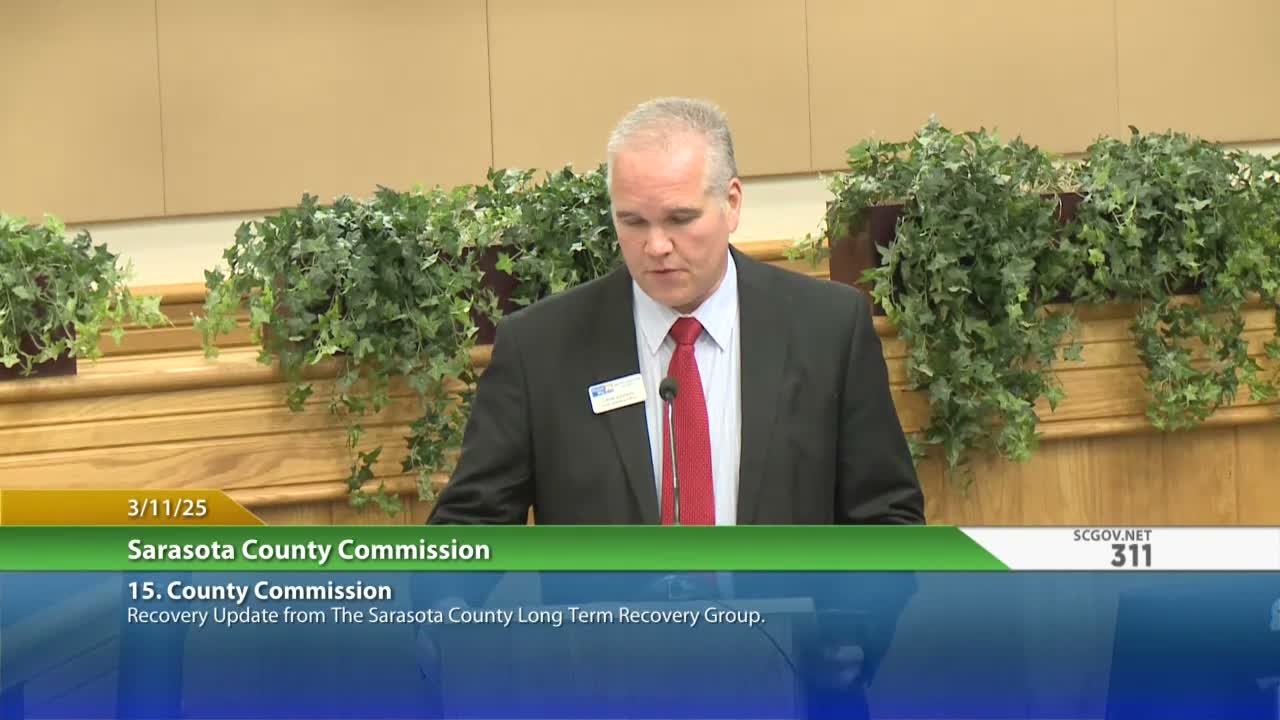
A coalition led by the United Way of South Sarasota County told the Board of County Commissioners on March 11 that county-managed CDBG-DR programs are allocating substantial administrative dollars and slowing recovery for some homeowners, and urged the county to partner more deeply with the Long Term Recovery Group (LTRG).
Chris Johnson, chief operating officer at United Way of South Sarasota County and lead for the LTRG, said the group has completed 81 rebuilds, has 10 sites in progress and 35 in queue for Hurricane Ian recovery, and that deduplicated FEMA data show nearly 4,000 homes were damaged by recent storms Helene and Milton. Johnson contrasted the LTRG's $3 million administrative budget (over three years) and an average repair cost of $7,700 per home with a county-contracted implementation vendor (DSW Homes) and an associated $6 million contract figure that he said effectively reduces funds available for direct repair. He argued the county's approach could reduce the number of homes repaired and urged the board to shift funds to the LTRG model to increase reach.
Johnson recounted cases of clients delayed in reconstruction because of shifting program requirements and coordination problems and urged the county to consider the LTRG a partner to accelerate repairs and reduce administrative overhead.
County staff responded that federal CDBG-DR rules, HUD timelines and reimbursement requirements drive much of the administrative work. Kim and Steve Hyde (program management) explained that the $6 million figure for DSW Homes includes construction start-up and construction-related services beyond pure administrative costs, that the county publicly competed for contractors, and that many HUD requirements (environmental testing, duplication-of-benefits checks, income verification, labor compliance) add necessary administrative steps and documentation. Staff also noted that reimbursement funding and HUD compliance impose cash-flow and oversight responsibilities that carry legal and fiscal risk.
The board asked for further monitoring of contract burn rates and reallocation options. Commissioners thanked LTRG partners for their work and emphasized the need to balance compliance, fiscal risk and speed of recovery.
Why it matters: The dispute centers on how federal disaster dollars are administered locally, and whether different implementation models materially affect the number of homes repaired for low- and moderate-income families.
Next steps: Staff said contract balances can be monitored and reallocated if appropriate; commissioners asked staff to continue reporting on program spend, awards and risk of federal "clawback".