Get Full Government Meeting Transcripts, Videos, & Alerts Forever!
Get email alerts on the Ad Hoc Investigation topic
No spam. Unsubscribe anytime.
Stockton council approves informal ad hoc investigatory committee over dissent
Summary
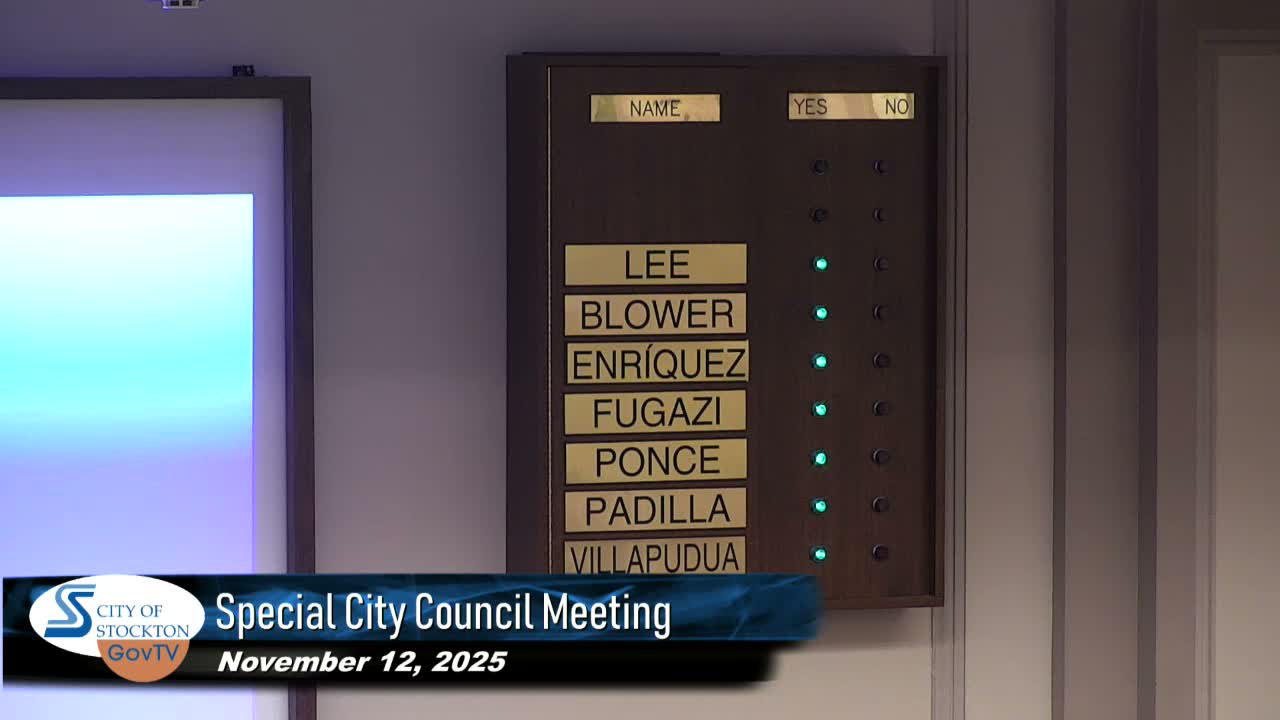
The Stockton City Council voted 4-3 to form an informal, two-member investigatory ad hoc committee to review allegations about council conduct and related policies; the motion allows the ad hoc to coordinate with HR, the city attorney and, if deemed necessary, outside investigators. Enriquez, Blauer and Vice Mayor Jason Lee voted no.
Stockton's City Council voted 4-3 on Nov. 12 to form an informal investigatory ad hoc committee to review allegations concerning council conduct, internal policies and related personnel concerns.
The motion: Councilmember Villapudua moved to create a two-person ad hoc and volunteered to serve; Mayor Mary Fugazi seconded the motion. The council discussion repeatedly returned to scope and procedure: whether the ad hoc would be public, whether it could or should review personnel matters in public, and whether it should have authority to engage outside investigators.
Why it matters: Supporters said a temporary ad hoc would allow the council to examine repeated complaints and recommend policy changes or further action. Opponents described the city as fatigued from multiple prior investigations and warned that an open-ended ad hoc with authority to hire outside counsel could be costly or politically driven.
City attorney guidance and limits: The city attorney explained the difference between a censure process (which requires specific initiation and limits participation) and the broader ad hoc the mayor proposed; the attorney noted ad hocs are not automatically Brown Act bodies but have typically been treated like standing committees and can be public. The city attorney also explained that employee personnel matters cannot be discussed in public and that some investigations should follow HR protocols.
Vote and membership: The motion to form the ad hoc passed 4-3; Councilmembers Mary Fugazi, Padilla, Ponce and Villapudua voted yes. Councilmembers Enriquez, Blauer and Vice Mayor Jason Lee dissented. The mayor said she would appoint the committee members (she indicated two members would serve) and that the ad hoc would report back to council. Meeting minutes show the ad hoc may, "coordinate with the city attorney, human resources, and any outside legal or investigative professionals as needed," but council members stressed that any hiring or major spending should return to council if not explicitly delegated.
Voices from the meeting: Vice Mayor Jason Lee defended his use of social media as political speech and said he would accept a censure if the process required it; council members who opposed formation cited lack of a written complaint and concerns about the ad hoc's open-ended scope.
What happens next: The mayor will appoint members to the two-person ad hoc. The committee is expected to review policies and present findings to the council; the city attorney and HR will advise the committee on personnel confidentiality and on when matters must be handled through formal personnel processes.