Get Full Government Meeting Transcripts, Videos, & Alerts Forever!
Get email alerts on the Charter Violations Funding Letter topic
No spam. Unsubscribe anytime.
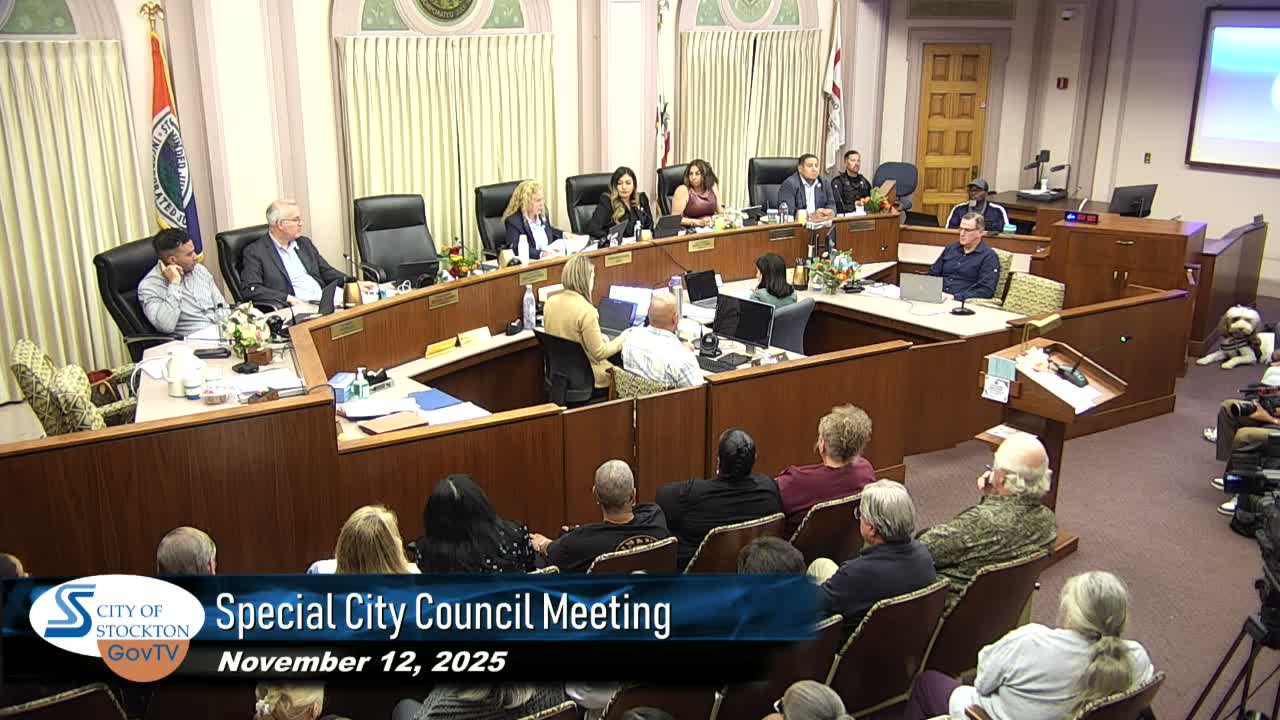
Stockton council unanimously refers alleged charter violations and funding letter to state and county prosecutors
Summary
The Stockton City Council voted 7-0 on Nov. 12 to refer questions about a commitment letter from the former interim city manager — tied to a conditional state award for Service First of Northern California — to the district attorney—s political corruption unit, the state attorney general and the grand jury, while the city attorney said the letter is likely nonbinding without council ratification.
Stockton City Council voted unanimously on Nov. 12 to refer possible charter violations, alleged abuse of authority and concerns about a commitment letter the former interim city manager sent to the California Department of Health Care Services to outside prosecutors.
Vice Mayor Jason Lee moved the referral, saying the city manager had sent an instrument to the state that appeared to commit cash beyond the manager's $100,000 authority and that the matter deserved investigation by agencies with investigative powers. "I make a motion to, refer these matters out to the district attorney's political corruption unit, the grand jury, and the attorney general's office," Lee said during the meeting.
Why it matters: Council members said the issue is about process and protecting the city's fiscal controls. City Attorney (speaker 23) told the council that, in the absence of delegated authority, a lone commitment by a city manager that purports to obligate the city beyond spending limits would likely not be legally binding without council action, but that the question is fact dependent and could warrant outside review. "In the absence of that authority, I think the city would argue likely that it's not legally binding depending on the will of the council," the city attorney said.
What was alleged: Councilwoman Padilla reported that she spoke with Marlies Perez at the Department of Health Care Services and shared an updated conditional award letter dated Nov. 7, 2025. Public testimony and council discussion contained several figures: Vernon Hill Jr. of Service First said his nonprofit received a conditional award of "$8,239,637.33" (public comment), and Padilla and others cited an approximate 10% local match figure that city staff and the council discussed as roughly $823,963.73 or smaller revised match estimates after county and Service First contributions.
Council debate and legal context: Several council members said no city funds had been transferred and emphasized the limits of the city manager's authority under the charter. The city attorney explained criminal charges would require a high evidentiary bar and that, procedurally, some matters are typically handled administratively; the council retains the option to refer matters to the DA or AG for criminal investigation if it wishes.
Council action and next steps: The council approved Lee's motion, which combined three directions: (1) refer the matter to the district attorney's political corruption unit, the state attorney general's office and the grand jury; (2) direct city staff to notify the state contact (identified in the transcript as Marlies Perez) that the council did not authorize the prior letter; and (3) retain the option to agendize the matter later for council consideration. The motion carried 7-0.
Voices from the meeting: Vernon Hill Jr., representing Service First of Northern California, defended his organization and its application process. Council members who supported the referral emphasized that sending the matter to outside agencies would allow neutral fact-finding; others stressed caution and the administrative path for personnel matters.
What happens next: The referral sends the question to external agencies for investigation; the city attorney and city manager's offices were assigned to coordinate notifications. The council also discussed but did not adopt a unilateral rescission of any prior letter because a newer letter presented to the council had effectively superseded it. If outside agencies pursue the matter, they would determine whether any civil or criminal violations occurred. The council said it would retain oversight and could agendize follow-up actions.