Get Full Government Meeting Transcripts, Videos, & Alerts Forever!
Get email alerts on the NOFA Process topic
No spam. Unsubscribe anytime.
Stockton staff proposes yearly NOFA cycle and tighter scoring to improve fairness and project delivery
Summary
City staff outlined a plan to standardize Notice of Funding Availability (NOFA) timing, require mandatory applicant workshops, tighten technical review and scoring, and increase transparency while preserving legally required redactions.
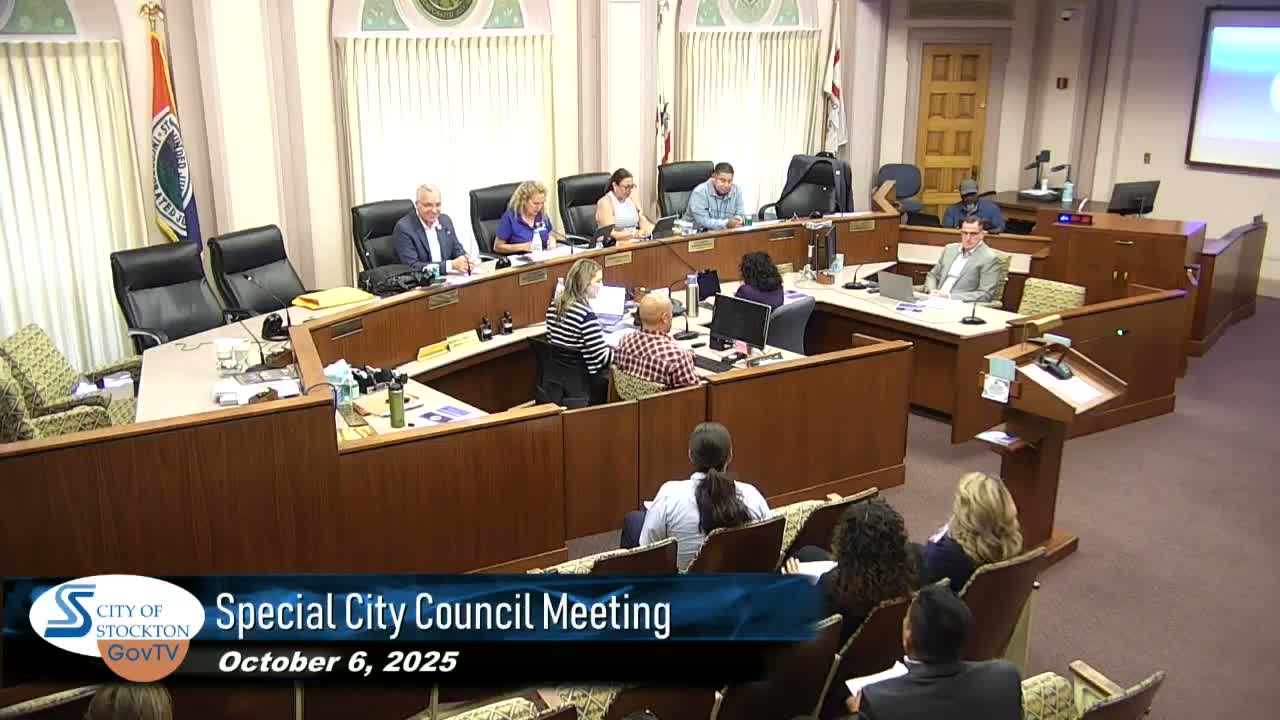
Stockton City staff on Oct. 6 proposed standardizing the city's NOFA schedule and tightening application and monitoring rules to make housing and services funding more predictable and to reduce the risk of having to return state or federal funds.
Tina McCarty, director of economic development, told the City Council the department wants to "issue NOFA's systematically once a year" so prospective applicants know when to expect funding opportunities and so the city can manage staff workloads more efficiently. She said the city has tightened requirements in recent years because federal and state funders, including HUD and HCD, increasingly require strict compliance.
Why it matters: City staff said clearer timing, a mandatory workshop and a more objective scoring process should increase fairness and help proposals better compete for tax credits and other leveraged funds. Councilmembers raised concerns about applicants repeatedly missing basic submission requirements and about how to balance transparency with protection for proprietary materials.
How the process would work: McCarty described a multi-step process: advance outreach to past partners and the public, a mandatory workshop with Q&A, a technical review that checks baseline documents (EIN, org chart, basic checklists) and a separate application-scoring panel made up of subject-matter managers and at least one financial expert. She said that technical review and scoring are deliberately done by different people to reduce the risk of a single reviewer influencing multiple stages.
McCarty also proposed including scoring details in the NOFA document itself. The draft scoring for housing includes a 5% "financial readiness" factor intended as a tiebreaker, heavier weight on developer experience and financial capacity, and scrutiny of pro forma budgets so projects can both be built and sustainably operated.
Legal and transparency constraints: Councilmembers asked that reading-room access to application materials be made more useful to elected officials. City Attorney Laurie cautioned that under the Public Records Act (PRA) certain financial and proprietary materials must be redacted and that providing packets to council does not change PRA obligations. McCarty said staff will work with the attorney's office to propose an improved process before the council's Nov. 4 vote on the NOFA procedures.
Public feedback and capacity building: Multiple residents urged recording the mandatory workshop and publishing the scoring rubric and presentation materials in advance. McCarty said the city already offers one-on-one technical assistance when proposals fail and is funding a United Way-led nine-month capacity-building program to help nonprofits strengthen applications.
Next steps: Staff will return to the council on Nov. 4 with a proposed NOFA process and the final NOFA document for adoption. The council did not take formal action at the Oct. 6 workshop.