Get Full Government Meeting Transcripts, Videos, & Alerts Forever!
Get email alerts on the Public Safety topic
No spam. Unsubscribe anytime.
Public safety budgets dominate Stockton's general fund; police and fire outline staffing gaps, technology and grant priorities
Summary
Police and fire leaders told council the departments face vacancies and rising costs even as both chiefs asked the council to preserve services. Police Chief Stanley McFadden reported roughly 50 sworn vacancies and $11M+ in active grants; Fire Chief Richard Edwards said the department staffs 59 firefighters daily versus 75 pre-bankruptcy and highlighted a 13% increase in call volume.
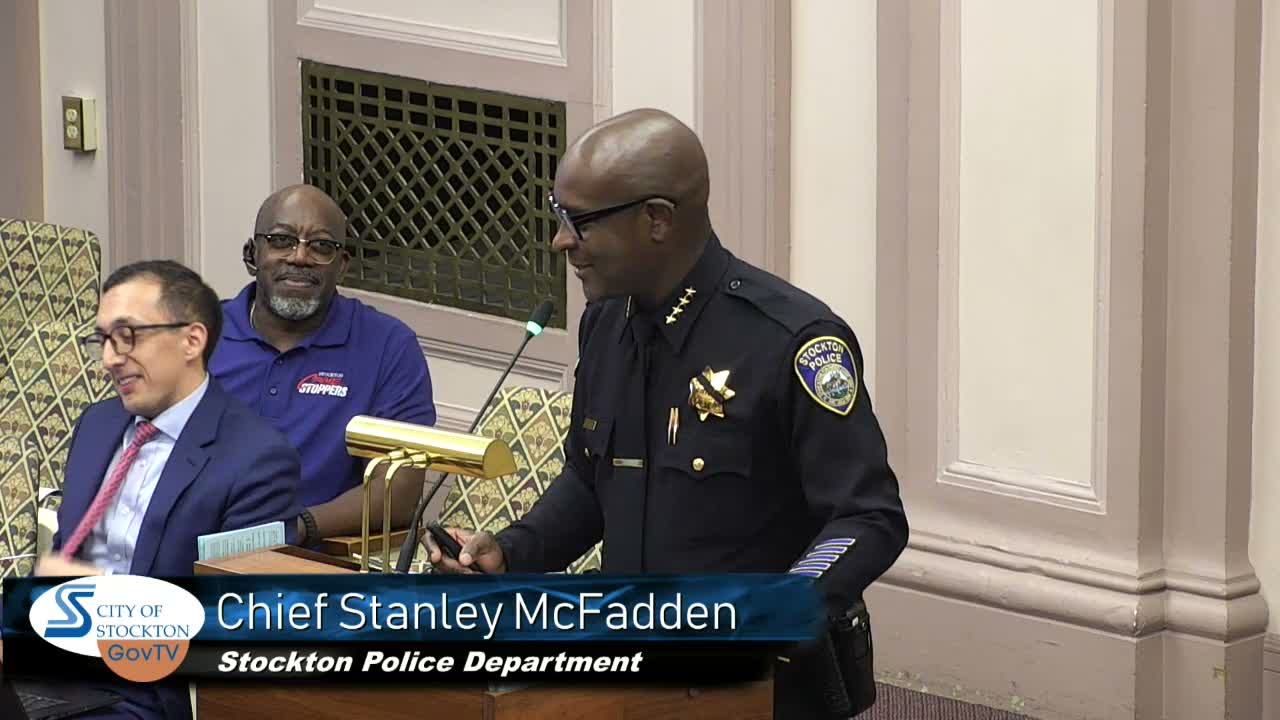
Police Chief Stanley McFadden and Fire Chief Richard Edwards used the council's budget study session to frame public-safety needs as central to Stockton's fiscal choices.
McFadden said the proposed police budget is approximately $184 million for FY25-26 and described a three-year strategic plan focused on recruiting a more diverse workforce, wellness and training, technology upgrades and stronger grant pursuit. "We are operating under 12 different grants that total over $11,000,000," McFadden said, and the department has been authorized to add a grant writer to increase outside funding. He reported about 50 vacant sworn officer positions and roughly 48 non-sworn vacancies.
Edwards told council the fire department now staffs 59 firefighters per shift compared with 75 pre-bankruptcy and that total incident responses have risen roughly 13% since pre-bankruptcy levels. "We staff 59 firefighters on duty every day. Pre-bankruptcy, we were at 75 firefighters," he said. The department deployed a two-person medic squad from Station 9 to absorb lower-priority calls and reduce pressure on core engine companies. Edwards also outlined capital and technology needs including updated station telecommunications, mass-notification software and station generator replacements after winter-storm failures.
Both departments emphasized grants and partnerships as ways to expand capacity without permanent general-fund increases. McFadden noted federal, state and private funding streams for technology and programmatic work; Edwards described SAFER grant history and cautioned that federal staffing grants require long-term absorption plans to avoid unsustainable expirations. Council members pressed for more detail on recruitment funding, diversity initiatives, and how community prevention programs (for example, the Office of Violence Prevention's work) fit with enforcement spending.
Next steps: council agreed to preserve public-safety funding while staff work through non-safety cuts elsewhere; chiefs will return with any further details needed to match grant opportunities and to show how proposed shortfall remedies will or will not affect public-safety operations.