Get Full Government Meeting Transcripts, Videos, & Alerts Forever!
Get email alerts on the Public Communications topic
No spam. Unsubscribe anytime.
New Office of Public Transparency unveiled; council asks for a measurable communications plan by Nov. 18
Summary
City PIO Tony Manner outlined a new Office of Public Transparency (OPTIC) focused on ADA digital accessibility, PEG operations and centralized messaging. Councilmembers praised the goals but pressed for measurable outputs, a tighter timeline for public storytelling and a November 18 plan showing metrics and near‑term deliverables.
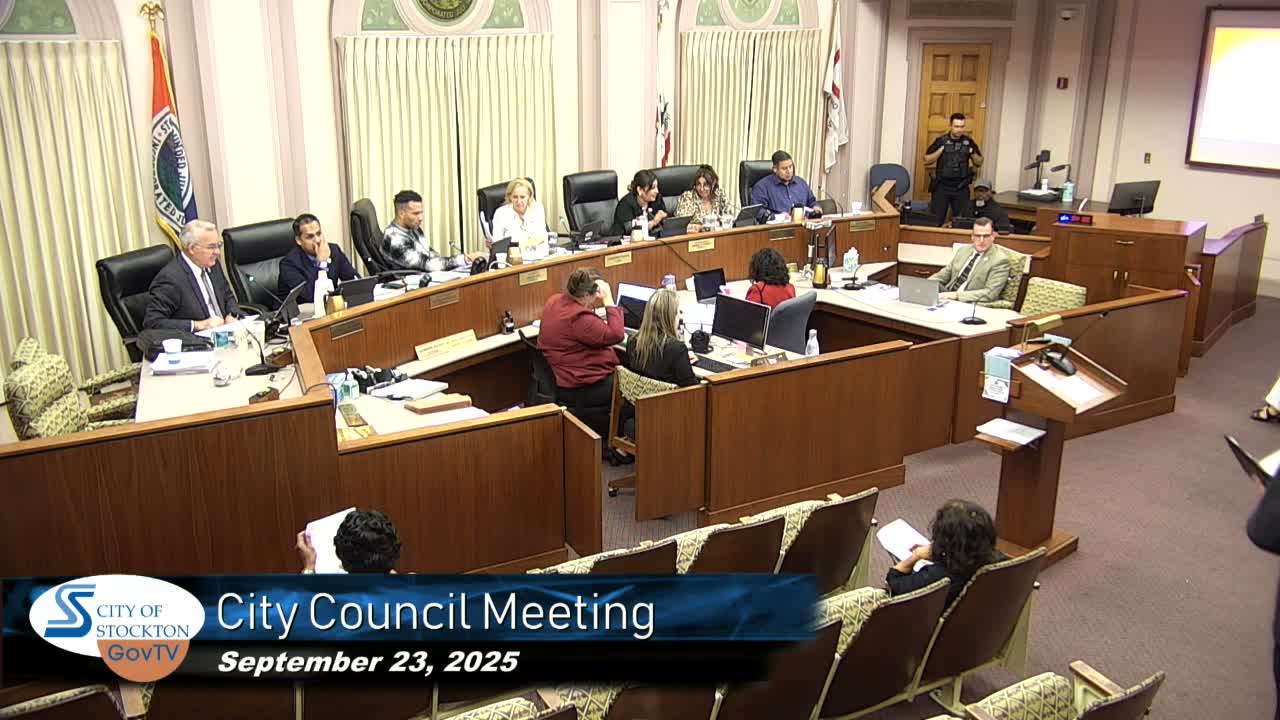
City Public Information Officer Tony Manner presented the Office of Public Transparency (OPTIC) to the Stockton City Council on Sept. 23, describing a small in‑house team focused on digital accessibility, coordinated messaging and running the city’s PEG (government‑channel) operations.
Manner said the office’s near‑term priority is compliance with federal accessibility standards (WCAG 2.1 Level AA guidance) and a federally mandated deadline in April 2026 to make city digital assets accessible. “Access is transparency, and this is why these actions must be taken,” he said, describing an audit of the city’s digital portfolio and a roadmap to reach accessibility compliance.
OPTIC staff introduced themselves as a multi‑disciplinary team of UX designers, accessibility specialists and media engineers. Manner said previous work with outside vendors left the city exposed and that in‑house technical capacity would both lower long‑term costs and provide continuity during a compliance push.
Several councilmembers welcomed the objectives but pressed for faster, measurable public outcomes. Vice Mayor Lee said the council “is not waiting until April 2026” to tell Stockton’s story and asked city management to deliver a measurable, trackable communications plan by Nov. 18. Councilmembers raised immediate concerns: the new office’s budget and FTE history, how the city website and social pages are updated, faster turnaround on event videos and how to balance ADA remediation with visible storytelling.
Manner and staff said they would prioritize the accessibility audit and then expand outward into proactive storytelling and event coverage. He said some resources (PEG funding) are restricted to government broadcasting and that other marketing storytelling work would follow once compliance work is underway.
Council directed city management to return with a plan that sets clear metrics and near‑term deliverables. Several members signaled willingness to support storytelling and promotional work if a measurable roadmap and ROI on investments are provided.