Get Full Government Meeting Transcripts, Videos, & Alerts Forever!
Get email alerts on the Homelessness topic
No spam. Unsubscribe anytime.
St. Petersburg PIT count shows decline overall as HUD funding shifts imperil permanent-housing projects
Summary
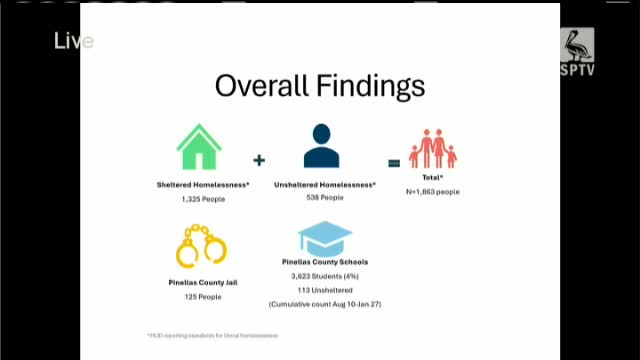
Homeless Leadership Alliance and the Pinellas Continuum of Care reported the county’s point-in-time (PIT) count was the lowest on record (total 1,863), but HUD’s abrupt NOFO changes — a 30% cap on permanent housing projects and a steep cut to noncompetitive renewals — risk destabilizing local programs and may force short-term funding gaps as early as January 2026.
Sherry Holzbacher, chief executive officer of the Homeless Leadership Alliance, told St. Petersburg City Council that the county’s annual Point-in-Time (PIT) count found the sheltered population at about 1,325, the unsheltered count at 538 and a total of 1,863 people — the lowest totals on record for Pinellas County.
Holzbacher said the declines reflect “increases in funding, strong system coordination” and local programs, but warned of a looming federal change that could undermine that progress. “The priority now is on short-term crisis response, not long-term housing support,” she said, summarizing HUD’s new notice of funding opportunity (NOFO). She said HUD also imposed a 30% cap on permanent housing projects and cut historically noncompetitive renewal funding from roughly 90% to about 30%, making most of the remainder fully competitive.
Those policy shifts matter locally because permanent supportive housing comprises a substantial share of the Continuum of Care portfolio in Pinellas County, Holzbacher said. She told the council that the earliest local impacts could appear by January 2026 if replacement funding is not secured and that the community is exploring “flexible or bridge funding options to help stabilize units that are at risk.”
Council members pressed staff on contingency planning and advocacy. Council Member Richie Floyd asked whether the competitive process could recoup much of the funding; city staff and HLA representatives said they are pursuing multiple gap-coverage strategies, including repurposing other federal grants for short-term rental assistance and seeking county advocacy and one-time local bridge dollars.
The presentation also highlighted subpopulation trends: an increase in older adults measured in the PIT, 253 veterans counted (an increase over previous counts), racial disparities (Black or African American people made up 38% of the counted population while comprising about 11% of the county population) and 494 people meeting the HUD definition of chronic homelessness. Speakers emphasized the relationship between housing stability and medical and employment shocks: respondents cited financial or job loss (40%) and medical issues (20%) as top causes.
Council members thanked HLA and the Continuum of Care for the report and urged residents to volunteer for the PIT count; staff said the NOFO was expected to be submitted to HUD in early January and that more will be known about competitive award outcomes later in the summer. Holzbacher and the Pinellas COC said they will keep the city updated on funding applications and risk assessments as they develop.