Get Full Government Meeting Transcripts, Videos, & Alerts Forever!
Get email alerts on the Big Creek Dam topic
No spam. Unsubscribe anytime.
Newport consultants say current Big Creek Dam design would produce sharply higher water bills; council launches alternatives analysis
Summary
Consultants told the Newport City Council that the current $185M–$215M dam design would push typical residential water bills into the hundreds of dollars monthly under plausible financing scenarios, and the council directed staff to pursue an alternatives analysis to find less-burdensome options.
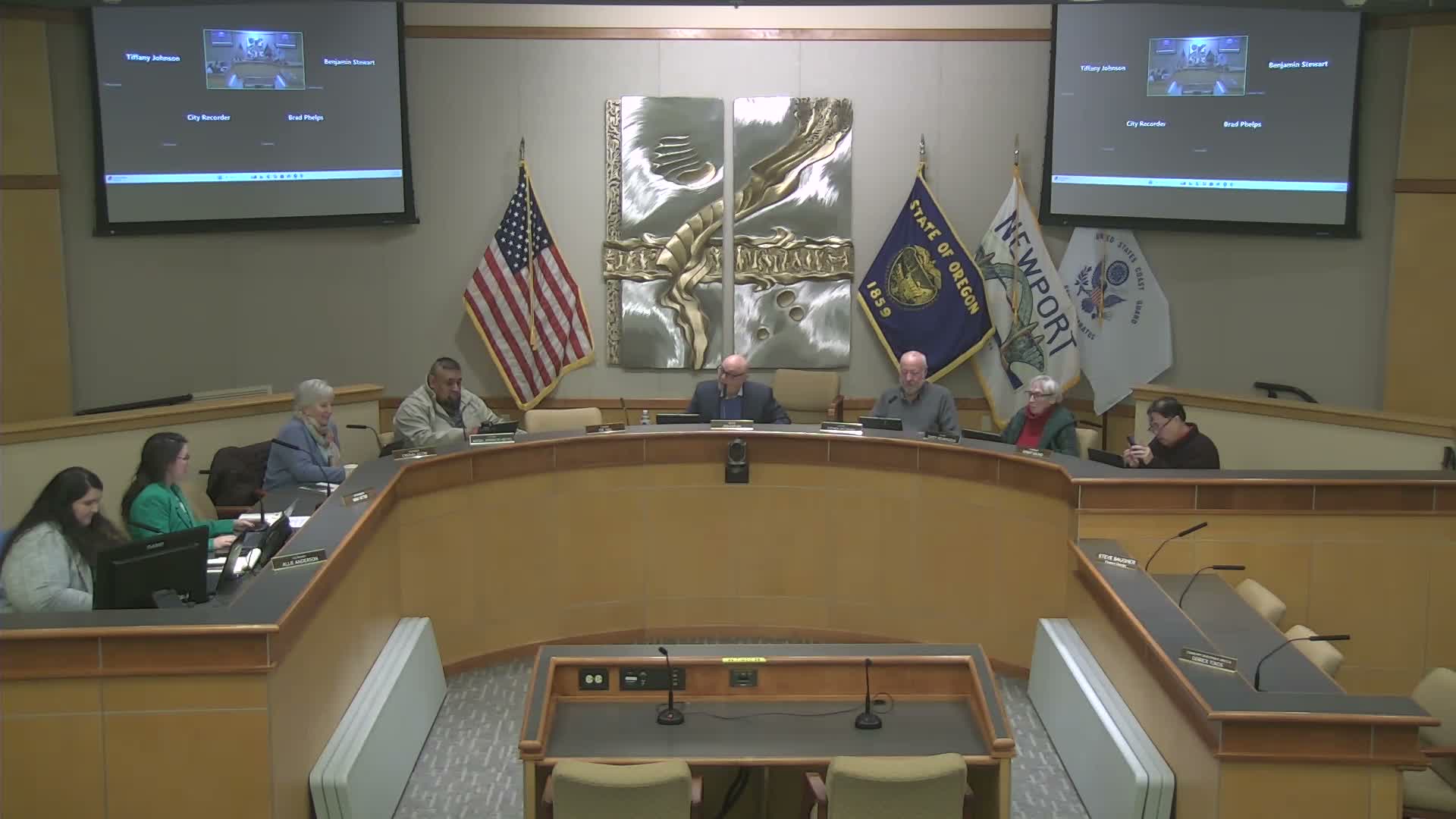
Consultants told the Newport City Council on Dec. 1 that the Big Creek Dam replacement as currently designed would create unaffordable water-rate impacts for residents unless large new grants or different project approaches are found.
The consultant presenting the financial analysis, identified in the meeting as Vince Stewart of Stantec, summarized a model that started from an HDR Engineering cost estimate of about $185,000,000 and, with escalation, modeled a project cost near $215,000,000. "All three scenarios for this project would result in water bills exceeding these industry affordability standards," the consultant said, concluding that the project in its current form "would not be financially feasible from the perspective of customer affordability."
Why it matters: the analysis modeled three funding approaches — (1) the water utility borrowing alone, (2) the utility plus a $50 million contribution from the City general fund, and (3) a combination that also used WIFIA loan financing — and found large rate increases in every case. Under the utility-only scenario the consultant estimated a typical residential bill near $385 a month by 2045 (a stated, modeled increase of over 400%); the $50 million general-fund scenario produced roughly $340/month; and the scenario including WIFIA produced about $328/month by 2045. The report measured affordability using industry benchmarks (bill as a percent of median household income and of the lowest income quintile, and hours at minimum wage to pay a bill) and found the modeled bills exceed common thresholds.
Funding constraints and uncertainties: presenters reviewed potential sources including the EPA WIFIA loan program (which can fund up to roughly 49% of a project but is competitive and may be ineligible when a project already has Water Resources Development Act authorization), the Drinking Water State Revolving Fund (which can offer low-interest loans and sometimes principal forgiveness but typically does not fund brand-new dams), and previously authorized federal support. The presenters said the city has received a state lottery bond award of about $14,000,000 (with roughly $7,100,000 spent to date) and has WRDA authorization for up to $60,000,000, but the consultants did not assume the $60,000,000 as guaranteed funding in their baseline scenarios because authorization does not equal an apportioned appropriation.
Technical and regulatory drivers: Jacobs Engineering, hired to run an alternatives analysis, told the council the near-term, state-required issues are (1) deterioration and corrosion of metal conduits through the existing dams and (2) seismic performance concerns documented by state review. Jacobs' Nathan McCullough said the 2015 roller-compacted-concrete (RCC) replacement design would address those technical problems but that cost escalation, possible fish-passage requirements and other uncertainties have substantially raised the estimated price. McCullough noted that if the state requires on-site fish passage rather than off-site mitigation, engineers estimate an additional roughly $30,000,000 could be added to project cost.
Options under study: Jacobs described a structured alternatives process that will (a) inventory technical and planning data, (b) define and weight transparent evaluation criteria (including seismic resilience, water supply needs, permitting and community acceptance), (c) identify and screen alternatives, and (d) produce rough-order-of-magnitude cost and schedule estimates for a set of feasible solutions. Alternatives to a full new dam include mitigating the existing dams in place, building a new dam with the existing storage (rather than increased capacity), partnering with nearby reservoirs (e.g., Mill Creek, Rocky Creek), pursuing groundwater or aquifer storage where feasible, desalination, recycled water, or combinations of these strategies. Jacobs said the alternatives analysis aims to conclude initial work in the March–Q2 2026 timeframe.
Council direction and next steps: after the presentations the council directed staff to move forward with the Jacobs-led alternatives analysis to identify lower-cost or staged approaches and to provide additional scenarios that incorporate partial federal funding or different design options. City staff and the consultants said they will run additional affordability scenarios as design alternatives are developed and will return to the council with refined cost and rate impacts.
What the consultants said (selected quotes): "All three scenarios for this project would result in water bills exceeding these industry affordability standards," the Stantec consultant said. The consultant also summarized model results: "a typical customer would be paying almost $385 a month for their water bill" under the utility-only scenario. Jacobs' Nathan McCullough summarized the alternatives project purpose: "This is to provide a safe and reliable feasible water supply, resilient components to supply water in the event of a dam failure caused by either deficiencies of the dam or a natural disaster."
Context and local impact: the presentations stressed the potential distributional impact to low-income households. The consultants modeled affordability against Newport income figures they cited (median household income about $60,000; lowest quintile about $29,000) and Oregon minimum wage assumptions used in the analysis. The council and staff also discussed the timing of construction under current plans (presenters noted a tentative construction-start window in the early 2030s) and emphasized the state letter that requires the city to address near-term safety and conduit concerns.
What remains unresolved: presenters and staff emphasized that the financial outlook depends heavily on evolving federal and state funding availability, regulatory requirements (notably fish-passage decisions), final design choices and whether the city can secure substantial grant funding. The alternatives analysis is intended to present options with clearer cost, schedule and community-impact tradeoffs so that the council can decide whether to pursue a full replacement, staged mitigation, or another combination of measures.
The work session adjourned after the council requested the alternatives analysis work to continue and scheduled follow-up briefings as studies and scenarios are produced.