Get Full Government Meeting Transcripts, Videos, & Alerts Forever!
Get email alerts on the Historic Preservation topic
No spam. Unsubscribe anytime.
Council deadlocks on Euclid Church adaptive‑reuse appeal after hours of testimony; map rezoning dies for lack of motion
Summary
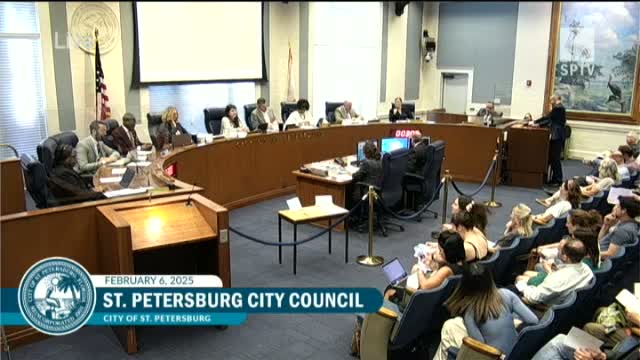
An extended quasi‑judicial hearing produced intense neighborhood debate. City staff and preservation groups backed an adaptive‑reuse path to save the landmark building; nearby residents opposed a commercial events venue and rezoning. Council failed to overturn the CPPC denial (4–4), and a separate motion to advance the map/zoning change did not pass.
A contested, hours‑long quasi‑judicial appeal over the historic Euclid Church ended without approval of the adaptive‑reuse appeal and with the associated map/zoning amendment unacted upon.
Background: the applicant (Noam and Irene Krasnanski / Treehouse) proposed to preserve and restore the century‑old Euclid Church as an adaptive‑reuse project: a special event space/meeting hall (weddings and other events), a bed‑and‑breakfast component (manager on site) and accessory lodging, plus a preemptive request to change future land‑use/zoning (PR‑R to PR‑MU and NT2 to CCT‑1) anticipating a corridor FAR adjustment later this year. The Community Planning & Preservation Commission (CPPC) had approved a certificate of appropriateness for exterior work but denied the adaptive‑reuse request and the map amendment; the owner appealed to city council.
What council heard: opponents living immediately north and in adjacent blocks urged council to uphold the CPPC denial. Michelle Gehrig, an adjacent homeowner and the registered opponent, summarized concerns: the property sits inside a residential neighborhood with narrow streets and limited on‑street parking, rendering a commercial event venue incompatible; she said letters of intent for off‑site parking are nonbinding, that outdoor events and unamplified noise would be difficult to police, and that transient lodging (short‑term stays) would change the character of the block.
Supporters and staff: the applicant and their team argued the building is in severe disrepair and that adaptive reuse to an events venue is a financially viable preservation path. The applicant presented a traffic/parking study by a licensed engineer that estimated the project would provide or secure roughly 203 combined on‑site and off‑site spaces (including leased lots and vendor shuttle/valet), and a sound consultant indicated projected exterior levels below the ordinance threshold used in the analysis. Preservation groups (Preserve the Burg) and the Euclid Saint Paul Neighborhood Association (ESPNA) provided letters of support or conditional support; some neighbors and nearby businesses also testified in favor of saving the landmark.
Council action and outcome: after final arguments and council Q&A, a motion to grant the appeal (i.e., overturn the CPPC denial and approve adaptive reuse) failed in an 4–4 tie (Councilmembers Driscoll, Curtis, Givens and Hanowitz voted no; Fig Sanders, Floyd, Gabbard and Harding voted yes). Because grant of the appeal requires a supermajority to overcome CPPC in practice and the motion failed, the adaptive‑reuse denial stands. Council then considered a map/zoning motion; no motion carried and the map amendment was not advanced.
What this means: the CPPC denial of adaptive reuse remains in effect; the owner retains options under city code (staff noted an applicant may return with a substantially different proposal, but a substantially similar plan cannot be reheard for 18 months). Staff recommended working with the owners on alternative reuse approaches and stressed that the map amendment was premature without an approved adaptive reuse. Residents and applicant will continue to negotiate or may pursue revised proposals consistent with historic‑preservation rules.
Representative quotations: applicant Noam Krasnanski told council, “Help us save our church,” and opponent Michelle Gehrig argued, “Our opposition is to the land use change, zoning change, and commercial adaptable reuse…all of which are inconsistent with our neighborhood.”
Next steps: the applicant may revise the proposal and work with staff and neighborhood groups; city staff reiterated the 18‑month limit on rehearing substantially similar applications and recommended careful drafting of any future application to address parking, buffering and noise concerns raised at the hearing.