Get Full Government Meeting Transcripts, Videos, & Alerts Forever!
Get email alerts on the Arts Funding topic
No spam. Unsubscribe anytime.
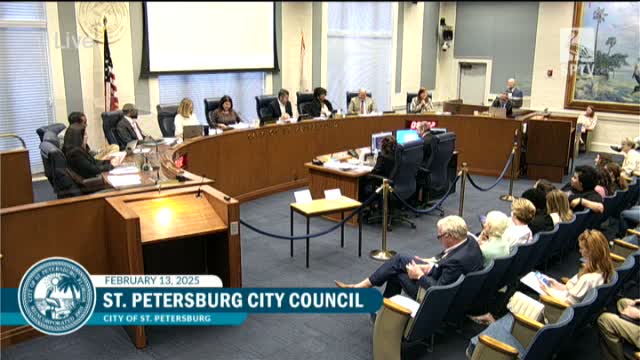
Arts Conservatory for Teens asks St. Petersburg for $500,000 to expand programs
Summary
ACT (Arts Conservatory for Teens) updated council on outcomes—100% reported high‑school graduation among participants—and requested $500,000 to scale services and wraparound support; councilmembers expressed support and asked for a detailed proposal and possible staged funding.
The Arts Conservatory for Teens (ACT) asked the St. Petersburg City Council for $500,000 to expand its research‑based arts programs, support transportation and scholarships, and scale a workforce pipeline for teens.
Dr. Alex Harris, ACT’s founder and executive director, told the council ACT now operates eight locations with 19 satellite sites, serves about 860 weekly students and reports a self‑reported 100% high‑school graduation rate among program participants. Harris said the $500,000 request would fund expansion of traditional and advanced programming and provide wraparound services such as transportation and scholarship support, estimating the funds would reach roughly 400–500 additional students.
“ACT has refined and defined its mission…we are asking for your support. This year, the request is $500,000 to continue expanding our footprint,” Harris said.
Several council members and members of the public spoke in favor of the request. Councilmember Gina Driscoll and others praised ACT’s outcomes and suggested the funding be considered as a new business item or within the coming fiscal‑year budget process. Councilmember Driscoll offered to bring a new business item for further discussion; Councilmember Deborah Fig Sanders and Councilmember Corey Givens said they supported an incremental approach and noted a possible initial set‑aside of $100,000 for year one.
Councilmembers and supporters also asked for a breakdown of how the funds would be spent. Harris said typical per‑student costs for traditional programming run about $1,500 per year and advanced placements $5,000 per year; the full request would support expansion of those services and workforce preparatory elements.
Members of the public—parents, board members and volunteers—gave testimony about ACT’s impact on students’ confidence, attendance and college/career trajectories, and urged the council to approve sustained city support.
Next steps: Councilmembers asked staff and ACT for a formal proposal and budget breakdown to consider during new business discussions and the city's budgeting process. No appropriation was approved at the meeting; councilmembers signaled support to pursue funding options.