Get Full Government Meeting Transcripts, Videos, & Alerts Forever!
Get email alerts on the Utility Billing topic
No spam. Unsubscribe anytime.
St. Petersburg council adopts leak‑adjustment and meter policies after wave of post‑storm overcharges
Summary
After months of public complaints about large post‑hurricane water bills, the St. Petersburg City Council unanimously approved three resolutions creating leak‑adjustment relief for flood events, procedures for high reads on mechanical meters, and updates to the Utility Bill Review Committee. Council also authorized a Stantec utility rate analysis to inform longer‑term fixes.
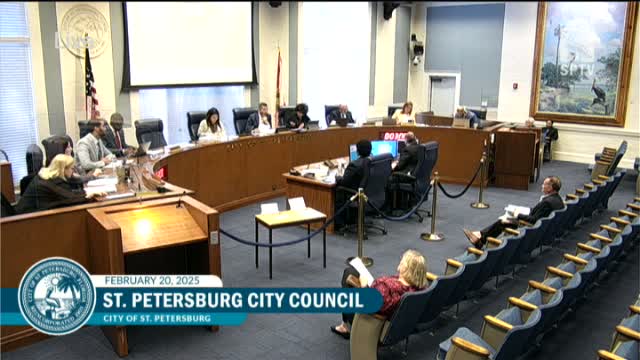
Public outcry over unusually large water bills after Hurricanes Helene and Milton led the St. Petersburg City Council on Thursday to adopt a package of measures intended to speed customer relief and improve meter handling.
Residents described bills that jumped from typical amounts into the thousands after the storms, and asked the council for more oversight and easier routes to replace or test meters. "Imagine my surprise when I received my utility bill in December of $1,439.31," said Michelle Dudley, a resident who addressed council during open forum. John Chin, who spoke later during the H3 agenda item, told the council his household readings showed implausible usage ("My bill is showing a usage of 13,000 gallons") and urged the city to make meter replacement easier.
The new council actions included three resolutions: a policy authorizing leak adjustment relief for involuntary leaks during flood events; a policy describing how to handle high reads on mechanical water meters when a leak is not found; and changes to the Utility Bill Review Committee intended to streamline reviews and appeals. Chair and staff emphasized these are procedural and do not immediately shift funds to residents — rather they create standards and a process for credits, meter testing, and committee review.
At the same meeting the council also approved a task order with Stantec to conduct a comprehensive rate analysis and multi‑year financial plan for water, stormwater and sanitation utilities. Claude (administration) said the Stantec scope includes a 20‑year financial outlook, bond calculations and what the staff called a ‘‘St. Pete Beach true‑up’’ analysis tied to an interlocal agreement; the contract amount cited by administration was $215,300. Councilmembers framed the Stantec work as an information source to shape future policy decisions about rates and credits.
Council members and multiple public speakers urged faster response times and easier meter diagnostics. Robert Craven told the council that digital meters submerged during Helene may have been compromised and that the city's online guidance explains mechanical meters but not these wireless/digital units; John Chin described paying for independent sprinkler and flow tests to try to prove he had not used the billed volume.
The council voted unanimously to adopt H3A, H3B and H3C, with Councilmember Driscoll absent. The Stantec task order was also approved unanimously with Driscoll absent. City staff committed to manager outreach to specific residents who raised cases and to report back to council about implementation and any recurring meter failures.
Officials said the resolutions clarify eligibility and caps tied to available authorities and do not amount to a blanket forgiveness of charges: adjustments will follow the new procedure, which includes documented testing, contractor verification where appropriate, and committee review. "We will make the process faster and more transparent," a staff member said during questions. The council directed staff to continue outreach, provide regular updates to council and ensure claim documentation and communication channels for affected residents.