Get Full Government Meeting Transcripts, Videos, & Alerts Forever!
Get email alerts on the Land Use Development topic
No spam. Unsubscribe anytime.
PZAB declines to recommend Isla Carroll Polo & Residences PUD, citing doubts about equestrian focus and club scale
Summary
After a lengthy combined hearing with developers and USPA testimony, Wellington’s Planning, Zoning & Adjustment Board voted 6–1 to not recommend rezoning and the master plan for the Isla Carroll Polo & Residences project, citing concerns the proposal’s small home lots and large membership club undercut the Equestrian Overlay’s intent.
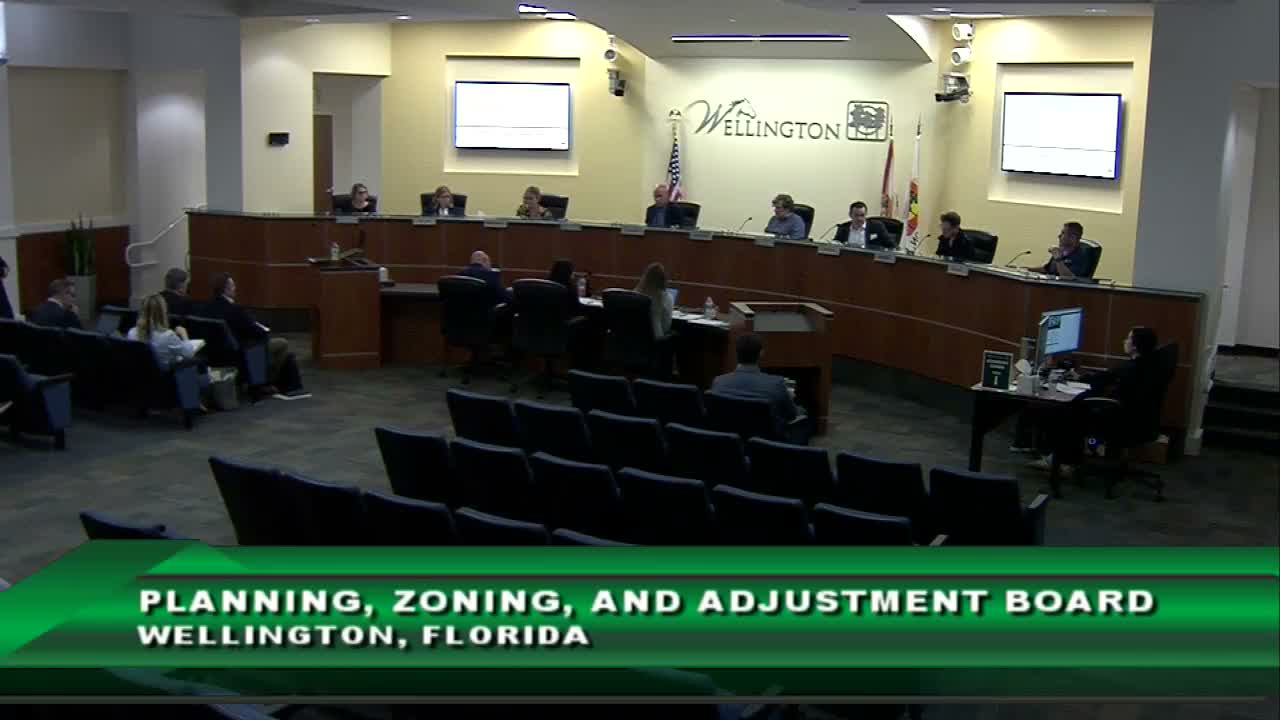
WELLINGTON — After more than three hours of testimony and public comment, the Village of Wellington Planning, Zoning & Adjustment Board voted 6–1 on Nov. 19 to not recommend approval of both the rezoning and master plan for the Isla Carroll Polo & Residences project.
The applicant team — led by counsel Neil Schiller of Government Law Group and developers McCourt Partners and Discovery Land Company — proposed rezoning roughly 79.17 acres in Subarea D of the Equestrian Overlay Zoning District (EOZD) to a planned unit development that would cluster 40 single‑family units and preserve the Isla Carroll East polo field under recorded restrictions and a long‑term operating agreement with the United States Polo Association (USPA).
Developer presentations said the plan increases open space on the site to roughly 60 percent, relocates homes to the west side of the property, and places the historic east polo field into long‑term stewardship with USPA. Bob McMurtry, interim chief operating officer of USPA, described a negotiated license that would let USPA’s MPC Polo Operations LLC manage and maintain the field under a 25‑year initial term with two automatic 10‑year renewals (an effective 45‑year commitment) and recording of a memorandum of license and deed restrictions in Palm Beach County land records. McMurtry said the license was under review by USPA’s board and was not yet executed.
"This agreement transforms intent into enforceable reality," McMurtry told the board, describing year‑round maintenance and scheduling rights during the polo season.
Developers also described a private club and amenity pod intended to provide equestrian‑adjacent services, a 64,000‑square‑foot enclosed clubhouse footprint plus substantial ancillary amenity areas, trailer parking and a pedestrian connection to the National Polo Center (NPC) across the street. The team said membership would be capped at 325 people (including 40 residents), and that the club model is needed to fund long‑term maintenance and programming for the field; applicant representatives estimated initiation fees could start near $50,000 and suggested finished home prices in the $5–$7 million range.
Opponents — including multiple equestrians and conservation advocates — urged denial. Christy Lund, a long‑time Equestrian Preserve resident, told the board the plan lacks large lots, stables and true on‑site equestrian uses and called the proposal a "Trojan horse" that would convert equestrian land into a predominantly non‑resident club. Maureen Bridal, who said she has served on USPA boards, told the board the license and deed language presented at the hearing were insufficient to make permanence certain and urged stronger third‑party conservation protections.
"A deed restriction that can be amended by a super‑majority is not perpetuity," Bridal said.
Board members pressed applicants and staff on core questions: whether the proposed club and outside membership were consistent with the EOZD requirement that an "internal focus" be equestrian in nature; whether the deed restriction and restrictive covenant would truly prevent future changes; and who would carry ultimate maintenance obligations if USPA did not perform. Staff said the application met the village’s regulatory criteria and included conditions in Resolution R2025‑567 to address parking, deed language, monitoring and other mitigation; staff recommended approval. Applicants proffered additional protections during the hearing, including limiting membership and offering to pursue stronger covenant language.
Notable project figures discussed at the hearing: 79.17 acres total; 40 dwelling units; roughly 60% open space; a proposed cap of 325 club members (285 non‑resident members plus 40 resident members); primary enclosed clubhouse footprint described at about 64,000 square feet and a larger overall amenity footprint referenced by the chair during questioning; parking of roughly 145 spaces in the amenity building plus additional perimeter parking; estimated annual high‑quality field maintenance around $220,000; and developer commitment to pay a proportionate share (≈2.82%) for traffic improvements at 120th Avenue South.
After deliberation, Board Member (speaker 14) moved to deny the rezoning recommendation; the motion passed 6–1. The board then voted 6–1 to not recommend approval of the master plan (Resolution R2025‑567). Chair and several board members said the record left them unconvinced the plan met the EOZD’s purpose of preserving a living, resident‑focused equestrian lifestyle rather than enabling a membership‑driven club with outside patrons.
The applicant team said they will refine conditions and that they will not bring the matter to the Village Council until agreements with USPA are executed. The matter will next be considered by Wellington Village Council, which will receive the PZAB recommendation, the record of public comment, and staff analysis.
Resolutions and petitions entered into record: Petition 2025‑0004‑REZ; Petition 2025‑0002‑MP; Resolution R2025‑567 (master plan conditions).