Get Full Government Meeting Transcripts, Videos, & Alerts Forever!
Get email alerts on the Land Development Regulations topic
No spam. Unsubscribe anytime.
Wellington committee votes to recommend striking LDR section 6.8.8, urges council to preserve minimum lot sizes
Summary
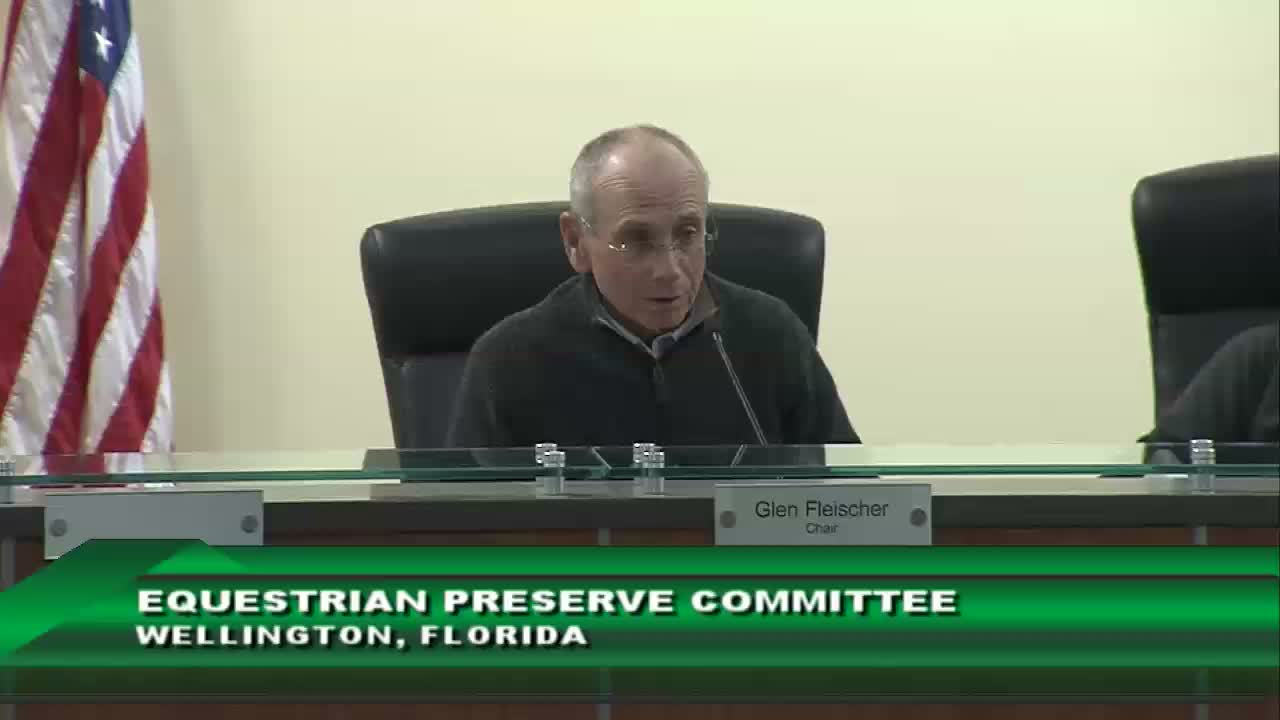
The Equestrian Preserve Committee voted unanimously to recommend that council strike section 6.8.8 from the Village land development regulations (LDRs), arguing the change would eliminate cluster‑housing incentives and restore consistent minimum lot sizes across the EOZD; members also asked that the recommendation be considered a 'zoning in progress.'
The Equestrian Preserve Committee voted unanimously to recommend that the Village Council strike section 6.8.8 from the land development regulations, a change members said would eliminate the special cluster‑housing provision and restore consistent minimum lot sizes across the Equestrian Open‑space and Conservation District (EOZD).
Committee members read aloud a proposed motion to council: "The EPC makes a motion to strike 6.8.8 from the Village LDR and to ensure that minimum lot sizes are adhered to across EOZD. We further recommend that this is considered a zoning in progress while this recommendation is under consideration." A member seconded the motion and the committee recorded a unanimous voice vote in favor.
Tim, a planning staff member who led the committee through legal and timing considerations, told the committee that the recommendation is intended to be administratively simple: "What would happen is a recommendation to the council would be provided, and then if they agreed with it, they would give us direction. We would then bring it back to the committee for formal action as an ordinance, and then the planning and zoning, and then the council for 2 readings to formally strike it from the land development regulations." He also cautioned members about state preemption: "Senate Bill 180 essentially put a restriction on municipalities from making their land development regulations more strict until October 2027," he said, noting municipalities and legal counsel are monitoring possible legislative changes.
Members debated practical effects on pending and potential applications. Public commenter Maureen Bridal asked how the change would affect the pending Isla Carrol application and whether projects such as "South 40" shared‑amenity developments could still be proposed. Tim responded that an application that was formally withdrawn and resubmitted after a new code would be measured against the new standards; he also explained that a zoning‑in‑progress can be used as a temporary measure that applies to applications submitted while the change is under consideration: "Zoning progresses are good for 6 months or until action," he said.
Supporters said striking the section removes a regulatory complexity that had invited varied interpretations and that maintaining existing subarea minimums would preserve Wellington's equestrian character. Opponents and cautious members pressed for clarity about grandfathering, potential legal challenges by property owners, and whether eliminating the cluster option would remove development incentives that sometimes encourage preservation of open space.
The committee directed staff to forward the recommendation and requested counsel consider reserving the section number to avoid renumbering the chapter. The recommendation now goes to council for direction; if council approves, the change would follow the standard ordinance path through planning board and two council readings before final adoption.