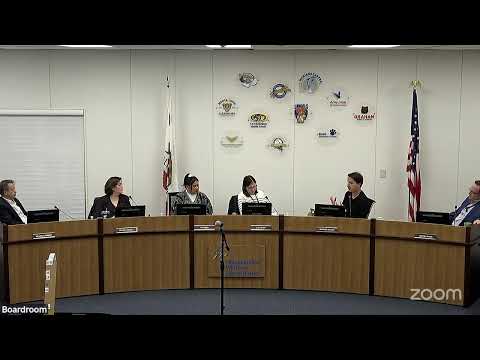
Consultant tells Mountain View Whisman trustees that systems, not staff, are holding back progress for vulnerable students
Loading...
Summary
A consultant'led review presented to the Mountain View Whisman Board found the district's relative performance has slipped against peers, with persistent gaps for socioeconomically disadvantaged students, English learners and Hispanic/Latino students; the report flagged inequities in advanced-math placement appeals and recommended prioritizing instructional alignment and protected core instructional time.
A district review presented to the Mountain View Whisman School District Board found the district's performance has lagged behind many peers and identified system-level causes that the consultant said explain persistent gaps for the district's most vulnerable students.
The presenter, identified in the meeting as Scott, told trustees the district's 'relative advantage' metric showed the district falling in statewide rankings: "So with this most recent this most recent year, it would be 95, 95 schools out of 100 are outperforming Mountain View," he said, noting the measure compares local data to the movement of other districts rather than to an absolute standard.
The report summarized roughly a decade of data, showing flat ELA trends since 2014 and post-pandemic rebounds concentrated among less-vulnerable student groups while students identifying as Hispanic/Latino, students learning English and students with IEPs lag behind in both language arts and math. The presenter cited subgroup mastery rates on state assessments and a district count of 934 students identified as socioeconomically disadvantaged last year.
Among operational findings, the report highlighted three recurring problems: data systems that do not consistently drive instruction, program design that fragments instructional time, and weak alignment across school and district systems. The consultant said the district has grown intervention staffing (about 17 FTE in 2016 to roughly 44 by 2024) without consistent gains for the most vulnerable groups, concluding, "It's not a people issue. It's a structure issue."
The review included a school-by-school placement graphic showing schools placed by vulnerability and achievement level. The presenter singled out Castro as an example of a most-vulnerable school currently in the low-achievement category and recommended deeper stability and leadership supports for sites with high principal turnover.
A detailed portion of the presentation examined middle-school math placement and the appeals process. The consultant described the district's advanced-math threshold (an i-Ready score near 527 and a CAST score of 4) and showed a cluster of borderline cases where students with near-identical metrics were admitted or denied placement. He reported appeal-grant rates by subgroup: 100% for students identifying as Asian who appealed, about 85% for students identifying as white, roughly 75% for students identifying as two or more races, and approximately 71% for Hispanic/Latino students who appealed. The presenter noted that many appeals from certain subgroups came from a single middle school and framed the pattern as a system navigation and access issue rather than an assertion of intentional exclusion.
Public commenters echoed concerns about tracking and access. Steven Nelson told trustees that middle-school tracking produced persistent placement patterns and said a common-core 8 math track produced 0% grade-level results in his review of records. A Castro teacher, Nicole Datta, urged trustees to visit sites before deciding on changes and cautioned against relying on data points alone.
Trustees responded that the report will inform immediate budget decisions as well as longer-term strategic planning. Several trustees urged staff to begin work that can be started quickly (for example, protecting elementary instructional time and reviewing district office role overlap) while beginning the longer alignment process that could take a year or more. Trustee Conley asked how a 3—-year strategic plan could align with near-term budget choices; the presenter recommended running the two processes concurrently.
What happens next: trustees said the findings will be used to inform the district's upcoming budget discussions and the board's strategic planning; the board asked for public feedback to aid deliberations. No formal motions or votes on policy changes or budget items were recorded during this meeting.
Reporting notes: the account is based only on statements made during the board meeting and public comment. Figures cited in this story (for example, intervention FTE growth and subgroup mastery percentages) were presented at the meeting and are included here as reported; where precise dates or some counts were not provided in the meeting, the article notes those items as reported rather than independently verified.