
Mount Vernon commission approves Arista Villas preliminary plat over residents' connectivity concerns
Get AI-powered insights, summaries, and transcripts
Subscribe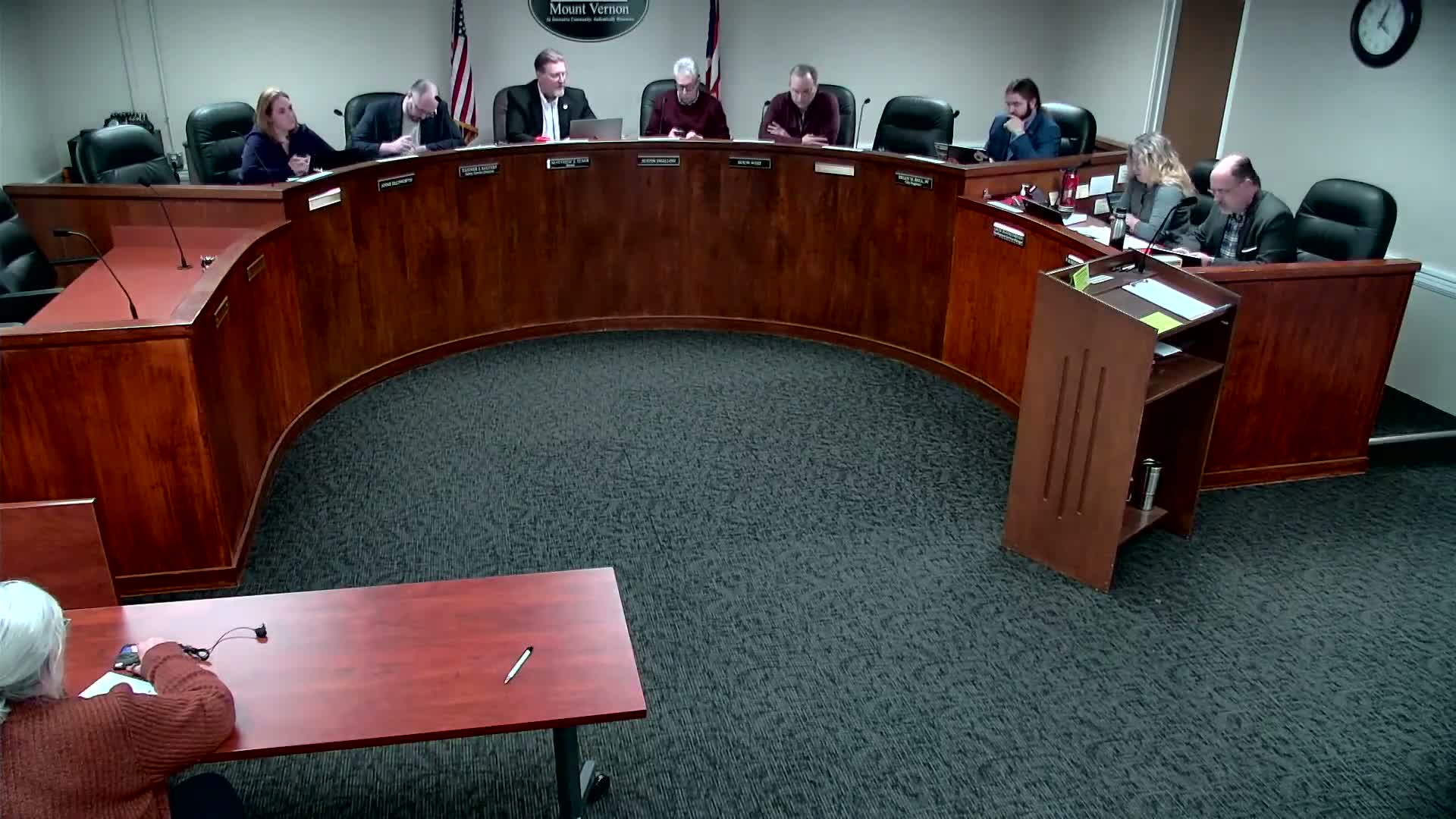
Summary
The Mount Vernon Municipal Planning Commission approved a preliminary plat for Arista Villas (about 100 single‑family lots) by a 4–1 vote, after developer and staff stated the plan meets R‑1 zoning standards and outstanding engineering and stormwater details will be addressed in later submittals.
The Mount Vernon Municipal Planning Commission approved the preliminary plat for the Arista Villas subdivision on Jan. 8, voting 4–1 to move the 100‑lot single‑family development forward.
Developer representative Clint Hura, who presented the plan, said the proposal is for 100 single‑family homes in the city's R‑1 (single‑family residential) zone, with 3–4 bedrooms, 2½ bathrooms and living areas of about 1,200 to 1,600 square feet. “Our goal is to create an affordable entry‑level housing development…our target price of the proposed homes is going to try to be in the $350,000 range,” Hura said. He described landscaping packages and an architectural review process for common areas and said the team prepared an urban‑forestry replanting plan for the roughly 40‑acre site.
Residents said the plan raised traffic and infrastructure concerns. Mike Hillier, a retired Malvern councilor, pressed whether the development's two points of access satisfy the city’s long‑range transportation expectations, asking when “proposed” connections become required. “When we approve a plan, do we approve a plan that says ‘proposed’? When is proposed finished?” Hillier asked.
City staff and counsel responded that Mount Vernon’s zoning code encourages interconnectivity to provide multiple access points for safety and traffic dispersion but does not, in the staff’s reading, create an absolute, immediate condition precedent that must be met before preliminary plat approval. The commission cited Mount Vernon City Code section 1101.01 in describing the code’s stated purpose to encourage connections rather than to impose an unconditional requirement.
Other residents raised technical questions: Donald Carr said prior staff comments indicated three access points were required and asked for proof; he also asked whether surety would be required so future phases are completed. Bob Beck asked whether lake/pond sizing and runoff calculations are known before finalizing lot counts. Staff said the preliminary plat review covers lot layout and that engineering details (stormwater pond sizing, water‑main looping and road improvements) will be pursued during the construction plan and final plat stages. Engineering staff said no technical barriers exist now to the R‑1 determination.
After public comment and staff responses, a commissioner moved to approve the preliminary plat “as presented.” The roll call produced a 4–1 result with Mr. West voting no. The commission and staff emphasized that final construction plans, development agreements and department reviews (erosion/sediment control, stormwater, utilities) remain required before building permits are issued.
The approval advances the Arista Villas preliminary plat to the next step of review; the developer must file construction documents and satisfy engineering and permitting requirements before final plat approval and construction.