Guam committee hears supporters and safety concerns on bill to allow temporary workforce housing in M‑1 zones
Loading...
Summary
A Guam legislative committee heard testimony Jan. 8 on Bill 240‑38 LS to permit temporary workforce housing in M‑1 light industrial zones; supporters said the change would free up rental housing and speed construction, while some senators and witnesses raised fiscal, sanitary and inspection concerns and requested further fiscal analysis. The committee took no vote and will accept written statements for seven days.
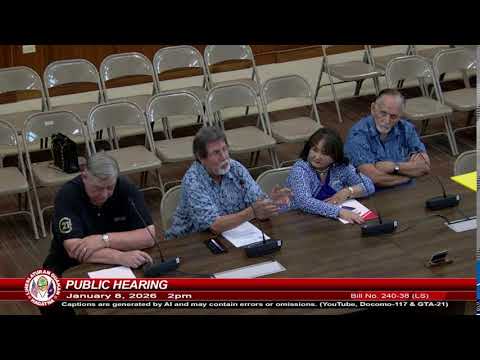
A Guam Legislature committee on Jan. 8 heard testimony on Bill 240‑38 LS, which would amend a provision of the Guam Code Annotated to add temporary workforce housing as a permitted use in M‑1 light industrial zones. The vice speaker delivered the sponsor statement for absent primary sponsor Sen. Chris M. Duenas, saying the measure aims to speed development near major project sites and retain sanitation, fire safety and health requirements.
The bill’s proponents told the Committee on Land, Environment, Housing, Agriculture, Parks and Infrastructure that permitting temporary workforce housing as a permitted use — rather than a conditional use — would reduce approval delays and free up existing rental inventory used by contract workers. "The existing housing inventory available to our local community has been significantly reduced with a substantial portion occupied by contractors housing their construction workforce," Liz Duenas said in testimony supporting the bill. "Allowing workforce housing projects as they're permitted use rather than a conditional use would greatly improve efficiency by reducing unnecessary delays."
Carl Peterson, a certified financial planner speaking for the Armed Forces Committee of the Chamber and the Guam Association of Realtors, recounted past workforce camps and said industrial zones historically accommodated worker barracks while meeting utility and setback requirements. "The point of all this is having workforce housing in an industrial zone is the least intrusive way to accommodate the people we need to perform the projects much needed in our society," Peterson said.
Supporters said faster approvals would make landlords more willing to lease buildings for conversion to compliant temporary housing and would reduce pressure on apartments and single‑family rentals used by contract workers. "By removing outdated restrictions, we provide certainty to developers and regulators, ensuring timely completion of infrastructure and commercial projects vital to our economy," the sponsor statement said.
But several senators and witnesses pressed for more detail on fiscal and safety effects. Senator Tidy noted a fiscal note that flagged lost revenue to the Guam Land Use Commission, the Guam Preservation Trust and the Environmental Health Fund but said the report did not quantify the loss. Tidy also raised concerns that a previously included two‑year limit on temporary approvals was removed and questioned whether the bill modifies inspection and oversight requirements, particularly minimum fire flow standards. "There's a lot of safety mechanisms that are in current law that needs to stay in place for the sake of the protection of these workers," she said.
Mister Yingling, speaking as a member of the Guam Land Use Commission in a personal capacity, said he initially feared impacts in areas like Harmon Industrial Park but had become "more relieved" after reading the bill. He and other speakers, however, emphasized Guam’s historic shortfall in follow‑up inspections and urged the legislature to ensure enforcement capacity. "We are woefully lax in getting inspectors out in virtually every agency," Yingling said.
Committee members also discussed the bill’s potential effects on local housing markets if workforce housing frees apartments and single‑family homes now occupied by contract workers. Supporters argued that adding supply would lower rental pressure for local residents; opponents and some senators asked for clearer fiscal analysis and confirmatory language on safety and inspection responsibilities.
No formal vote was taken at the hearing. The committee invited additional written statements and said it will accept them for seven days, to be mailed to the Guam Congress Building or emailed to vice speaker tonyatta@guamlegislature.gov. The hearing was adjourned at 2:39 p.m.