
House Science Committee hearing spotlights EPA review delays and risks to independent science as industry warns competitiveness at stake
Get AI-powered insights, summaries, and transcripts
Subscribe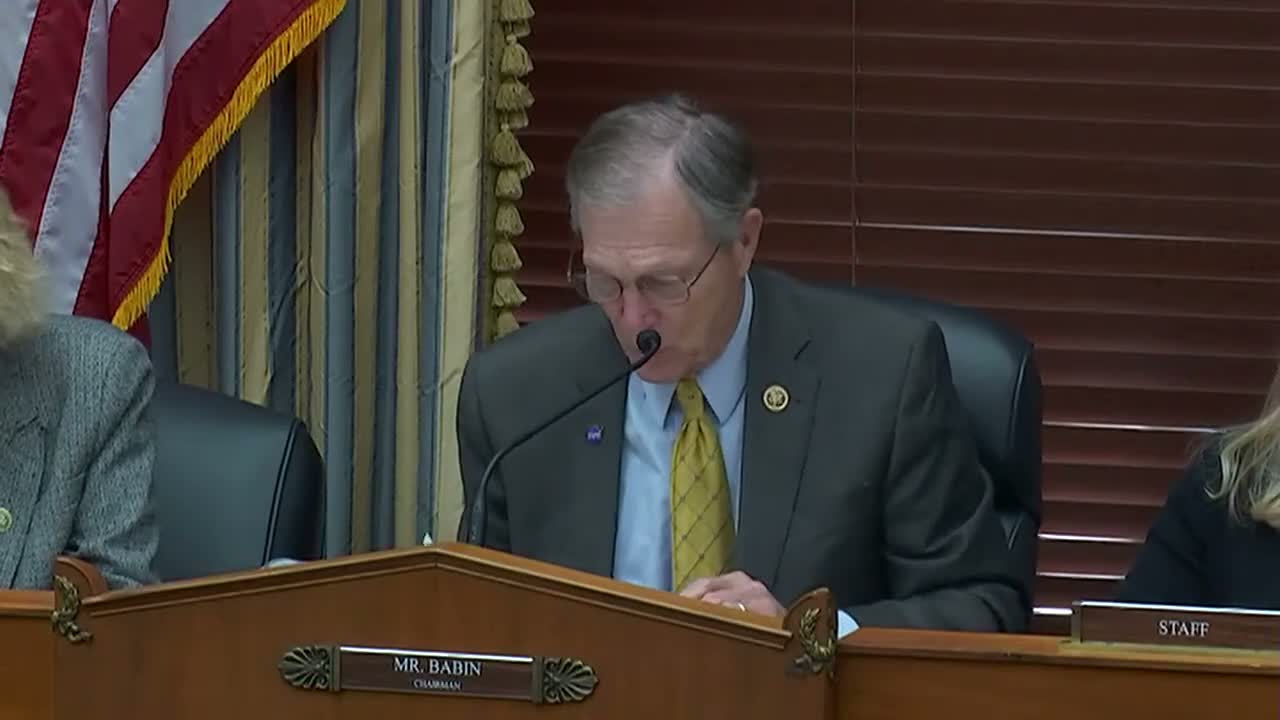
Summary
Industry witnesses told the House Science, Space and Technology Committee that slow EPA chemical reviews and regulatory uncertainty are pushing U.S. innovation overseas, while former EPA officials and Democrats warned that cuts to the agency's independent research office risk public‑health protections.
WASHINGTON — Lawmakers probed federal chemical policy and agency capacity Tuesday as industry representatives and former Environmental Protection Agency officials sparred over whether agency changes and review delays are slowing U.S. chemistry innovation.
"America's success depends on America's chemistry," Charlotte Bertrand, senior director for chemical management, regulatory policy and strategy at the American Chemistry Council, told the House Science, Space and Technology Committee. Bertrand said EPA currently has "461 new chemicals under EPA's review" and that "90% of those have exceeded the 90‑day statutory deadline," arguing the backlog and lengthy reviews discourage domestic investment.
A former EPA official who testified, Stan Myberg, said the central question is trust in EPA science. "Independent EPA science should not be a partisan issue," Myberg said, urging Congress to preserve the Office of Research and Development and avoid reallocating its scientists to meet short‑term review targets. Myberg noted the agency asked for about $124 million in FY2023 for TSCA reviews but that the FY2026 request was roughly $73 million for the same function.
Industry witnesses stressed the economic impact of delays and uncertainty. Keith Corkwell, president of Lubrizol Additives, described company experience with multi‑year waits, saying an EPA review "resulted in the delay of 3 years" for a new molecule and that another transmission additive project has been awaiting a final new‑use rule since 2020 after more than $10,000,000 in R&D. Dr. Gwen Gross, a senior technical fellow at Boeing, described long certification timelines for aerospace materials — "It can take 10 years or more to design, build, test, and receive type certification" — and said rapid regulatory shifts can force downstream users to pivot away from otherwise promising materials.
Republican members, led by Chair Brian Babin, pressed witnesses for policy fixes to reduce uncertainty and speed approvals without sacrificing safety. Democrats, led by Ranking Member Zoe Lofgren, warned that the Trump administration's reorganization of EPA has gutted independent research capacity and could undermine public‑health protections. "The EPA, in my view, has abandoned its mission and obligation to protect the environment and public health," Lofgren said.
Witnesses offered overlapping prescriptions: more staffing and funding for TSCA reviews; clearer, time‑bound processes and earlier, transparent communication between applicants and reviewers; and stronger protections for independent, agency‑based science so decisions remain defensible and less vulnerable to litigation. Myberg said that without credible independent science, "public confidence in EPA's decisions will deservedly diminish."
Members also discussed computational tools and artificial intelligence as ways to speed parts of the review process; panelists said AI and computational toxicology can narrow candidates and reduce the need for some tests but cautioned that empirical validation and transparency remain essential.
Several representatives raised local and public‑health concerns, including PFAS contamination and the role ORD played in emergency response and monitoring. Myberg cited ORD's contributions to state monitoring and said hollowing out the office weakens long‑term scientific capacity.
The committee left the record open for 10 days for additional comments and documents and adjourned without pursuing immediate legislative action. Members framed possible next steps that could range from resourcing EPA review functions to crafting TSCA reauthorization language that seeks timeliness while preserving scientific rigor.