Get Full Government Meeting Transcripts, Videos, & Alerts Forever!
Get email alerts on the Cpace topic
No spam. Unsubscribe anytime.
Buncombe County staff explain CPACE financing; board set to consider resolution of intent
Summary
County staff presented Commercial Property Assessed Clean Energy (CPACE), a state-enabled, property-tied financing tool for large clean-energy projects, and recommended adopting a resolution of intent on Jan. 20 with a public hearing and final vote Feb. 3. County staff said legal exposure for Buncombe is minimal.
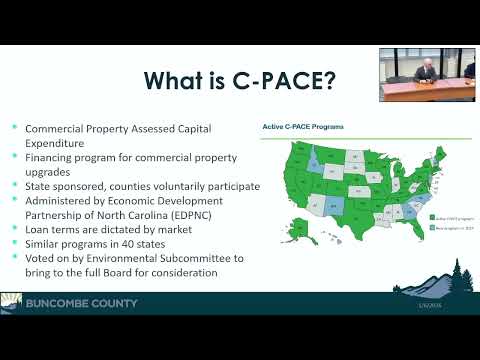
Jeremiah LaRoy, introduced as a presenter for an NCC-based program, told the Buncombe County Board of Commissioners that CPACE — often called Commercial Property Assessed Clean Energy — is a state-enabled financing tool that places a lien on a property to fund clean-energy and resiliency upgrades.
LaRoy said CPACE loans typically are large and remain with the property rather than the owner: “Repayment obligations are transferred with the property itself,” he said. He described eligible projects as solar, batteries, energy-efficiency measures, HVAC upgrades, resiliency work and water-conservation projects, and said loans can cover hard and soft costs up to an asset’s useful life. LaRoy cited a national average CPACE loan of about $11,400,000 to illustrate the program’s typical scale.
LaRoy told the board the state legislature enabled the program and the state administrator (the Economic Development Partnership of North Carolina, EDP&C) will run applications and processing; counties must opt in. “To make Buncombe County businesses eligible to participate in CPACE, those are the three steps for us,” he said, describing adoption of a resolution of intent, a public hearing and a final resolution to join.
LaRoy emphasized the county’s limited role and legal exposure: per the statute as explained in the presentation, the county’s primary administrative task is recording liens at the register of deeds. He said fee administration and billing will be handled at the state level and by private lenders, not by the county.
Commissioners asked for examples and clarifications. LaRoy pointed to early North Carolina adopters — New Hanover, Mecklenburg and Brunswick counties — and cited the Trenton Mill Lofts in Gastonia as a local example where CPACE financed energy-efficiency upgrades and was used in part to refinance existing debt. Board members expressed support for the program’s potential for resilience and economic development, noting uses ranging from multifamily housing upgrades to nursing-home resiliency work.
Next steps: LaRoy asked the board to consider a resolution of intent at its Jan. 20 meeting and said a public hearing and vote to join CPACE are scheduled for Feb. 3. The presentation closed with staff offering to host an educational event for potential participants and reporting that some local businesses have already expressed serious interest.
The board did not take formal action on CPACE at this meeting; the matter is scheduled to return for consideration on the dates LaRoy outlined.